Opening the book…
Given the Rotated Vector, Find the Angle of Rotation
Suppose we did not know the angle \(\theta\) of rotation. We can get it by working backwards and solving a system of equations. The rotation formula
\[\left[\begin{array}{l}
x^{\prime} \\
y^{\prime}
\end{array}\right]=\left[\begin{array}{cc}
\cos \theta & -\sin \theta \\
\sin \theta & \cos \theta
\end{array}\right]\left[\begin{array}{l}
x \\
y
\end{array}\right] \nonumber \]
produces the system of equations
\[\left\{\begin{array}{c}
x^{\prime}=x \cdot \cos \theta+y \cdot(-\sin \theta) \\
y^{\prime}=x \cdot \sin \theta+y \cdot \cos \theta
\end{array}\right. \nonumber \]
In Example 4.4.1 of Section 4.4, we found that when the vector \(\left[\begin{array}{l}
x \\
y
\end{array}\right]=\left[\begin{array}{c}
1 \\
-1
\end{array}\right]\) was rotated counterclockwise by 90°, it became the vector \(\left[\begin{array}{l}
x^{\prime} \\
y^{\prime}
\end{array}\right]=\left[\begin{array}{l}
1 \\
1
\end{array}\right]\). We got this rotated vector by applying the rotation formula \(\left[\begin{array}{cc}
\cos \theta & -\sin \theta \\
\sin \theta & \cos \theta
\end{array}\right]\).
\[\begin{gathered}
{\left[\begin{array}{l}
x^{\prime} \\
y^{\prime}
\end{array}\right]=\left[\begin{array}{cc}
\cos \theta & -\sin \theta \\
\sin \theta & \cos \theta
\end{array}\right]\left[\begin{array}{l}
x \\
y
\end{array}\right]} \\
{\left[\begin{array}{l}
1 \\
1
\end{array}\right]=\left[\begin{array}{cc}
\cos \theta & -\sin \theta \\
\sin \theta & \cos \theta
\end{array}\right]\left[\begin{array}{c}
1 \\
-1
\end{array}\right]} \\
{\left[\begin{array}{l}
1 \\
1
\end{array}\right]=\left[\begin{array}{c}
1 \cdot \cos \theta+(-1) \cdot(-\sin \theta) \\
1 \cdot \sin \theta+(-1) \cdot \cos \theta
\end{array}\right]}
\end{gathered} \nonumber \]
Since two vectors are equal only if their corresponding components are equal, we have the system of two equations
\[\left\{\begin{array}{c}
1=1 \cdot \cos \theta+(-1) \cdot(-\sin \theta) \\
1=1 \cdot \sin \theta+(-1) \cdot \cos \theta
\end{array}\right. \nonumber \]
Using Technology
We can use WolframAlpha to help us solve above system for the angle of rotation, \(\theta .\)
Go to www.wolframalpha.com.
Since we want to rotate only one time around the coordinate system, we want to instruct WA to give us solutions only where the angle \(\theta\) is between 0 and 2\(\pi\).
Using the English letter \(x\) in place of the Greek letter \(\theta\), enter
Solve \(1=1^* \cos (x)+(-1)^*(-\sin (x)), 1=1^* \sin (x)+(-1)^* \cos (x), 0<=x<=2^* \text { pi }\) in the entry field.
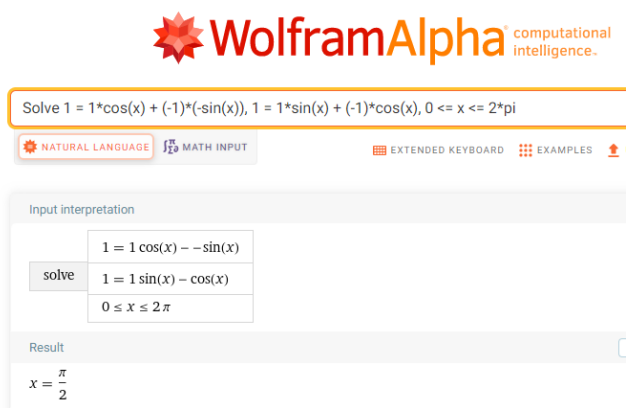
WA shows the angle of rotation is \(\theta =\frac{\pi }{2}\), which is 90°. We conclude that the angle of rotation is 90°.
In Example 4.4.2 of Section 4.4, we found that when the vector \(\left[\begin{array}{l}
x \\
y
\end{array}\right]=\left[\begin{array}{l}
2 \\
6
\end{array}\right]\) was rotated counterclockwise by 60°, it became the vector \(\left[\begin{array}{l}
x^{\prime} \\
y^{\prime}
\end{array}\right]=\left[\begin{array}{c}
1-3 \sqrt{3} \\
3+\sqrt{3}
\end{array}\right]\). We got this rotated vector by applying the rotation formula \(\left[\begin{array}{cc}
\cos \theta & -\sin \theta \\
\sin \theta & \cos \theta
\end{array}\right]\).
\[\begin{aligned}
& {\left[\begin{array}{c}
x^{\prime} \\
y^{\prime}
\end{array}\right]=\left[\begin{array}{cc}
\cos \theta & -\sin \theta \\
\sin \theta & \cos \theta
\end{array}\right]\left[\begin{array}{l}
x \\
y
\end{array}\right]} \\
& {\left[\begin{array}{c}
1-3 \sqrt{3} \\
3+\sqrt{3}
\end{array}\right]=\left[\begin{array}{cc}
\cos \theta & -\sin \theta \\
\sin \theta & \cos \theta
\end{array}\right]\left[\begin{array}{l}
2 \\
6
\end{array}\right]} \\
& {\left[\begin{array}{c}
1-3 \sqrt{3} \\
3+\sqrt{3}
\end{array}\right]=\left[\begin{array}{c}
2 \cdot \cos \theta+6 \cdot(-\sin \theta) \\
2 \cdot \sin \theta+6 \cdot \cos \theta
\end{array}\right]}
\end{aligned} \nonumber \]
Since two vectors are equal only if their corresponding components are equal, we have the system of two equations
\[\left\{\begin{array}{c}
1-3 \sqrt{3}=2 \cdot \cos \theta+6 \cdot(-\sin \theta) \\
3+\sqrt{3}=2 \cdot \sin \theta+6 \cdot \cos \theta
\end{array}\right. \nonumber \]
We will use WolframAlpha to help us solve this system for the angle of rotation, \(\theta\).
Using the English letter x in place of the Greek letter \(\theta ,\) enter
Solve \(1-3 \operatorname{sqrt}(3)=2^* \cos (x)+6^*(-\sin (x)), 3+\operatorname{sqrt}(3)=2^* \sin (x)+6^* \cos (x), 0<=x<=2^* \text { pi }\)
in the entry field. Separate the two equations with a comma.
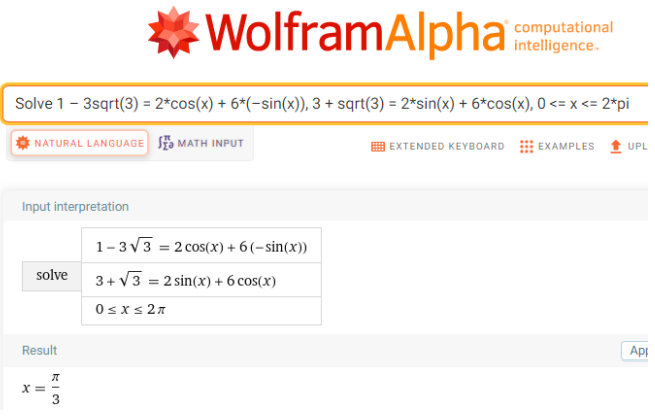
WA shows the angle of rotation is \(\theta =\frac{\pi }{3}\), which is 60°. We conclude that the angle of rotation is 60°.
Try these
Find the angle \(\theta\) through which the vector \(\left[\begin{array}{l}
3 \\
3
\end{array}\right]\) is rotated to become \(\left[\begin{array}{c}
0 \\
3 \sqrt{2}
\end{array}\right]\).
- Answer
-
\(\theta =\frac{\pi }{4}=45{}^\circ\)
Find the angle \(\theta\) through which the vector \(\left[\begin{array}{l}
2 \\
-2
\end{array}\right]\) is rotated to become \(\left[\begin{array}{c}
1+\sqrt{3} \\
-1+\sqrt{3}
\end{array}\right]\).
- Answer
-
\(\theta =\frac{\pi }{3}=60{}^\circ\)
Find the angle \(\theta\) through which the vector \(\left[\begin{array}{l}
2 \\
0
\end{array}\right]\) is rotated to become \(\left[\begin{array}{c}
0 \\
-2
\end{array}\right]\).
- Answer
-
\(\theta =\frac{3\pi }{2}=270{}^\circ\)
Find the angle \(\theta\) through which the vector \(\left[\begin{array}{l}
-2 \\
-2
\end{array}\right]\) is rotated to become \(\left[\begin{array}{l}
-1+\sqrt{3} \\
-1-\sqrt{3}
\end{array}\right]\).
- Answer
-
\(\theta =\frac{\pi }{3}=60{}^\circ\)
Find the angle \(\theta\) through which the vector \(\left[\begin{array}{l}
1 \\
1
\end{array}\right]\) is rotated to become \(\left[\begin{array}{c}
\sqrt{2} \\
0
\end{array}\right]\).
- Answer
-
\(\theta =\frac{7\pi }{4}=315{}^\circ = -45{}^\circ\)
This page titled 4.5: Finding the Angle of Rotation Between Two Rotated Vectors in 2-Dimensions was last modified on Mon, 08 May 2023 23:44:01 GMT and is shared under a CC BY 4.0 license and was authored, remixed, and/or curated by Denny Burzynski (Downey Unified School District) .
The book could not be loaded just now.