Opening the book…
Chapter 1
1.1
2) \(\displaystyle \lim_{x \to 1}f(x)\) does not exist because \(\displaystyle \lim_{x \to 1^−}f(x)=−2 \neq \lim_{x \to 1^+}f(x)=2\).
4) \(\displaystyle \lim_{x \to 0}(1+x)^{1/x}\approx 2.7183\).
6) a. 1.98669331; b. 1.99986667; c. 1.99999867; d. 1.99999999; e. 1.98669331; f. 1.99986667; g. 1.99999867; h. 1.99999999; \(\displaystyle \lim_{x \to 0}\frac{\sin 2x}{x}=2\)
8) \(\displaystyle \lim_{x \to 0}\frac{\sin ax}{x}=a\)
10) a. −0.80000000; b. −0.98000000; c. −0.99800000; d. −0.99980000; e. −1.2000000; f. −1.0200000; g. −1.0020000; h. −1.0002000; \( \displaystyle \lim_{x \to 1}(1−2x)=−1\)
12) a. −37.931034; b. −3377.9264; c. −333,777.93; d. −33,337,778; e. −29.032258; f. −3289.0365; g. −332,889.04; h. −33,328,889; \( \displaystyle \lim_{x \to 0}\frac{z−1}{z^2(z+3)}=− \infty \)
14) a. 0.13495277; b. 0.12594300; c. 0.12509381; d. 0.12500938; e. 0.11614402; f. 0.12406794; g. 0.12490631; h. 0.12499063; \( \displaystyle ∴\lim_{x \to 2}\frac{1−\frac{2}{x}}{x^2−4}=0.1250=\frac{1}{8}\)
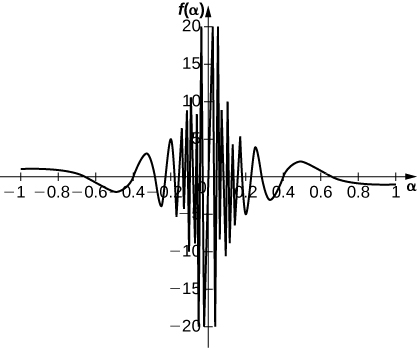
16) a. 10.00000; b. 100.00000; c. 1000.0000; d. 10,000.000;
Guess: \(\displaystyle \lim_{ \alpha \to 0^+}\frac{1}{ \alpha }\cos\left(\frac{ \pi }{ \alpha }\right)= \infty \);
Actual: DNE , since the graph shows the function oscillates wildly between values approaching positive infinity and values approaching negative infinity, as the value of \( \alpha \) approaches \(0\) from the positive side.
1.2
2) a. 10.00000; b. 100.00000; c. 1000.0000; d. 10,000.000;
Guess: \(\displaystyle \lim_{ \alpha \to 0^+}\frac{1}{ \alpha }\cos\left(\frac{ \pi }{ \alpha }\right)= \infty \);
Actual: DNE , since the graph shows the function oscillates wildly between values approaching positive infinity and values approaching negative infinity, as the value of \( \alpha \) approaches \(0\) from the positive side.

4) False; \(\displaystyle \lim_{x \to −2^+}f(x)=+ \infty \)
6) False; \(\displaystyle \lim_{x \to 6}f(x)\) DNE since \(\displaystyle \lim_{x \to 6^−}f(x)=2\) and \(\displaystyle \lim_{x \to 6^+}f(x)=5\).
8) \(2\)
10) \( 1 \)
12) \( 1 \)
14) DNE
16) \( 0 \)
18) DNE
20) \( 2 \)
22) \( 3 \)
24) DNE
26) \( 0 \)
28) \( -2 \)
30) DNE
32) \( 0 \)
34) Answers may vary

36) Answer may vary

38) a. \( \rho _2\) b. \( \rho _1\) c. DNE unless \( \rho _1= \rho _2\). As you approach \(X_{SF}\) from the right, you are in the high-density area of the shock. When you approach from the left, you have not experienced the "shock" yet and are at a lower density.
1.3
1) Use constant multiple law and difference law:\[ \begin{array}{rcl}
\displaystyle \lim_{x \to 0}\,(4x^2−2x+3) & = & 4 \displaystyle \lim_{x \to 0}x^2−2\lim_{x \to 0}x+\lim_{x \to 0}3 \\[6pt]
& = & 0 + 0 + 3 \\[6pt]
& = & 3 \\[6pt]
\end{array} \nonumber \]
3) Use root law: \(\displaystyle \lim_{x \to −2}\sqrt{x^2−6x+3}=\sqrt{\lim_{x \to −2}(x^2−6x+3)}=\sqrt{19}\)
5) \(\displaystyle \lim_{x \to 7}x^2\;=\;49\)
7) \(\displaystyle \lim_{x \to 0}\frac{1}{1+\sin x}\;=\;1\)
8) \(\displaystyle \lim_{x \to 1}\frac{2−7x}{x+6}\;=\;−\frac{5}{7}\)
9) \[ \begin{array}{rcl}
\displaystyle \lim_{x \to 6}2f(x)g(x) & = & 2\left(\displaystyle \lim_{x \to 6}f(x)\right)\left(\displaystyle \lim_{x \to 6}g(x)\right) \\[6pt]
& = & 2 (4)(9) \\[6pt]
& = & 72 \\[6pt]
\end{array} \nonumber \]
11) \[ \begin{array}{rcl}
\displaystyle \lim_{x \to 6}\left(f(x)+\frac{1}{3}g(x)\right) & = & \displaystyle \lim_{x \to 6}f(x)+\frac{1}{3}\displaystyle \lim_{x \to 6}g(x) \\[6pt]
& = & 4+\dfrac{1}{3}(9) \\[6pt]
& = & 7 \\[6pt]
\end{array} \nonumber \]
13) \[ \begin{array}{rcl}
\displaystyle \lim_{x \to 6}\sqrt{g(x)−f(x)} & = & \sqrt{\displaystyle \lim_{x \to 6}g(x)−\displaystyle \lim_{x \to 6}f(x)} \\[6pt]
& = & \sqrt{9-4} \\[6pt]
& = & \sqrt{5} \\[6pt]
\end{array} \nonumber \]
15) \(\displaystyle \lim_{x \to 6}[(x+1)f(x)]=\left(\lim_{x \to 6}(x+1)\right)\left(\lim_{x \to 6}f(x)\right)=7(4)=28\)
17)

a. \(9\); b.\( 7\)
21) \[ \begin{array}{rcl}
\displaystyle \lim_{x \to −3^−}(f(x)−3g(x)) & = & \displaystyle \lim_{x \to −3^−}f(x)−3\displaystyle \lim_{x \to −3^−}g(x) \\[6pt]
& = & 0+6 \\[6pt]
& = & 6 \\[6pt]
\end{array} \nonumber \]
23) \(\displaystyle \lim_{x \to −5}\frac{2+g(x)}{f(x)}=\frac{2+\left(\displaystyle \lim_{x \to −5}g(x)\right)}{\displaystyle \lim_{x \to −5}f(x)}=\frac{2+0}{2}=1\)
25) \(\displaystyle \lim_{x \to 1}\sqrt[3]{f(x)−g(x)}=\sqrt[3]{\lim_{x \to 1}f(x)−\lim_{x \to 1}g(x)}=\sqrt[3]{2+5}=\sqrt[3]{7}\)
27) \(\displaystyle \lim_{x \to −9}(xf(x)+2g(x))=\left(\lim_{x \to −9}x\right)\left(\lim_{x \to −9}f(x)\right)+2\lim_{x \to −9}g(x)=(−9)(6)+2(4)=−46\)
29) The limit is zero.

31) a.

b. \( \infty \). The magnitude of the electric field as you approach the particle q becomes infinite. It does not make physical sense to evaluate negative distance.
5.8.1: A.8.1- Chapter 1 Answers is shared under a not declared license and was authored, remixed, and/or curated by LibreTexts.
The book could not be loaded just now.