Opening the book…
Practice Makes Perfect
In the following exercises, evaluate each function.
- \(f(x)=\sqrt{4 x-4}\), find
- \(f(5)\)
- \(f(0)\)
- \(g(x)=\sqrt{6 x+1}\), find
- \(g(4)\)
- \(g(8)\)
- \(F(x)=\sqrt{3-2 x}\), find
- \(F(1)\)
- \(F(-11)\)
- \(G(x)=\sqrt{5 x-1}\), find
- \(G(5)\)
- \(G(2)\)
- \(g(x)=\sqrt[3]{2 x-4}\), find
- \(g(6)\)
- \(g(-2)\)
- \(h(x)=\sqrt[3]{x^{2}-4}\), find
- \(h(-2)\)
- \(h(6)\)
- For the function \(f(x)=\sqrt[4]{2 x^{3}}\), find
- \(f(0)\)
- \(f(2)\)
- For the function \(g(x)=\sqrt[4]{4-4 x}\), find
- \(g(1)\)
- \(g(-3)\)
- Answer
-
1.
- \(f(5)=4\)
- \(f(5)=2i\)
2.
- \(g(4)=5\)
- \(g(8)=7\)
3.
- \(F(1)=1\)
- \(F(-11)=5\)
4.
- \(G(5)=2 \sqrt{6}\)
- \(G(2)=3\)
5.
- \(g(6)=2\)
- \(g(-2)=-2\)
6.
- \(h(-2)=0\)
- \(h(6)=2 \sqrt[3]{4}\)
7.
- \(f(0)=0\)
- \(f(2)=2\)
8.
- \(g(1)=0\)
- \(g(-3)=2\)
In the following exercises, find the domain of the function and write the domain in interval notation.
- \(f(x)=\sqrt{3 x-1}\)
- \(g(x)=\sqrt{2-3 x}\)
- \(h(x)=\sqrt{x-2}\)
- \(f(x)=\sqrt{-x+3}\)
- \(g(x)=\sqrt[3]{8 x-1}\)
- \(f(x)=\sqrt[3]{4 x^{2}-16}\)
- \(F(x)=\sqrt[4]{8 x+3}\)
- \(G(x)=\sqrt[5]{2 x-1}\)
- Answer
-
- \(\left[\frac{1}{3}, \infty\right)\)
- \(\left(-\infty, \frac{2}{3}\right]\)
- \([2, \infty)\)
- \((-\infty,3]\)
- \((-\infty, \infty)\)
- \((-\infty, \infty)\)
- \(\left[-\frac{3}{8}, \infty\right)\)
- \((-\infty, \infty)\)
In the following exercises,
- find the domain of the function
- graph the function
- use the graph to determine the range
- \(f(x)=\sqrt{x+1}\)
- \(g(x)=\sqrt{x+4}\)
- \(f(x)=\sqrt{x}+2\)
- \(g(x)=2 \sqrt{x}\)
- \(f(x)=\sqrt{3-x}\)
- \(g(x)=-\sqrt{x}\)
- \(f(x)=\sqrt[3]{x+1}\)
- \(g(x)=\sqrt[3]{x+2}\)
- \(f(x)=\sqrt[3]{x}+3\)
- \(g(x)=\sqrt[3]{x}\)
- \(f(x)=2 \sqrt[3]{x}\)
- Answer
-
17.
- domain: \([-1, \infty)\)
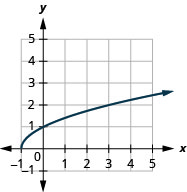
Figure 8.7.8- \([0, \infty)\)
18.
- domain: \([-4, \infty)\)
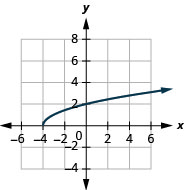
Figure 8.7.9- \([0, \infty)\)
19.
- domain: \([0, \infty)\)
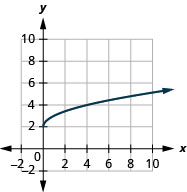
Figure 8.7.10- \([2, \infty)\)
20.
- domain: \([0, \infty)\)
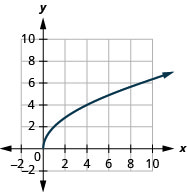
Figure 8.7.11- \([0, \infty)\)
21.
- domain: \((-\infty, 3]\)
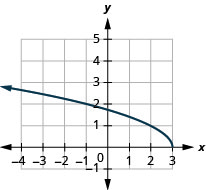
Figure 8.7.12- \([0, \infty)\)
22.
- domain: \([0, \infty)\)
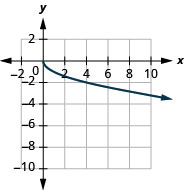
Figure 8.7.13- \((-\infty, 0]\)
23.
- domain: \((-\infty, \infty)\)
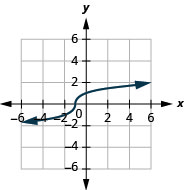
Figure 8.7.14- \((-\infty, \infty)\)
24.
- domain: \((-\infty, \infty)\)
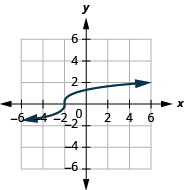
Figure 8.7.15- \((-\infty, \infty)\)
25.
- domain: \((-\infty, \infty)\)
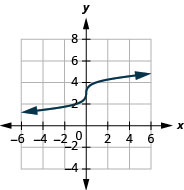
Figure 8.7.16- \((-\infty, \infty)\)
26.
- domain: \((-\infty, \infty)\)
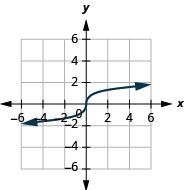
Figure 8.7.17- \((-\infty, \infty)\)
27.
- domain: \((-\infty, \infty)\)
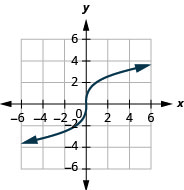
Figure 8.7.18- \((-\infty, \infty)\)
- Explain how to find the domain of a fourth root function.
- Explain how to find the domain of a fifth root function.
- Explain why \(y=\sqrt[3]{x}\) is a function.
- Explain why the process of finding the domain of a radical function with an even index is different from the process when the index is odd.
- Answer
-
Answers may vary
This page titled 5.3E: Exercises was last modified on Thu, 01 Dec 2022 04:02:58 GMT and is shared under a CC BY-NC-SA 4.0 license and was authored, remixed, and/or curated by Stanislav A. Trunov and Elizabeth J. Hale via source content that was edited to the style and standards of the LibreTexts platform.
The book could not be loaded just now.