Opening the book…
Imagine yourself standing at night at point P on Earth and observing the pole star (or better, the position of the north celestial pole, near that star), at an elevation angle \(\lambda\) above the horizon.
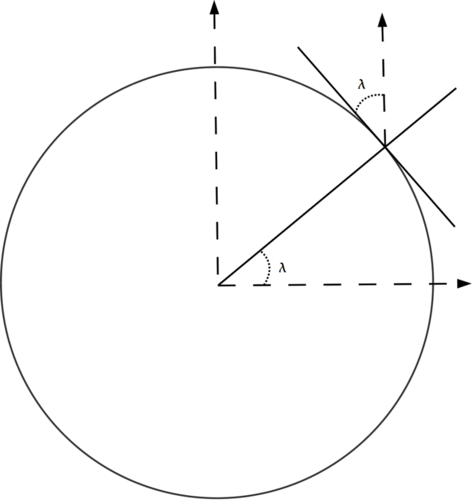
The angle between the direction of the pole and the zenith is then 90∘−\(\lambda\) degrees. If you continue the line from zenith downwards it reaches the center of the Earth, and the angle between it and the Earth's axis is also 90∘−\(\lambda\).
Therefore, as the accompanying figure shows, \(\lambda\) is also your latitude.
This page titled 11.2: Finding Latitude with the Pole Star was last modified on Tue, 15 Feb 2022 18:35:08 GMT and is shared under a CK-12 license and was authored, remixed, and/or curated by CK12 via source content that was edited to the style and standards of the LibreTexts platform.


The book could not be loaded just now.