Opening the book…
Simple and Compound Time Signatures
Simple Time Signatures
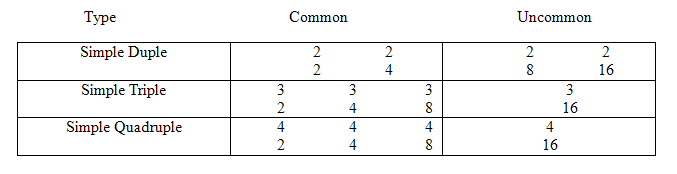
In simple time signatures the top number represents the number of beats per measure. The bottom number indicates the type of note equal to one beat. The division of the beat is the lower number multiplied by 2. Thus, the division of the beat is grouped by twos.

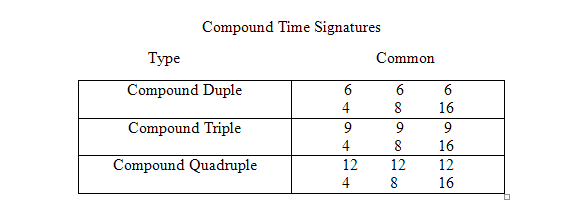
In compound time signatures the top number divided by 3 represents the number of beats per measure. The bottom number indicates the type of note that divides the beat. The division of the beat is grouped by threes.

Hearing simple and compound time signatures
Listen carefully for the pulse or beat of the music. Do you hear divisions of two or three? A simple test is to try saying "apple" or "pineapple" to each beat. "Apple" has two syllables and will fit simple meters. "Pineapple"--having three syllables--naturally fits compound meters.
Protions created by Laurel A. Ewell and used with her permission.
This page titled 2.7: Simple and Compound Time Signatures was last modified on Tue, 13 Feb 2024 01:28:15 GMT and is shared under a CC BY 3.0 license and was authored, remixed, and/or curated by Terry B. Ewell and Catherine Schmidt-Jones (Connections) via source content that was edited to the style and standards of the LibreTexts platform.
The book could not be loaded just now.