Opening the book…
As we have seen, when Octavian succeeded in defeating Marc Antony, he removed the last obstacle to his own control of Rome’s vast territories. While paying lip service to the idea that the Republic still survived, he in fact replaced the republican system with one in which a single sovereign ruled over the Roman state. In doing so he founded the Roman Empire, a political entity that survived for almost five centuries in the west and over a thousand years in the east. This system was called the Principate, rule by the “First Citizen.” Likewise, although “Caesar” had originally simply been the family name of Julius Caesar’s line, “Caesar” came to be synonymous with the emperor himself by the end of the first century CE. The Roman terms for rule survived into the twentieth century: the imperial titles of the rulers of both Russia and Germany – “Tsar” and “Kaiser” – meant “Caesar.” In turn, the English word “emperor” derives from imperator, the title of a victorious Roman general in the field, which was adopted as yet another honorific by the Roman emperors. The English word “prince” is another Romanism, from Princeps Civitatis, “First Citizen,” the term that Augustus invented for himself. For the sake of clarity, this chapter will use the anglicized term “emperor” to refer to all of the leaders of the Roman imperial system.
Pax Romana
The Imperial Dynasties
The period of the Pax Romana included three distinct dynasties:
- The Julian dynasty: 14 – 68 CE – those emperors related (by blood or adoption) to Caesar’s line.
- The Flavian dynasty: 69 – 96 CE – a father and his two sons who seized power after a brief civil war.
- The “Five Good Emperors”: 96 – 180 CE – a “dynasty” of emperors who chose their successors, rather than power passing to their family members.
The Julian Dynasty
There is a simple and vexing problem with any discussion of the Roman emperors: the sources. While archaeology and the surviving written sources create a reasonably clear basis for understanding the major political events of the Julian dynasty, the biographical details are much more difficult. All of the surviving written accounts about the lives of the Julian emperors were written many decades, in some cases more than a century, after their reign. In turn, the two most important biographers, Tacitus and Suetonius, detested the actions and the character of the Julians, and thus their accounts are rife with scandalous anecdotes that may or may not have any basis in historical truth (Tacitus is universally regarded as the more reliable, although Suetonius’s The Twelve Caesars does make for very entertaining reading). Thus, the biographical sketches below are an attempt to summarize what is known for sure, along with some notes on the scandalous assertions that may be at least partly fabricated.
Succession Issues
As Augustus aged, he began to face the issue of who would succeed him and who he could trust to maintain his reforms and legacy. The problem stemmed from the fact that Augustus only had one child, a daughter named Julia, from his first marriage. Perhaps in an effort to fix this, he divorced his first wife in 38 BCE and married Livia, who divorced her husband to marry Augustus even though she was pregnant with their second son. Livia then went on to remain barren during her marriage to Augustus. Seeking a male heir, Augustus used Julia as a pawn in a game of dynastic marriage, divorce, and remarriage, but to no avail. Julia’s first two husbands both predeceased her, as did two sons, each of whom Augustus had adopted before their untimely deaths. Ultimately, Augustus was forced to choose as successor, and adopt, a man he disliked, Tiberius, Livia’s elder son. But, he did make Tiberius marry his daughter Julia, forcing him to divorce his beloved wife to become Julia’s third husband. And unlike Julia’s first two husbands, Tiberius survived the marriage. Many believed that Livia had orchestrated the succession, poisoning Julia’s children and husbands (who did all die quite suddenly and very young) to secure the Principate for her son. Some even thought she may have killed Augustus when he died after a short illness in 14 CE.
When Augustus died, his stepson Tiberius (r. 14 – 37 CE) became emperor. While it was possible that the Senate might have tried to reassert its power during the transfer, there was no political will to do so. Only idealistic or embittered senators really dreamed of restoring the Republic, and a coup would have been rejected by the vast majority of Roman citizens. Under the Caesars, after all, the empire had never been more powerful or wealthy. Genuine concessions had been made to the common people, especially soldiers, and the only people who really lost out in the short term were the old elite families of patricians, who no longer had political power independent of the emperor (although they certainly retained their wealth and status).
Tiberius began his rule as a cautious leader who put on a show of only reluctantly following in Augustus’s footsteps as emperor. He was a reasonably competent emperor for over a decade, delegating decisions to the Senate and ensuring that the empire remained secure and financially solvent. His one focus was to expand and strengthen the Praetorian Guard to better secure the city. No Roman Emperor would be able rule without the guard’s support after Tiberius’s reign. In addition, he oversaw a momentous change to the priorities of the Roman state: the Roman Empire no longer embarked on a sustained campaign of expansion as it had done ever since the early decades of the Republic half a millennium earlier. This does not appear to have been a conscious policy choice on the part of Tiberius, but instead a shift in priorities: the Senate was now staffed by land-owning elites who did not predicate their identities on warfare, and Tiberius himself saw little benefit in warring against Persia or invading Germany (he also feared that successful generals may threaten his power, at one point ordering one to call off a war in Germany). The Roman Empire continued to expand at times in the following centuries, but never to the degree or at the pace that it had under the Republic.
Eventually, Tiberius retreated to a private estate on the island of Capri (off the west coast of Italy). Suetonius’s biography would have it that on Capri, Tiberius indulged his penchant for bloodshed and sexual abuse, which is highly questionable – what is not questionable is that Tiberius became embittered and suspicious, ordering the murders of various would-be claimants to his throne back in Rome, and sometimes ignoring affairs of state. When he died, much to the relief of the Roman populace, great hopes were pinned on his heir.


That heir was Gaius (r. 37 – 41 CE), much better known as “Caligula,” literally meaning “little boots” but which translates best as “bootsie.” As a boy, Caligula moved with his father, a famous and well-liked general related by marriage to the Julians, from army camp to army camp. While he did so he liked to dress up in miniature legionnaire combat boots; hence, he was affectionately dubbed “Bootsie” by the troops.
Even if some of the stories of his personal sadism are exaggerated, there is no doubt that Caligula was a disastrous emperor. According to biographers, Caligula quickly earned a reputation for cruelty and megalomania, enjoying executions (or simple murders) as forms of entertainment (including executing his own sister after he married her) and spending vast sums on shows of power. Convinced of his own godhood, Caligula had the heads of statues of the gods removed and replaced with his own head. He liked to appear in public dressed as various gods or goddesses; one of his high priests was his horse, Incitatus, whom he supposedly also appointed as a Roman consul. Many believe he may have gone this far to show his disdain for the Senate or any republican institutions.
He staged an invasion of northern Gaul of no tactical significance which culminated in a Triumph (military parade, traditionally one of the greatest demonstrations of power and glory of a victorious general) back in Rome where all he had to show for his efforts were some collected sea shells. Just before his death he was making plans to erect a golden statue of himself (as a God) to be placed in the temple of Jerusalem.
Much of the scandalous gossip about him, historically, is because he was unquestionably the enemy of the Senate, seeing potential traitors everywhere and inflicting waves of executions against former supporters. He used trials for treason to enrich himself after squandering the treasury on buildings and public games. He also made senators wait on him dressed as slaves, and demanded that he be addressed as “dominus et deus,” meaning “master and god.” He was finally murdered by a group of senators and guardsmen.
The next emperor was Claudius (r. 41 – 54 CE), the one truly competent emperor of the Julian line after Augustus. Claudius had survived palace intrigues because he walked with a limp and spoke with a pronounced stutter; he was widely considered to be a simpleton, whereas he was actually highly intelligent. Once in power Claudius proved himself a competent and refreshingly sane emperor, ending the waves of terror Caligula had unleashed. He went on to oversee the conquest of England, first begun by Julius Caesar decades earlier. He was also a scholar, mastering the Etruscan and Punic languages and writing histories of those two civilizations (the histories are now lost, unfortunately). He restored the imperial treasury, depleted by Tiberius and Caligula, and maintained the Roman borders. He also established a true bureaucracy to manage the vast empire and began the process of formally distinguishing between the personal wealth of the emperor and the official budget of the Roman state.
Part of the expansion of the bureaucracy was his strengthening even further of the Praetorian Guard. The guard was nine cohorts of 480 men, already expanded by Tiberius, but under Claudius each cohort was grown to 1,000 men. The terms of service in the Praetorian Guard were very attractive: 16 years instead of 25 (the term of service of the regular Roman army) and pay that was significantly higher (this was a necessity: emperors starting with Claudius knew that they were vulnerable to the Praetorians and needed to keep them happy and loyal). Not surprisingly, Praetorians were recruited from veteran legionaries. They did not simply serve the emperor in the city of Rome, instead actively campaigning both when defending Roman territory from invasion (which became an increasing problem by the fourth century CE), and with the emperor while on campaign.
According to Roman historians, despite his expansion of the Praetorian Guard, Claudius was eventually betrayed and poisoned by his wife, who sought to have her son from another marriage become emperor. That son was Nero. Nero (r. 54 – 68 CE) was another Julian who acquired a terrible historical reputation; while he was fairly popular during his first few years as emperor, he eventually succumbed to a Caligula-like tendency of having elite Romans (including his domineering mother) killed. In 64 CE, a huge fire nearly destroyed Rome, which was largely built out of wood. This led to the legend of Nero “playing his fiddle while Rome burned” – in fact, in the fire’s aftermath Nero had shelters built for the homeless and set about rebuilding the roughly half of the city that had been destroyed, using concrete buildings and grid-based streets. That said, he did use space cleared by the fire to begin the construction of a gigantic new palace in the middle of Rome called the “golden house,” into which he poured state revenues.
Nero’s terrible reputation arose from the fact that he unquestionably hounded and persecuted elite Romans, using a law called the Maiestas that made it illegal to slander the emperor to extract huge amounts of money from senators and equestrians. He also ordered imagined rivals and former advisors to kill themselves, probably out of mere jealousy. Besides Roman elites, his other major target was the early Christian movement, whom he blamed for the fire in Rome and whom he relentlessly persecuted (thousands were killed in the gladiatorial arena, ripped apart by wild animals). Thus, the two groups in the position to write Nero’s history – elite Romans and early Christians – had every reason to hate him. In addition, Nero took great pride in being an actor and musician, two professions that were considered by Roman elites to be akin to prostitution. His artistic indulgences were thus scandalous violations of elite sensibilities. After completely losing the support of both the army and the Senate, Nero committed suicide in 68 CE.
Another note on the sources: what the “bad” emperors of the Julian line (Tiberius, Caligula, and Nero) had in common is that they violated the old traditions of Romanitas, squandering wealth and glorifying themselves in various ways, thus inspiring hostility from many elite Romans. Since it was other elite Romans (albeit many years later) who became their biographers, we in the present cannot help but have a skewed view of their conduct. Historians have rehabilitated much of the rule of Tiberius and (to a lesser extent) Nero in particular, arguing that even if they were at loggerheads with the Senate at various times and probably did unfairly prosecute at least some senators, they did a decent job of running the empire as well.
The Flavian Dynasty
In the aftermath of Nero’s death, a brief civil war broke out. Four generals competed for the emperorship, supported by their armies. In the end, a general named Vespasian (r. 69 – 79 CE) seized power and founded a fairly short-lived dynasty consisting of himself and his two sons, known to history as the Flavians. The importance of Vespasian’s takeover was that it reinforced the idea that real power in Rome was no longer that of the old power-broking families, but instead the armies; Vespasian had no legal claim to the throne, but his emperorship was ratified by the Senate nevertheless. The emperor’s major concern had to be maintaining the loyalty of the armies above all else, because they could and would openly fight to put their man on the throne in a time of crisis – this occurred numerous times in the centuries to come.
Vespasian was one of the great emperors of the early empire. He pulled Rome’s finances back from the terrible state they had been left in by Nero and restored the relationship between the emperor and the Roman elite; it certainly did not hurt his reputation that he was a successful general, one of the traditional sources of status among Roman leaders. He was also renowned for his openness and his grounded outlook. Reputably, he did not keep a guard and let people speak to him directly in public audiences. In an act of classic Romanitas, he started work on the famous Colosseum (known at the time as the Flavian Amphitheater) in Rome in order to provide a grand setting for public games and performances. All of this happened in just a decade; he died of natural causes in 79 CE.

Vespasian’s older son Titus (r. 79 – 81 CE) had been groomed to follow his father and began as a promising and competent emperor. He was also the first Roman Emperor to inherit the position from his father. The Arc of Titus, pictured below, was constructed to honor the occasion. The arch also included treasures looted from the Temple at Jerusalem.


Unfortunately, almost as soon as Titus took the throne a volcano in southern Italy, Mt. Vesuvius, erupted, followed shortly by another huge fire as well as an epidemic in Rome. Titus’ reign lasted only 2 years, yet he maintained a strong popularity with the Roman people based on his handling of the Mount Vesuvius disaster in 79 CE. Titus struggled to aid victims of all three disasters, but was then struck by fever and died in 81 CE cutting short what could have been a much more impactful reign.
On August 24, 79 CE at 1pm, Mt. Vesuvius erupted, covering the cities of Pompeii and Herculaneum in ashes, freezing/preserving them in time. This tragedy that took so many lives also created a treasure trove for today’s historians and archaeologists. The sites provide a unique snapshot of two thriving commercial cities with sophisticated infrastructure like aqueducts and public baths, revealing insights into social stratification, religious practices, sexual practices, art, and graffiti as a form of early social media. Because both cities were abandoned after the disaster, one can gain a picture perfect impression of life at the height of the Roman Empire/Principate. One of the more interesting facets of the Roman Empire was the proliferation of prostitution and importance of sex in social and political dealings. Pompeii allows one to see this frozen in time, including in the oldest still intact brothel. For more on this, see: https://www.bbc.com/reel/video/p09xtq4m/the-forbidden-erotica-of-ancient-pompeii


Vespasian’s second son, Domitian (r. 81 – 96 CE), who was not “supposed” to take the throne, proved to be a terrible ruler. He created an atmosphere of terror in elite Roman circles in an effort to watch out for potential rebels, murdering senators and elites he suspected. He adopted a Caligula-like concern for glorifying himself (like Caligula, he insisted that he be addressed as “dominus et deus” and that all oaths be sworn to the godhood of the emperor) and liked to appear before the senate in the armor of a Roman commander returning from victory. He also enjoyed large spectacles, including flooding the Colosseum to host mock naval battles.
However, Domitian differed from Caligula in his opinions regarding sex. Whereas Caligula promoted prostitution and may have had affairs with his sisters, Domitian implemented widespread reforms such as banning male castration and penalizing Vestal Virgins for transgressions, like sexual promiscuity. He also undertook major building projects during his reign, both for palaces for himself and public works, including roads and fortifications. And the empire did remain relatively stable during his rule (with little if any military expansion). That noted, Domitian became increasingly paranoid and violent between 89 and 96 CE, until he was finally killed by assassins in his palace after 15 years as emperor. The senate then replaced him with Nerva.
The “Five Good Emperors” and the Severans
Following the work of the great eighteenth-century English historian Edward Gibbon, historians frequently refer to the rulers of the Roman Empire who followed the death of Domitian as the “Five Good Emperors,” those who successfully managed the Empire at its height. For almost a century, emperors appointed their own successors from the most competent members of the younger generation of Roman elites. Not least because none of them (except the last, to disastrous consequences) had surviving direct heirs of their own, each emperor would adopt a younger man as his son, thereby ensuring his succession. Rome prospered during this period under this relatively meritocratic system of political succession where duty to the state and the Gods superseded familial sentiment. In these emperors we also see the first leaders to be born outside of Italy. Trajan, Hadrian, and Marcus Aurelius all came from Hispania (present day Spain) and Antoninus Pius came from Gaul. It was under one of these emperors, Trajan, that the empire achieved its greatest territorial expanse.
One of the important aspects of the behavior of the “good emperors” is that they fit the model of a “philosopher-king” first described by Plato centuries earlier. Even though monarchy had been repugnant to earlier Romans, during the period of the Republic, the good emperors tried to live and act according to traditional Roman Romanitas, undertaking actions not only for their own glorification but for the good of the Roman state, not just Rome. They went to great lengths to care for the provinces. These emperors not only commonly received petitions from cities, associations, and individuals in far off regions, but answered them. The Empire’s borders were maintained (or, as under Trajan, expanded), public works and infrastructure built, and infighting among elites kept to a minimum.
Trajan’s accomplishments deserve special mention, not only because of his success in expanding the Empire, but in how he governed it. He was a fastidious and straightforward administrator, focusing his considerable energies on the practical business of rule. He personally responded to requests and correspondence, he instituted a program of inexpensive loans to farmers using the interest to pay for food for poor children, and he worked closely with the Senate to maintain stability and imperial solvency. The fact that he personally led the legions on major military campaigns capped his reign in the military glory expected of an emperor following the rule of the Flavians, but he was remembered at least as well for his skill as a leader in peacetime.

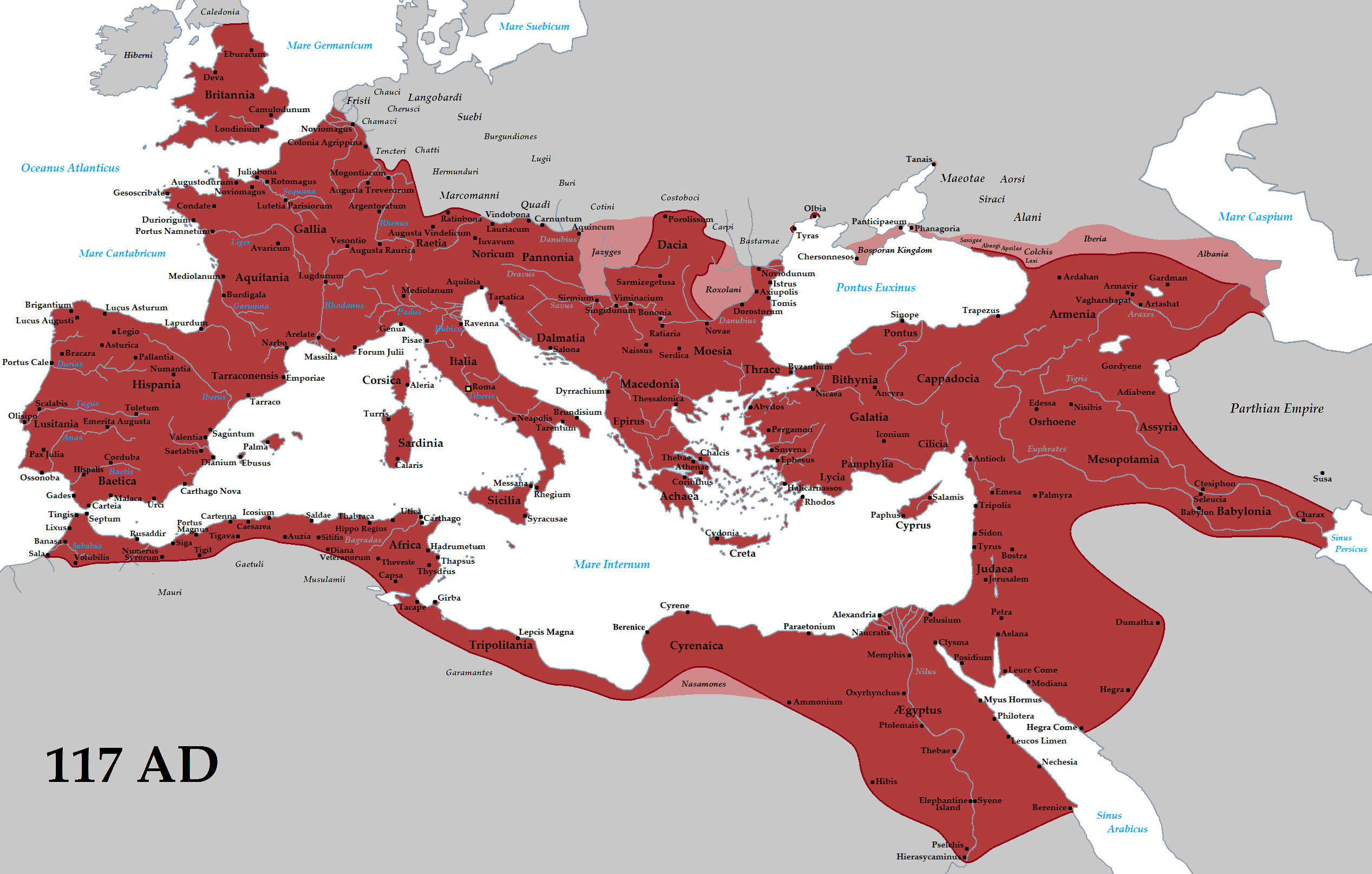
The next two emperors, Hadrian and Antoninus Pius, did not win comparable military glory, but they did defend the borders (Hadrian gave up Trajan’s conquests in Mesopotamia to do so, recognizing that they were unsustainable), oversaw major building projects, and maintained Roman stability. Hadrian spent much of his reign touring the Roman provinces, particularly Greece. It was clear by his reign that the emperor’s authority was practically limitless, with both emperors issuing imperial proclamations known as “rescripts” while away from Rome that carried the force of law. With Hadrian one can see most clearly that humane leadership did not always mean softness, in particular in his suppression of the revolt in Judea.
This period of successful rule eventually broke down when the practice of choosing a competent follower ended – the emperor Marcus Aurelius, a brilliant leader and Stoic philosopher (161 – 180 CE) named his arrogant and foolish son Commodus (r. 177 – 192 CE) his co-emperor three years before Aurelius’s death. Storm clouds had already been gathering under Aurelius, who found himself obliged to lead military campaigns against incursions of Germanic tribes in the north despite his own lack of a military background (or, really, temperament). He had, however, been a scrupulously efficient and focused political leader. His decision to make Commodus his heir was due to a simple fact: Aurelius was the first of the Five Good Emperors to have a biological son who survived to adulthood. As emperor, Commodus indulged his taste for debauchery and ignored affairs of state, finally being assassinated after twelve years of incompetence.
One last dynasty emerged in the aftermath of Commodus’s death, that of the Severans who ruled from 192 – 235 CE. They faced growing threats on the Roman borders, as Germanic tribes staged repeated (and often at least temporarily successful) incursions to the north and a new Persian dynasty known as the Sasanians pressed against Roman territory to the east. The last Severan emperor, Severus Alexander, died in 235 CE, ushering in a terrible period of military defeat and instability considered in the next chapter.
Romanization
As noted above, by the year 117 CE under Trajan, the Roman Empire reached its greatest size. It encompassed most of England across to Germany and Romania, all of North Africa from present-day Morocco, and extended to the borders of the Persian Empire. Beyond these borders were “barbarians” of various kinds; as far as the Romans were concerned there were no civilized people outside of their borders except the Persians. Trajan’s successor, the emperor Hadrian, built an enormous series of fortifications to consolidate power on the frontiers – these were eventually (by the third century CE) known as the limes, permanent garrisons and fortresses that were meant to serve as barriers to prevent “barbarian” incursions. Some of these survive to the present, including Hadrian’s Wall in northern England. While fleets patrolled the rivers and oceans, these garrisons controlled access to the empire.
Throughout the first 2 centuries CE, all portions of the Roman Empire, except for the furthest extended boundary settlements, experienced the phenomenon of Romanization. At its most basic, Romanization meant the spread and sharing of Roman ideas, language, religion, laws, cultural practices, architecture, technology and more across their enormous empire. Most of the spread of culture and infrastructure, was purely pragmatic, like the need for systems of roads to connect northern Europe with Africa, the southeastern Mediterranean, and even with Mesopotamia. For the first time urban centers appeared across Europe and northern Africa, outside of Ptolemaic Egypt of course. Everywhere the Romans went they shared their culture. They built aqueducts along with roads allowing for freshwater to be more readily available across Europe. Coliseums and gladiatorial competitions followed the Romans. And ultimately, the Romans would be the bearers of one of the most influential religions in Western Civilization, Christianity, as it spread throughout their empire.
Roman Legions & Expansion of Roman Citizenship
Perhaps the most important thing Augustus did besides establishing the principate itself was to reorganize the Roman legions. He created a standing professional army with regular pay and retirement benefits, permanently ending the reliance on the volunteer citizen – soldiers that had fought for Rome under the republic. Instead, during the empire, Legionaries served for twenty years and then were put on reserve for another five, although more than half died before reaching retirement age. The major benefits of service were a very large bonus paid on retirement (equivalent to 13 years of pay!) and land: military colonies spread across the empire ensured that a loyal soldier could expect to establish a prosperous family line if he lived that long.
Service in the army was grueling and intense. Roman soldiers were expected to be able to march over 20 miles a day carrying a heavy pack. They were subject to brutal discipline, up to and including summary execution if they were judged to have been derelict in their duties – one of the worst was falling asleep on guard duty, punishable by being beaten to death by one’s fellow soldiers. Roman soldiers were held to the highest standards of unit cohesion, and their combat drills meant they were constantly ready for battle.
Starting in the Augustan period, the essential division in the Roman military was the legion, a self-sufficient army unto itself that could be combined with other legions to form a full-scale invasion force but could also operate on its own. During the Augustan period, each legion consisted of 5,400 infantry and 120 cavalry, along with hundreds of specialists such as engineers, arrow-makers, and blacksmiths who allowed the legion to operate independently while traveling. The legions were subdivided into cohorts of 480 men, each of which was led by a centurion, veterans who had risen through the ranks to lead. The legions were designed to be flexible, adaptable, and “standardized”: each legion was comparable in its organization, down to the placement of the tents in the camps built at the end of every day while the legion was on the march.
In turn, each legion was led by a legionary legate, usually a powerful noble appointed by the imperial government or the emperor himself. These legates were often politicians rather than soldiers, meaning that the key figures in actual battle were the centurions, each of whom had earned his position through exemplary service. Perhaps most important of all was the lead centurion, the First Spear, who dictated tactics on the field. The legions were made up of Roman citizens, but not all members of the Roman military were citizens. Instead, as numerous as the legions were auxiliaries: Roman subjects (e.g. Celts, North Africans, Syrians, etc.). who nevertheless served the empire. The auxiliaries were divided into cohorts of infantry and alae (“wings”) of cavalry. In comparison to the infantry-focused Roman legions, the auxiliaries tended to vary their arms – auxiliaries could be slingers and archers as well as foot soldiers and cavalry. They tended to serve as scouts and support for the legions as well as engaging in combat in their own right. As of 23 CE they numbered about 150,000 men, which was the same as the legions at the time. The emperor Claudius rewarded 25 years of service with citizenship; by the early second century, all auxiliaries gained citizenship on discharge.
The army was important in integrating provincial subjects into Roman culture. A soldier recruited from the provinces had to learn Latin, at least well enough to take orders and respond to them. Auxiliaries served with men from all over the empire, not just their own home regions, and what each soldier had in common was service to Rome. Commanding officers were often from the Italian heartland, forming a direct link to the Roman center. Military families were a reality everywhere, with sons often becoming soldiers after their fathers. Thus, the experience of serving in the legions or the auxiliaries tended to promote a shared sense of Roman identity, even when soldiers were drawn from areas that had been conquered by Rome in the recent past.
In the provinces, there was a pattern that took place over a few generations. After being conquered by the Romans, there were often resistance movements and rebellions. Those were put down with overwhelming, brutal force, often worse than that of the initial invasion. Eventually, local elites were integrated in the governor’s office and ambitious people made sure their sons learned Latin. Locals started joining the army and, if lucky, returned eventually with money and land to show for it. Roman amenities like aqueducts and baths were built and roads linked the province with the rest of the empire. In short, assimilation and/or romanization happened. A few generations after Roman conquest, many (local elites especially) in a given province would identify with Roman civilization. Regular people in the countryside, meanwhile, would at least be obliged to tolerate Roman rule even if they did not embrace it.
Roman Law, Arts, and Technology
For the republican period and the first few hundred years of the Empire, Roman jurisprudence was split in the provinces. This meant that provincial people were accountable to their own legal systems so long as they were loyal to Rome and paid their taxes on schedule. The most famous historical example of the overlapping legal systems of the Empire was the biblical trial of Jesus before the Roman governor Pontius Pilate. Pilate tried to hand the case off to the local Jewish puppet king, Herod, who in turn refused it and handed Jesus back over to Pilate. In the end, Jesus was executed by the Roman government for inciting rebellion, using the traditional Roman punishment of crucifixion. More on this to come.
Roman citizens could always appeal to Roman law if they wanted to, even if they lived in a province far from Rome. There were many benefits, not least exemption from the local laws that non-citizens were obliged to follow, and wealthy citizens were exempt from the more horrible forms of punishment and execution as well (such as crucifixion). This changed dramatically in 212 CE when the emperor Caracalla extended citizenship to all free men and women (to make it easier to collect taxes). This was an important event because it extended Roman law to almost everyone in the empire, essentially laying the foundation for Western law across the Mediterranean world. Some of the concepts and practices of Roman law outlived the empire itself. Rome initiated the tradition of using precedent to shape legal decisions, as well as the idea that there is a spirit to laws that is sometimes more important than a literal interpretation. The Romans were the first to codify the idea that someone accused of a crime was innocent until proven guilty; this was a totally radical idea in the area of justice, which in the rest of the ancient world normally held the accused guilty unless guilt could be conclusively disproved.
In addition to the spread and maintenance of Roman laws throughout the empire, Romans also brought their culture and technology with them wherever they colonized. To this day we can see and touch Roman architecture across the Mediterranean world and into Northern Europe. One need not visit Rome to see the beauty and power of Roman engineering and architecture. Just a few examples follow.


Religion: Roman Faiths and the birth and spread of Christianity
Rome had always been a center of religious diversity. While the official Roman gods were venerated across the Empire, Roman elites had no objections to the worship of other deities, and indeed many Romans (elites and commoners alike) eagerly embraced foreign faiths. Originating in the Hellenistic kingdoms, many Romans were attracted to mystery religions, cults that promised spiritual salvation to their members. These mystery religions shared a belief that the universe was full of magical charms that could lead to spiritual salvation or eternal life itself. In many ways, they were more like cults of magic than traditional religious faiths. A worshiper could join multiple mystery religions, intoning chants and prayers and participating in rituals in hopes of securing good fortune and wealth in life and the possibility of spiritual immortality after death.
Even Rome’s perennial adversary Persia supplied sources of spiritual inspiration to Rome. Mithras, the Zoroastrian god of war, the sun, and rebirth became immensely popular among Romans. Mithrans believed that Mithras had been a soldier, slain by his enemies, who then rose to enjoy eternal life, a secret he could share with his initiates. His worshipers believed that Mithras had captured and killed a scared bull whose blood and body were the source of life. Accordingly, Mithraism focused on bull sacrifice carried out in a vaulted cave like temple called a Mithraeum. Initiates were baptized with the bull’s blood and participated in various other rituals among them a sacramental meal. Their moral code advised imitating the life of their hero. Roman soldiers campaigning in Persia brought Mithraism back to Rome since Mithras’s identity as a former soldier made his worship all the more appealing to members of the Roman military. The worship of Mithras was so popular that, some historians have noted, it is easy to imagine the Roman Empire becoming Mithran instead of Christian if Constantine had not converted to the latter faith.


In some cases, non-Roman gods even came to supplant Roman ones; one of the Severan emperors embraced the worship of the Syrian sun god Sol Invictus (meaning “the unconquered sun”) and had a temple built in Rome to honor the god alongside the traditional Roman deities. The notion of being as powerful and unstoppable as the sun appealed to future emperors, so subsequent emperors tended to venerate Sol Invictus along with the Roman Jupiter until the triumph of Christianity. In other cases, the worship of non-Roman gods was so popular that it simply could not be suppressed in the few cases in which Roman leaders saw a need to. The Egyptian goddess Isis, who was at the heart of the largest mystery cult in the entire Mediterranean region, was so popular among both women and men that repeated attempts to purge her cult from Rome for being socially disruptive utterly failed.
The cult of Isis derived from the ancient Egyptians’ worship of Isis, her brother, and husband Osiris and their son, Horus. Like other cults, its central theme was eternal life, through the promise of resurrection achieved by moral behavior in this life. Isis, the “Goddess of 10,000 names,” was portrayed as a loving mother and elements of Isis were later syncretized in the cult of the Virgin Mary. Her followers were known to march in colorful, and at times terrifying (and disruptive), parades through Roman streets, flagellating themselves as a sign of penitence, something we will see much more of in Medieval Europe. Although men joined in the worship of Isis, the cult mainly appealed to women. The goddess’s popularity crossed class lines; devotees ranged from slaves to the wealthiest Romans.
So here in these cults, one can see several things. First, how the various regions conquered by Rome were actively influencing Roman culture; of most significance were cults from both Persia and Egypt. Second we can see some similarities to Christianity, and perhaps how they influenced one another during their development. Of course the religion with the closest most clear connection to Christianity is Judaism.
The Jews and Jesus
The Roman territory of Palestine was a thorn in Rome’s side thanks to the unshakable opposition of the Jews. Palestine suffered from heavy taxation and deeply-felt resentment toward the Romans. One key point of contention was that the Jews refused to pay lip service to the divinity of the emperors. The Romans insisted that their subjects participate in symbolic rituals acknowledging the primacy of the emperors, but since the Jews were strict monotheists, they would not do so.
In 66 CE there was a huge uprising against Rome. It took four years for imperial forces to crush the uprising, resulting in the greatest disaster in ancient Jewish history: the permanent destruction of the Temple of Jerusalem in 70 CE. In the aftermath, the Romans enslaved or deported much of the Jewish population, which contributed to the phenomenon of the Jewish diaspora, the people without a homeland united only by the Hebrew Bible, the teaching of the rabbis, and Jewish cultural traditions. Another uprising decades later (between 132 – 136 CE) resulted in the almost complete dispersal of the Jews, to the point that the Jewish homeland was truly lost to them until the foundation of the modern state of Israel in 1948 CE.
In the first century CE, Jewish society, especially its leadership, was divided between rival groups. Some powerful priests, the Sadducees, claimed that all Jews should follow the 10 Commandments, but only the priests of the Temple needed to follow the 613 laws and injunctions laid down by Moses. They were opposed by the Pharisees, who insisted that all Jews had to abide by all of the laws of Moses, and they also preached that a messiah – a savior – would soon come to bring about a day of judgment before Yahweh and the fulfillment of the Biblical Covenant. In the deserts outside of the major cities, a group called the Essenes emphasized a life of asceticism and mysticism, while across Palestine anti-Roman revolutionaries known as the Zealots advocated for armed revolt against the Roman occupier.
The Jewish uprising that occurred against the Romans in 66 CE happened a generation after the death of another Jewish revolutionary of sorts: Jesus of Nazareth. For all its historical importance, Jesus’s life is poorly documented. The main source on the life of Jesus are the four Gospels, accounts of his life and teachings composed after his death by three of his apostles (his closest followers and students), Matthew, Mark, and John, and another early Christian leader, Luke. The Gospels were transmitted orally for decades before being recorded in their definitive versions; most scholars now date the written gospels to approximately 90 CE (about sixty years after the death of Jesus). While the specific language of the Gospels is, of course, different, and some of the events described are also described differently, the Gospels agree on most of the major aspects of the life of Jesus, some of which are corroborated by scanty Roman documents.
According to the Gospels, Jesus was the son of the miraculous union of the Holy Spirit, one of the aspects of the Jewish God Yahweh, and a virgin named Mary. Jesus showed an aptitude for theological and spiritual understanding at a young age, debating Jewish doctrine with learned Jewish priests when he was still a boy. At the age of thirty, having earned his living as a carpenter up to that point, Jesus began to preach a message of salvation that revolved around the concept that mankind as a whole could be saved if it sought forgiveness from God for their sins. He traveled and delivered his teachings in the Roman province of Palestine and the nearby puppet kingdoms dominated by the Romans for three years, but was then arrested by the Roman authorities for inciting rebellion. In the end, Jesus was executed in the customary Roman fashion of crucifixion at the age of 33.
According to the Gospels, Jesus returned to life, with an angel rolling the boulder back from the entrance to the tomb in which his body had been laid to rest. He renewed his call for devotion to God and the offer of salvation for those who sought forgiveness, then passed into the divine presence. Jesus’s followers, led by the twelve apostles, began to teach his lessons to others, and the new religion of Christianity was born. His followers began to refer to Jesus as “the Christ,” meaning “the anointed one” in Greek, a reference to the idea that Jesus was anointed to provide salvation for humanity.
But, what does evidence beyond the Gospels tell us about Jesus? Again, not a great deal, but with some careful analysis we can paint a basic picture of Jesus the man. He was probably born not long before the death in 4 BCE of Herod, the Roman-installed client-king of the province of Judea. The date of 1 CE for Jesus’s birth, a mistaken calculation of Late Antiquity, does not accord with the date of the New Testament. At around age 30, Jesus was baptized by the mysterious preacher John the Baptist. Soon afterward Herod Antipas, the Roman’s client-king of Galilee, ordered the execution of John. John had preached that God’s kingdom was about to arrive, a time of universal perfection and the end of misery. In preparation, sinful humankind needed to repent.
Jesus’s teachings were both similar to and different from John’s preaching and other contemporary doctrines of Palestinian Judaism, but closest to the most popular group, the Pharisees, who focused on the spiritual needs of ordinary people. The Pharisees believed that law was central to Judaism but argued that it could be interpreted flexibly, in light of the oral tradition that had grown up alongside the written text of the Hebrew Bible. The Pharisees emphasized charity toward the poor and spoke in parables-vivid allegories/stories that made their teaching accessible. Like the Pharisees Jesus strongly criticized the pillar of the Jewish establishment, the priests and wealthy men who saw the Temple at Jerusalem and its rites as the heart of Judaism. Also like the Pharisees, Jesus rejected the growing movement of the Zealots, advocates of revolt against Roman rule, although there were many Zealots among his followers.
Yet Jesus was not a Pharisee. His teachings went further than the Pharisees’ in rejecting the need to follow the letter of biblical law. Inward purity became the key principle, as reflected in Jesus’s statement to his disciples: “Who ever does not accept the kingdom of God like a child will never enter it.” Only an adult could become an expert in biblical law, but it is probably easier for a child than for an adult to attain spiritual innocence. Jesus argued that the kingdom of God, which John the Baptist had said was coming soon, was actually already beginning to arrive. Moreover, Jesus said that he himself, acting through the direct order of God, could forgive sins. He emphasized the notion of God as a loving and forgiving father. He welcomed marginalized groups, including prostitutes and lepers. He praised the poor and the humble and scorned the pursuit of wealth instead of righteousness. He called for generosity and forgiveness, recalling the traditional Jewish golden rule-to treat others as one would like to be treated. He said that prayer, fasting, and acts of charity should be conducted in private, not in public, in order to emphasize purity of motive.
Jesus’s teachings while winning him many Jewish followers, also gained him hostility from some Pharisees, who considered his claim to be able to forgive sins blasphemous. In fact most Jewish groups did not accept Jesus as the Messiah. And he only made things worse by actively challenging the central authority by going to Jerusalem and teaching and healing in the Temple under the eyes of the very priests that he criticized. Nor did he confine his opposition to words, he drove merchants and moneychangers away from the Temple precincts by over turning their tables and perhaps even threatening them with a whip. Jesus attracted large crowds of followers, at least some of whom were armed. Authorities began to fear trouble, especially the overlords of Judea, the Romans. The governor, Pilate (Pontius Pilatus) had already endured vehement Jewish objections to the display in Jerusalem of an imperial medallion and of an inscription that asserted Augustus’s divinity. Pilate had no need of further uproar or rebellion. Temple police and Roman soldiers were called on to arrest Jesus quietly.
Jesus’s subsequent trial and execution have always been controversial. The New Testament emphasizes the role of the Jewish leadership and the Jerusalem mob in Jesus’s death. Written after the First Jewish Revolt (66-70 AD), however, the Gospels may reflect anti-Jewish sentiment in the empire. Crucifixion, the method used to execute Jesus, was a Roman penalty (the traditional Jewish punishment was stoning) and Jesus was executed by Romans, not Jews. Jesus probably appeared in informal and hurried proceedings before both the Jewish council and Pilate. He suffered a slow death by crucifixion on Golgotha Hill, just outside of the city. It was a spring Friday, on the eve of the Passover festival, around 30 CE.
After Jesus’s death, Christianity could have remained a small Jewish cult, if not for St. Paul’s conversion and the active missionizing of his core group of disciples. After Jesus’s death, his disciples, returned to Jerusalem and spread his teachings. They preached in synagogues, private households, and even Greek Temples, to Greek-speaking as well as Palestinian Jews. Their movement spread in the 30s and 40s throughout Palestine and into Syria. In Jerusalem Christians were known as Nazarenes-that is, followers of Jesus of Nazareth; it was at Antioch that they were first called the “men of Christ” or Christians. The leaders of the movement were known as apostles, from the Greek word apostle, “one who is sent” and who enjoys the authority of the sender. The apostles included Jesus’s 12 original followers, or disciples. The most prominent disciple was Peter, a Galilean fisherman whom Jesus endowed with particular authority. After the crucifixion, Peter became a miracle-worker and leading apostle. According to reliable tradition, he went to Rome, whose church he headed and where he died as a martyr in 64 CE.
Early Christianity
At the beginning of the Christian faith, there was no single set of texts or beliefs that united Christians. The four major Gospels do not agree on everything, because they were written by different people from memory (decades after the apostles themselves were alive). It was St. Paul, a Jewish leader who underwent a profound conversion experience and became the foremost Christian evangelist, who popularized the notion that the death of Jesus on the cross was part of a divine plan that canceled out human sin. For hundreds of years, Christians debated and argued about what Christ’s message had “really” been because many of Jesus’s teachings were, and are, open to interpretation. Early Christians were divided on very significant issues, including:
What God did Jesus represent? One cult believed that the God of Christ was not the Jewish God, who had been vengeful and warlike. According to this sect, Christ’s God was a more powerful and loving deity come to save the world from Yahweh.
Was Jesus the messiah? In Jewish doctrine, the messiah was to be a figure who liberated the Jews from oppression and made good on the Covenant between the Jews and God, delivering the Promised Land for all eternity. Many Jews had hoped that Jesus would be a revolutionary against Roman rule and, since Judea remained in Roman hands after his death, they did not believe that Jesus had been the messiah. Early Christians came to insist, following Paul, that Jesus had indeed been the messiah, but that the “liberation” he offered was spiritual in nature, rather than having to do with prosaic politics. In other words, the potential to save one’s soul from damnation superseded the old Covenant.
Was Jesus human, or was he instead somehow God Himself? He lived like a normal man, but according to the gospels he had also performed miracles, and he claimed to be the son of God. Likewise, while Jesus lived an exemplary life, he also displayed traits like anger and doubt (the latter most famously on the cross when he asked God why He had “forsaken” Jesus), traits that did not seem those of a “perfect” being. This debate would go on for centuries, with equally pious groups of Christians coming to completely different conclusions about Christ’s divine and human natures.
Likewise, early Christians were torn as to whether everyone could be a Christian, or instead, if membership was limited to the Jews. If Jesus was indeed the specifically Jewish messiah, after all, it did not make sense for a Roman or a Persian or a Celt to be able to convert. In the end, thanks largely to the influence of St. Paul again, most Christians came to believe that the salvation offered by Christ was potentially universal, and that not just Jews could become Christians as a result. Some Christians, however contemplated a radial break; among them no one was more important than Paul of Tarsus.
A remarkable figure, Paul, originally Saul, embodied 3 different and interlocking worlds. He was a Jew of the Diaspora from the southern Anatolian city of Tarsus. He was a learned Pharisee, and a native speaker of Aramaic, but also knew Hebrew and Greek. His father was one of the few Jews to attain Roman citizenship, a privilege that Paul inherited. At first Paul joined in the persecution of the Christians, whom he considered blasphemous. Around 36 CE, however, he claimed to see a blinding light on the road to Damascus, a vision of Jesus that convinced him to change from persecutor to believer. It was a complete turn around. At this point Saul changed his name to Paul and became a Christian. But more importantly, he changed what being a Christian meant.
The key to Paul’s faith was not so much Jesus’s life, although that was a model for Christian ethics, as it was Jesus’s death and resurrection. Jesus’s fate, Paul wrote, offered all humanity the hope of resurrection, redemption, and salvation. Paul retained his belief in Jewish morality and ethics, but not in the rules of Jewish law. He claimed that following the law, no matter how carefully, would not lead to salvation; only faith in Jesus as Messiah would. Paul’s doctrine meant a break with Judaism, opening up the religion to gentiles instead of just to Jews. For centuries some gentiles had shown interest in Judaism, but they were put off by the strict dietary laws, circumcision, observance of the Sabbath, and other Jewish rituals. But, Paul and his followers did not have to strictly follow Jewish laws. Even while many Jewish temples baptized converts and considered them Jews, Paul did not consider them to be Jews alone, but more specifically, converts to Christ.
From the late 40s to the early 60s CE Paul undertook missionary journeys through the cities of the Roman East and to Rome itself. He aimed to convert Gentiles, yet many of his followers were already Hellenized Jews. While Paul had opened the door to differentiate Christianity from Judaism, it took events in the next centuries to completely divide the two. First was the persecution of the Jews after the Jewish Revolt in 70 CE when most remaining, surviving Jews rallied to the Pharisees, beginning to consolidate the Jewish community under one doctrine. Second, Jews and Christians began competing for converts and thus emphasized their respective differences. Third, although many Jews made their peace with Rome in 70 CE, enough Jewish-Roman hostility remained to lead to uprisings in the 2nd century that were suppressed, but made Judaism even more stigmatized by the Romans. Many Christians sought to distance themselves from the Jews at this point.


Once the debate about whether non-Jews could become Christians was resolved, Christianity’s teachings and doctrine was open to all. Early Christians recognized no social distinctions, which was fundamentally at odds with the entire Roman system, reliant as it was on formal legal separations between social classes and a stark system of social hierarchy. Likewise, one unequivocal requirement placed on Christians was to love their neighbors, meaning in practice showing kindness and compassion to others regardless of their social rank. Few concepts could have been more alien to Roman sensibilities.
Christianity thus at least potentially threatened the hierarchical nature of Roman society. Likewise, it inherited from Judaism a strict monotheism that refused to accept the worship of the Roman emperors. What made it even more threatening than Judaism, however, was that Christianity actively sought out new converts (i.e. Christianity was inherently evangelical, in stark contrast to Judaism which did not seek new members). Roman authorities were thus already very much inclined to be suspicious of the Christians as potential rabble-rousers. In 68 CE, Nero blamed the Christians for the huge fire that consumed much of the city of Rome, and hundreds of Christian were rounded up and slaughtered in the arena. The persecution of Christians became a potent symbol for Christianity as a whole. Over a thousand years later, when Christianity was firmly entrenched as the religion of Europe, the trope of martyrdom was still used to explain righteous suffering.
Expansion, Divergence, and Persecution
Although Jesus’s mission had primarily been in the countryside, early Christianity quickly became an urban movement and spread throughout the cities of the Roman Empire. By around 200 CE orthodox (meaning “right thinking” in Greek) Christianity had emerged. Rooted in Judaism, it was nonetheless a distinct and separate religion that found most of its supporters among Gentiles. A simple rule of faith emphasizing the belief in one God and the mission of his son Jesus as savior, united Christians from one end of the Empire to the other. Christianity attracted all types of followers, men and women, poor and wealthy. Many of the early followers believed that Christ’s return was imminent. Early churches were simple and relatively informal congregations that gathered for regular meetings. The liturgy or service consisted of reading from the Scriptures, old and New Testaments, teaching, praying, and singing hymns. Baptism was used to initiate converts. The Lord’s Supper, a communal meal in memory of Jesus, was the major ritual. The most important parts of the meal were the baking and distribution of bread at the beginning and the passing of a cup of wine at the end; these recalled the body and blood of Christ.
As Christianity spread, its trouble with the authorities deepened. For one thing, Christians met in small groups, a kind of assembly the conservative Romans had long suspected as a potential source of sedition. More troubling, however, was Christians’ refusals to make sacrifices to the emperor. The Romans expected all subjects to make such sacrifices as a sign of patriotism. The only exception was the Jews, who were permitted to forgo the imperial cult because their ancestral religious beliefs prohibited them from worshipping idols. The Christians, however, were a new group, and the Romans distrusted novelty. As a result the emperors considered Christianity at best a nuisance and at worst a serious threat. Christians were tested from time to time by being asked to sacrifice to the emperor; those who failed to do so might be executed, sometimes in the arena. More often, however the Romans tacitly tolerated Christians as long as they kept their religion private. Christians could not proselytize in public places, put up inscriptions or monuments, or build churches. Christianity thus spread under severe restrictions, but spread it did, particularly in the cities of the East and due to the appeal of its promise of a good afterlife for all, not just Jews. The only requirement was accepting Jesus Christ as their savior. The willingness of martyrs to die for their faith made a strong impression on potential converts. Although the number of Christians in the empire is not known, it is clear that by the late 3rd century they were a significant and growing minority.
Early Christian Organization
Early Christians had already developed a distinct hierarchy of worshipers, a divide between priests and worshipers. Bishops were the head of each city’s congregation, and they supervised a staff of priests and deacons who interacted with everyday worshipers and led services. The bishops of main cities, usually the imperial capitals of their respective provinces, came to be called an archbishop. Each bishop oversaw activity in the diocese, again following the imperial structure, in instructing people in Christian doctrine and in building charity networks. One important effect was that the church actively supported charities for the poor and hungry, a practice which won over new converts. This was one of the notable moments in history when a religion linked together a message of compassion for the needy and real, practical efforts to help the needy. In another strong contrast with Roman practice, Christianity saw disenfranchised groups like women and the poor (not to mention poor women) play major roles in the early church’s organization.
And as Christianity spread across the Empire, slowly formalizing its doctrines, structure, and practices, it also began to transform the Roman Empire from within. At the same time, Rome began to face increasing pressure from new enemies. For the first two centuries of its existence, Rome was overwhelmingly powerful, and its political institutions were strong enough to survive even prolonged periods of incompetent rule. However, trouble was afoot on Rome’s borders, as barbarian groups became more populous and better-organized, and as the meritocratic system of the “Five Good Emperors” gave way to infighting, assassination, and civil war. The Roman Empire was slowly falling apart by the 3rd century CE.
This page titled Chapter 9: The Roman Empire was last modified on Sun, 04 Oct 2026 05:56:49 GMT and is shared under a CC BY-NC-SA 4.0 license and was authored, remixed, and/or curated by Erin Stone via source content that was edited to the style and standards of the LibreTexts platform.
The book could not be loaded just now.