Opening the book…
Handel and the English Oratorio
George Frideric Handel was one of the superstars of the late Baroque period He was born the same year as one of our other Baroque superstars, Johann Sebastian Bach, not more than 150 miles away in Halle, Germany. His father was an attorney and wanted his son to follow in his footsteps, but Handel decided that he wanted to be a musician instead. With the help of a local nobleman, he persuaded his father to agree. After learning the basics of composition, Handel journeyed to Italy to learn to write opera. Italy, after all, was the home of opera, and opera was the most popular musical entertainment of the day. After writing a few operas, he took a job in London, England, where Italian opera was very much the rage, eventually establishing his own opera company and producing scores of Italian operas, which were initially very well received by the English public. After a decade or so, however, Italian opera in England imploded. Several opera companies there each
competed for the public’s business. The divas who sang the main roles and whom the public bought their tickets to see demanded high salaries. In 1728, a librettist name John Gay and a composer named Johann Pepusch premiered a new sort of opera in London called ballad opera. It was sung entirely in English and its music was based on folk tunes known by most inhabitants of the British Isles. For the English public, the majority of whom had been attending Italian opera without understanding the language in which it was sung, English language opera was a big hit. Both Handel’s opera company and his competitors fought for financial stability, and Handel had to find other ways to make a profit. He hit on the idea of writing English oratorio.
https://upload.wikimedia.org/wikipedia/commons/3/3e/Handel-Mercier.jpg

From Italian Opera to English Oratorio
Oratorio is sacred opera that is not staged. Like operas, they are relatively long works, often spanning over two hours when performed in entirety. Like opera, oratorios are entirely sung to orchestral accompaniment. They feature recitatives, arias, and choruses, just like opera. Most oratorios also tell the story of an important character from the Christian Bible. But oratorios are not acted out. Historically-speaking, this is the reason that they exist. During the Baroque period at sacred times in the Christian church year such as Lent, stage entertainment was prohibited. The idea was that during Lent, individuals should be looking inward and preparing themselves for the death and resurrection of Christ, and attending plays and operas would distract from that. Nevertheless, individuals still wanted entertainment, hence, oratorios. These oratorios would be performed as concerts not in the church but because they were not acted out, they were perceived as not having a “detrimental” effect on the spiritual lives of those in the audience. The first oratorios were performed in Italy; then they spread elsewhere on the continent and to England.
Handel realized how powerful ballad opera, sung in English, had been for the general population and started writing oratorios but in the English language. He used the same music styles as he had in his operas, only including more choruses. In no time at all, his oratorios were being lauded as some of the most popular performances in London.
Messiah: Recitative and Aria
His most famous oratorio is entitled Messiah and was first performed in 1741. About the life of Christ, it was written for a benefit concert to be held in Dublin, Ireland. Atypically, his librettist, took the words for the oratorio straight from the King James Version of the Bible instead of putting the story into his own words.
Once in Ireland, Handel assembled solo singers as well as a chorus of musical amateurs to sing the many choruses he wrote for the oratorio. There it was popular, if not controversial. One of the soloists was a woman who was a famous actress. Some critics remarked that it was inappropriate for a woman who normally performed on the stage to be singing words from sacred scripture. Others objected to sacred scripture being sung in a concert instead of in church. Perhaps influenced by these opinions, Messiah was performed only a few times during the 1740s. Since the end of the eighteenth century, however, it has been performed more than almost any other composition of classical music. While these issues may not seem controversial to us today, they remind us that people still disagree about how sacred texts should be used and about what sort music should be used to set them.
https://upload.wikimedia.org/wikipedia/commons/f/ff/Handel%27s_Messiah.jpg
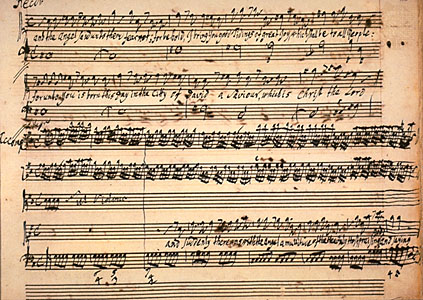
We’ve included three numbers from Handel’s Messiah as part of our discussion of this focus composition. We’ll first listen to a recitative entitled “Comfort Ye” that is directly followed by an aria entitled “Every Valley.” These two numbers are the second and third numbers in the oratorio. Then we’ll listen to the Hallelujah Chorus, the most famous number from the composition that falls at the end of the second of the three parts of the oratorio.
“Comfort Ye” and “Every Valley”
| Composer | George Frideric Handel |
|---|---|
| Composition | “Comfort Ye” and “Every Valley” from Messiah |
| Date | 1741 |
| Genre | accompanied recitative and aria from an oratorio |
| Form | accompanied recitative—through composed; aria—binary form AA’ |
| Nature of Text | English language libretto quoting the Bible |
| Performing Forces | solo tenor and orchestra |
| What we want you to remember about this composition | As an oratorio, it uses the same styles and forms as operas but is not staged The aria is very virtuoso with its melismas, and alternates between orchestral ritornellos and solo sections |
| Other things to listen for | The accompanied recitative uses more instruments than standard basso continuo-accompanied recitative, but the vocal line retains the flexibility of recitative Motor rhythm in the aria In a major key In the aria, the second solo section is more ornamented than the first, as was often the custom. |
| Accompanied Recitative | “Comfort Ye” |
| https://www.youtube.com/watch?v=GDEi38TxBME | ||
|---|---|---|
| Timing | Text and Form | Performing Forces, Melody, and Texture |
| 0:00 | Reduced orchestra playing pia- no repeated notes | |
| 0:13 | Vocalist & light orchestral ac- companiment: “Comfort Ye my people” | Mostly stepwise, conjunct sung melody; Homophonic texture |
| 0:27 | Vocalist and light orchestral accompaniment: Comfort ye my people says your God; speak ye comforter of Jerusalem; and cry upon....that her iniquity is pardoned. A voice of him that cryeth in the wilderness. Prepare ye the way for the Lord. Make straight in the desert a highway for our God | Orchestra and vocalist alternate phrases until the recitative ends |
| 2:22 | Orchestra plays ritornello | Repeated motives; starts loud, ends with an echo |
| 2:39 | Tenor and orchestra: Every valley shall be exalted | Soloist presents melodic phrase first heard in the ritornello and the orchestra echoes this phrase |
| 2:52 | Tenor and orchestra: Shall be exalted And every mountain and hill made low | Long melisma on the word exalted...repeats High note on mountain and low note on “low” |
| 3:17 | Tenor and orchestra: The crooked straight | Repeated oscillation between two notes to represent crookedness; then one note is sustained on the word straight. |
| 3:23 | Tenor and orchestra: And the rough places plain | Repeated oscillation between two notes to represent roughness; then one note is sustained on the word plain. |
| 3:38 | Continued | Melismatic descending sequence on the word “Plain” |
| 3:53 | Tenor and Orchestra: “Every valley shall be exalted” (Repeti- tion of text and music) | Goes back to the beginning, but with even more ornamentation from the melismas |
| 5:10 | Orchestra: ritornello | Repeats the music of the ritornello one final time |
Messiah: “Hallelujah” Chorus

The “Hallelujah” Chorus closes Part II of Messiah. Listen especially for Handel’s shifts among homophonic, monophonic, and polyphonic textures, and for the repetition and sequencing of key motives.
| Composer | George Frideric Handel |
|---|---|
| Composition | “Hallelujah” from Messiah |
| Date | 1741 |
| Genre | chorus from an oratorio |
| Form | sectional; sections delineated by texture changes |
| Nature of Text | English language libretto quoting the Bible |
| Performing Forces | solo tenor and orchestra |
| What we want you to remember about this composition | It is for four-part chorus and orchestra It uses a sectional form where sections are delineated by changes in texture |
| Other things to listen for | In a major key, using mostly major chords Key motives repeat over and over, often in sequence |
| https://www.youtube.com/watch?v=ptBZwDYKA14 | ||
|---|---|---|
| Timing | Text and Form | Performing Forces, Melody, and Texture |
| 0:00 | Orchestra: Introduces main musical motive in a major key with a homophonic texture where parts of the orchestra play the melody and other voices provide the accompaniment | |
| 0:09 | Hallelujah | Chorus + orchestra: Here the choir and the orchestra provide the melody and accompaniment of the homophonic texture |
| 0:26 | For the Lord God omnipotent reigneth | Chorus + orchestra: Dramatic shift to monophonic with the voices and orchestra performing the same melodic line at the same time. |
| 0:34 | Hallelujah | Chorus + orchestra: Homophonic texture, as before. |
| 0:38 | For the Lord God omnipotent reigneth | Chorus + orchestra: Homophonic texture, as before. |
| 0:45 | Hallelujah | Chorus + orchestra: Homophonic texture, as before. |
| 0:49 | For the Lord God omnipotent reigneth | Chorus + orchestra: Texture shifts to non-imitative polyphonic with the initial entrance of the sopranos, then the tenors, then the altos. |
| 1:17 | The Kingdom of this world is begun | Chorus + orchestra: Homophonic texture, as before. |
| 1:36 | And he shall reign for ever and ever | Chorus + orchestra: Imitative polyphony starts in bass- es, then is passed to tenors, then to the altos, and then to the sopranos. |
| 1:57 | King of Kings | Chorus + orchestra: Homophonic texture, as before. |
| 2:01 | Forever, and ever hallelujah hallelujah | Chorus + orchestra: Homophonic texture, as before. |
| 2:05 | And Lord of Lords...Repeated alternation of the monophonic king of kings and lord of lords with homophonic for ever and ever | Chorus + orchestra: Each entrance is sequenced higher; the women sing the monophonic repeated melody motive Monophony alternating with homophony |
| 2:36 | King of kings and lord of lords | Chorus + orchestra: Homophonic texture |
| 2:40 | And he shall reign for ever and ever | Chorus + orchestra: Polyphonic texture (with some imitation) |
| 2:52 | King of kings and lord of lords alternating with “for ever and ever” | Chorus + orchestra: The alternation of monophonic and homophonic textures. |
| 3:01 | And he shall reign...Hallelujah | Chorus + orchestra: Mostly homophonic |
Handel’s Water Music
Suites and Stylized Dance
Although Handel is perhaps best known today for his operas and oratorios, he also wrote a lot instrumental music, from concertos like Vivaldi wrote to a kind of music called the suite. Suites were compositions having many contrasting movements. The idea was to provide diverse music in one composition that might be interesting for playing and listening. They could be written for solo instruments such as the harpsichord or for orchestral forces, in which case we call them orchestral suites. They often began with movements called overtures and modeled after the overtures played before operas. Then they typically consisted of stylized dance movements. By stylized dance, we mean a piece of music that sounds like a dance but that was not designed for dancing. In other words, a stylized dance uses the distinct characteristics of a dance and would be recognized as sounding like that dance but might be too long or too complicated to be danced to.

Dancing was very popular in the Baroque period, as it had been in the Middle Ages and Renaissance. We have several dancing text- books from the Baroque period that mapped out the choreography for each dance. Some of the most popular dances included the saraband, gigue, minuet, and bourée. The saraband was a slow dance in triple meter, whereas the gigue (or jig) was a very fast dance with triple subdivisions of the beats. The minuet was also in triple time but danced at a much more stately tempo. The bourrée, on the other hand, was danced at a much faster tempo, and always in duple meter.
Music on the Thames
When King George I asked Handel to compose music for an evening’s diversion, the suite was the genre to which Handel turned. This composition was for an event that started at 8pm on Wednesday the seventeenth of July, 1717. King George I and his noble guests would launch a barge ride up the Thames River to Chelsea. After disembarking and spending some time on shore, they re-boarded at 11pm and returned via the river to Whitehall Palace, from whence they came. A contemporary newspaper remarked that the king and his guests occupied one barge while another held about fifty musicians and reported that the king liked the music so much that he asked it to be repeated three times.
The bourée, as noted above, is fast and in duple time. The minuet is in a triple. Many of the movements that were played for the occasion were written down and eventually published as three suites of music, each in a different key. You have two stylized dance movements from one of these suites here, a bourée and a minuet. We do not know with any certainty in what order these movements were played or even exactly who played them on that evening in 1717, but when the music was published in the late eighteenth century, it was set for two trumpets, two horns, two oboes, first violins, second violins, violas, and a basso continuo, which included a bassoon, cello(s), and harpsichord.
The bourée, as noted above, is fast and in duple time. The minuet is in a triple meter and taken at a more moderate tempo. They use repeated strains or sections of melodies based on repeated motives. As written in the score, as well as interpreted today in the referenced recording, different sections of the orchestra—the strings, woodwinds, and sometimes brass instruments—each get a time to shine, providing diverse timbres and thus musical interest. Both are good examples of binary form.
Bourrée from Water Music
| Composer | George Frideric Handel |
|---|---|
| Composition | Bourée from Water Music |
| Date | 1717 |
| Genre | stylized dance movement from a suite |
| Form | Binary form, AABB, performed here three times; B is twice as long as A |
| Performing Forces | Baroque orchestra: according to the musical score, 2 trumpets, 2 horns, 2 oboes, 1 bassoons, 1st violins, 2nd violins, violas, cello, and basso continuo (the cellos play the same music as the bassoon) |
| What we want you to remember about this composition | It’s a stylized dance. It’s in duple time and starts with a pick up (a note that appears before the first beat of the measure). It has a relatively fast tempo. |
| Other things to listen for | The A section is half the length of the B section; each section is repeated The strings and woodwind instruments alternate taking the lead in this performance The cello, bassoon, and harpsichord make up the basso continuo |
| https://www.youtube.com/watch?v=Se542KiZgN8 | ||
|---|---|---|
| Timing | Text and Form | Performing Forces, Melody, and Texture |
| 8:26 | A, repeated | Strings, basso continuo, trumpet Short phrase A of four measures, repeated |
| 8:36 | B | Same instruments play an answer phrase B of eight measures with descending motivic sequences |
| 8:52 | A | Flute, oboe, bassoon, trumpets, strings Play the same A phrase as above |
| 8:44 | A | Repeated |
| 9:01 | B | Same instruments play the B phrase |
| 9:09 | B | Repeated |
| 9:17 | A, repeated | Strings, trumpets, flute, oboe bassoon, and basso continuo play the A phrase. |
| 9:26 | B | Same instruments play the B phrase. |
| 9:34 | B | Repeated |
Minuet from Water Music
| Composer | George Frideric Handel |
|---|---|
| Composition | Minuet from Water Music |
| Date | 1717 |
| Genre | Stylized dance from a suite |
| Form | AA BB, to be performed three times according to the score |
| https://www.youtube.com/watch?v=Se542KiZgN8 | ||
|---|---|---|
| Timing | Text and Form | Performing Forces, Melody, and Texture |
| 9:49 | A | Strings, trumpets: triple meter in a major key; Melody starts with repeated notes and is very conjunct; some ornaments on the first beats of some measures |
| 9:59 | A | Repeated |
| 10:11 | B | Starts with repeated notes in just strings, oboes, and bassoon and ascends and then the trumpets and horns join: melody ascends and descends, mostly by step; trumpet becomes more prominent new phrases with a three-note motive that repeatedly ascends and then descends by step |
| 10:33 | B | As with B above |
| 10:55 | A | Flute, oboes, bassoons, horns, trumpets, basso continuo including cello play the opening strain |
| 11:07 | A | Flute, oboes, bassoons, horns, trumpets, basso continuo including cello play the opening strain |
| 11:18 | A | First just double reeds, then adding horns |
| 11:39 | B | Repeated |
| 12:02 | A | Full orchestra |
| 12:13 | A | Repeated |
| 12:24 | B | First strings and then the full orchestra |
| 12:46 | B | First strings and then the full orchestra |
This page titled 2.2.5: Music of George Frideric Handel (1685-1759) was last modified on Sat, 22 Aug 2026 20:35:01 GMT and is shared under a CC BY-SA 4.0 license and was authored, remixed, and/or curated by Clark, Heflin, Kluball, and Kramer (GALILEO Open Learning Materials) via source content that was edited to the style and standards of the LibreTexts platform.
The book could not be loaded just now.