Opening the book…
| Words (or words that have the same definition) | The definition is case sensitive | (Optional) Image to display with the definition [Not displayed in Glossary, only in pop-up on pages] | (Optional) Caption for Image | (Optional) External or Internal Link | (Optional) Source for Definition |
|---|---|---|---|---|---|
| (Eg. "Genetic, Hereditary, DNA ...") | (Eg. "Relating to genes or heredity") | The infamous double helix | https://bio.libretexts.org/ | CC-BY-SA; Delmar Larsen |
|
Word(s) |
Definition |
Image | Caption | Link | Source |
|---|---|---|---|---|---|
| Hue |
The name of the pure state of a color or chromatic group, determined by the wavelengths, which distinguish one color from another |
 |
|||
| Value |
Lightness or darkness of hue. |
 |
Scale of values in black, white, and red. | ||
| Temperature |
The association of colors or groups of color as relatively warm or cool compared to others. Typically warm colors range from red-violet to yellow while cool colors range from yellow green to blue-violet. The strongest polarity in temperature is present between red orange and blue green.
|
 |
Temperature modulation | ||
| Complement | Complements are naturally harmonious pairs of colors. They are found opposite each other on the color wheel. | ||||
| Saturation | Chromatic intensity; the degree of concentration or suffusion of a hue from vivid to dull. |  |
|||
| Extension | One of Johannes Itten’s seven contrasts of color. Applies to the relationship between two or more color areas considering elements of quantity, recurrence, and brilliance. | ||||
| Spectrum | A band of colors, as seen in a rainbow, produced by separation of the components of light by their different degrees of refraction according to wavelength. | ||||
| Color Wheel | The band of individual colors that shows the spectrum bent into a circle. Used for painting. | ||||
| Color Solid | A three-dimensional structure that shows all the colors in a consecutive and interrelated relationship in space. | ||||
| Primary | Primary colors are any group of colors from which all other colors can be obtained by mixing. In pigment: red, yellow, blue; printing: magenta, yellow, cyan; light: red, blue-violet, green; and psychology: yellow, red, blue, green. | 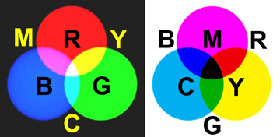 |
|||
| Secondary | Colors mixed from two primaries: orange, green, violet. | ||||
| Intermediate | |||||
| Triad | Any three colors that are equally spaced or equidistant on the color circle. Triadic harmonies | ||||
| Analagous | Color appearing in a row on the color wheel. | ||||
| Complementary | Opposite colors on the color wheel. When mixed, complementary colors yield balanced, chromatic neutrals. Complementary polarities: Y/V, light dark; O/B, warm cool; R/G equal weight, equal value. | ||||
| Split Complement | |||||
| False Pairs | Sets of two secondary colors: O&G, G&V, V&O. | ||||
|
Tertiary |
Color step which appears between each primary and secondary; intermediate: YG, YO, RO, RV, BV, BG | ||||
|
False Pairs |
Sets of two secondary colors: O&G, G&V, V&O. | ||||
|
Split Complement |
The use of one hue in a complementary pair with one or two hues on either side of that pair. | ||||
|
Monochromatic |
A color scheme that contains only one hue, but with value and intensity changes | ||||
|
Neutral |
Dull hues, hues with little intensity, low-chroma. | ||||
|
Tint |
Hue mixed with white | ||||
|
Tone |
Hue mixed with gray | ||||
|
Shade |
Hue mixed with black | ||||
| Modulation | Smooth transitions on a value continuum | ||||
| Modulation | Smooth transitions from one color to another. |
|
|||
| Gradation | A scale or a series of successive changes, stages, or degrees between colors |
|
|||
| Intervals | A compositional tool for creating rhythm and movement by using alternating steps in colors along a single gradation. | ||||
| Chroma | Degree of intensity, saturation, or purity of color. | ||||
| Chromatic | Relating to or produced by color. | ||||
| Color Symbolism | The use of color in culture, art, spiritual traditions to signify meaning. May be universal or subjective and shifts with time and context. |  |
|||
| After Image | The image that appears after the viewer has looked intently for a period and shifts their gaze to another surface. The apparent image seen is the complement or near complement of the original image. |  |
|
||
| Simultaneous Contrast | This occurs when two or more hues are seen next to each other or in succession. The after image of the dominant hue in the large area washes over onto the smaller area as the hues are seen simultaneously. Also known as successive contrast. One of Itten’s 7 contrasts. |  |
|
||
| Synesthesia | The fusion of the senses. Cross sensory associations. Color to sound etc. See Kandinsky. |
|

The book could not be loaded just now.