Opening the book…
MODULE 1 VOCABULARY
| Nomi di persona | Nomi di cosa | Aggettivi e Colori | Verbi ed espressioni |
|---|---|---|---|
|
Uomo Man Donna Woman Ragazzo: Young guy Ragazza: Young gal Bambino: boy Bambina: girl Professoressa: professor F Professore: Professor M Studentessa: student F Studente: Student M |
Quadro: Picture -Painting Statua: Statue Museo: Museum Città: City Banco: Desk Cartina: Map Finestra: Window Porta: Door Gomma: Eraser Lavagna: Black or White board Libro: book Luce: light Matita: Pencil Orologio: Watch or Clock Penna: Pen Pennarello: Marker Quaderno: Booknote Zaino: Backpack Borsa: Bag or Purse Biologia: Biology Chimica: Chemistry Economia: Business Giornalismo: Journalism Informatica: Computer Studies Infermieristica: Nursing Lingue Straniere: Foreign Languages Letteratura: Literature Psicologia: Psychology Scienze Politiche: Political Sciences Storia: Social Studies, History Storia dell’arte: Art History |
Affettuoso: Caring Altruista: Generous Anziano: Old for people Basso: Short Bello: Beautiful/ Handsome Biondo: Blonde Bruno: Brown hair Brutto: hugly Buono: good Calvo: bold (no hair) Carino: cute Cattivo: bad Corto: short Difficile: difficult Divertente: funny Egoista: selfish Facile: easy Felice: happy Lieto: glad Generoso: genourous Gentile: kind Giovane: young Grande: big Grasso: fat Impaziente: Impatient Indifferente: Indifferent Interessante: Interesting Lungo: Long Magro: thin Noioso: boring Nuovo: new Ottimista: optimist Paziente: Patient Pessimista: pessimist Piccolo: small Pigro: lazy Serio: serious Simpatico: nice Sportivo: active Stupido: stupid Timido: shy Tirchio: stingy Triste: sad Vecchio: old Americano: American Arabo: Arab Messicano: Mexican Francese: French Inglese: English Italiano: Italian Giapponese: Japanese Spagnolo: Spanish Tedesco: German COLORIArancione: Orange Bianco: White Blu: Blue Giallo: Yellow Grigio: Gray Marrone: Brown Nero: Black Rosa: Pink Rosso: Red Verde: Green Viola: Purple |
Essere: to be Stare: to stay Chiamarsi: to be named Avere: to have Abitare: to live Studiare: to study Avere… anni: To be... years old Avere caldo: to be hot Avere fame: to be hungry Avere freddo: to be cold Avere fretta: to be in a hurry Avere paura di: to be afraid of Avere ragione: to be right Avere torto: to be wrong Avere sete: to be thirsty Avere sonno: to be sleepy |
Usa QUIZLET [quizlet.com] per fare pratica!
Keep exploring the Story of Artemisia, Michelangelo, Oprah Winfrey, and Sergio Mattarella in Florence
- Read the Story: Begin by reading the story of Artemisia and Michelangelo, along with Oprah Winfrey and Sergio Mattarella, while in Florence. Focus on understanding the context and the characters involved.
- Read Aloud: After familiarizing yourself with the vocabulary, read the text aloud. This will help improve your pronunciation and fluency in Italian.
- AI Reading: Utilize an AI tool to read the text aloud. Listening to the AI will help you grasp the correct pronunciation and intonation of the Italian language.
- Answer Questions: Finally, answer the questions related to the story. Read the questions aloud and respond to them, ensuring you articulate your answers clearly.
By following these directions, you will enhance your comprehension, vocabulary, and speaking skills in Italian while enjoying the story set in Florence.
|
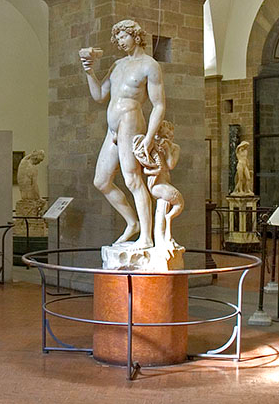
Artemisia: “Conosci (do you know) un’altra statua di Michelangelo?” Michelangelo :”Sì, c’è un’altra statua di un dio (a god) che si chiama Bacco. La statua è al museo del Bargello. Ecco una fotografia. Il Bacco è giovane, muscoloso." Artemisia: "È molto bello! Ho voglia di andare (to go) a vedere (to see) questa statua!" Michelangelo :"Domani (tomorrow) hai tempo?" Artemisia: "Sì, qual è il tuo numero di telefono?" Michelangelo: "Il mio numero di cellulare è 342 789 5612. E il tuo?" Artemisia :" Il mio numero è 369 798 7812. Ti mando un text. (I send you a text). |
Michelangelo's Bacchus, photo taken at the Museo del Bargello in 2021, by Rossella Pescatori. |
|---|
Museo del Bargello : museo del Bargello [www.museodelbargello.it]
Il Bacco di Michelangelo:
Bacco [youtu.be]
|
La signora Oprah Winfrey e il signor Mattarella camminano (walk) per Firenze. Oprah : “Signor Mattarella dove siamo?” Mattarella : “Siamo davanti (we are in front of ) al palazzo Medici Ricciardi” Oprah “È molto bello. Chi abita qui?” Mattarella: “ Una volta abitava (used to live) la famiglia de’ Medici. C’è una bella canzone… Ascolti (listen to this) CANZONE BACCO E ARIANNA [youtu.be] |
|---|
Leggi a voce alta (read aloud) e rispondi (answer) a queste domande.
1. Come si chiama l'altra statua di Michelangelo?
2. Dov'è quella statua?
3. Artemisia ha voglia di vedere quella statua?
4.Qual è il numero di telefono di Michelangelo?
5. Dove sono la signora Winfrey e Mattarella?
6. Di chi è il Palazzo Medici-Ricciardi?
Leggi, ascolta e dai un commento a questa canzone.
|
Quest’è Bacco e Arïanna, belli, e l’un dell’altro ardenti: perché ’l tempo fugge e inganna, sempre insieme stan contenti. Queste ninfe ed altre genti sono allegre tuttavia. Chi vuol esser lieto, sia: di doman non c’è certezza Questi lieti satiretti, delle ninfe innamorati, per caverne e per boschetti han lor posto cento agguati; or da Bacco riscaldati ballon, salton tuttavia. Chi vuol esser lieto, sia di doman non c’è certezza. Queste ninfe anche hanno caro da lor essere ingannate: non può fare a Amor riparo se non gente rozze e ingrate: ora, insieme mescolate, suonon, canton tuttavia. Chi vuol esser lieto, sia: di doman non c’è certezza. Mida vien dietro a costoro: ciò che tocca oro diventa. E che giova aver tesoro, s’altri poi non si contenta? Che dolcezza vuoi che senta chi ha sete tuttavia? Chi vuol esser lieto, sia: di doman non c’è certezza. Donne e giovinetti amanti, viva Bacco e viva Amore! Ciascun suoni, balli e canti! Arda di dolcezza il core! Non fatica, non dolore! Ciò c’ha a esser, convien sia. Chi vuol esser lieto, sia: di doman non c’è certezza. Quant’e` bella giovenezza, Che seppure fugge tuttavia, Chi vuol esser lieto, sia: di doman non c’è certezza. |
This is Bacchus and this is Ariadne, Beautiful, and are in fire because they are in love of each other. Because time runs away and fools They forever stays together, ard are happy. These nymphs and other people are happy however.. Whoever wants to be joyous, please do it! Nobody know what will happen tomorrow. These joyful little satyres Are in love of the nymphs, In the caves and in the woods They set one hundred ambushes up Now fired up by Bacchus, They dance, jump however. Whoever wants to be joyous, please do it! Nobody know what will happen tomorrow Also these nymphs love to be tricked by them: Nobody can escape Love, Only those people who are rude and ungrateful: now, all together , play, sing nevertheless . Whoever wants to be joyous, please do it! Nobody know what will happen tomorrow Midas comes after these people: Whatever he touches, it becomes gold. And what is the benefit of richness if we cannot enjoy it with others? What type of sweetness can be experienced by whoever is thirsty, nevertheless? Whoever wants to be joyous, please do it! Nobody know what will happen tomorrow. Women and young lovers, Long life for Bacchus and long life for Love! Everyone: play, dance and sing! The heart will flare of sweetness! No struggle, no pain! Whatever must be, it is right it will be, Whoever wants to be joyous, please do it! Nobody know what will happen tomorrow. How beautiful is youth That runs away, nevertheless! Whoever wants to be joyous, please do it! Nobody know what will happen tomorrow. |
|---|
WHAT AND WHY? CHE COSA E PERCHÉ?
|
A Carnevale, le persone indossano maschere e cantano e ballano. Siamo nel 1490 a Firenze, in Italia. Lorenzo scrive le "ballate" che si chiamano canti carnascialeschi. Di solito, queste ballate sono scherzose e divertenti. Lorenzo nel "Trionfo di Bacco e Arianna" unisce poesia e divertimento. Crea versi belli che sono un inno alla vita. Il "Trionfo" è un carro mascherato con uomini e donne travestiti da Bacco e Arianna, satiri e ninfe. Tutti sono giovani e belli. Il carro passa e così passa il tempo... e la giovinezza. Non conosciamo il domani. Lorenzo il Magnifico muore a 43 anni, vive dal 1449 al 1492 e a soli 20 anni, inizia a governare Firenze. È anche grazie a lui che abbiamo l’arte del Rinascimento, conosciuta in tutto il mondo. |
During Carnival, people wear masks and sing and dance. We are in 1490 in Florence, Italy. Lorenzo writes the "ballads" called carnival songs. Usually, these ballads are playful and fun. In the "Triumph of Bacchus and Ariadne," Lorenzo combines poetry and entertainment. He creates beautiful verses that are an anthem to life. The "Triumph" is a masked float with men and women dressed as Bacchus and Ariadne, satyrs, and nymphs. Everyone is young and beautiful. The float passes, and so does time... and youth. We do not know what tomorrow holds. Lorenzo the Magnificent dies at 43 years old; he lives from 1449 to 1492, and at just 20 years old, he begins to govern Florence. It is also thanks to him that we have the art of the Renaissance, known all over the world. |
|---|
Leggi a voce alta a queste domande e rispondi con una frase completa.
-
Cosa fanno le persone a Carnevale?
-
Chi è Lorenzo?
-
Cosa significa il "Trionfo di Bacco e Arianna"?
-
Cosa crea Lorenzo
-
Come sono le persone nel carro mascherato
-
A che età inizia Lorenzo a governare Firenze?
Attività : ATTIVITÀ [docs.google.com]
Il Carnevale di Viareggio oggi.
This page titled 1.11: Vocabolario- Modulo 1 BANCA DI PAROLE- IL TRIONFO DI BACCO E ARIANNA was last modified on Wed, 30 Apr 2025 08:51:29 GMT and is shared under a CC BY 4.0 license and was authored, remixed, and/or curated by Rossella Pescatori.
The book could not be loaded just now.