Opening the book…
Stress is the force exerted per unit area and strain is the physical change that results in response to that force. When the applied stress is greater than the internal strength of rock, strain results in the form of deformation of the rock caused by the stress. Strain in rocks can be represented as a change in rock volume and/or rock shape, as well as fracturing the rock. There are three types of stress: tensional, compressional, and shear [1]. Tensional stress involves forces pulling in opposite directions, which results in strain that stretches and thins rock. Compressional stress involves forces pushing together, and the compressional strain shows up as rock folding and thickening. Shear stress involves transverse forces; the strain shows up as opposing blocks or regions of the material moving past each other.
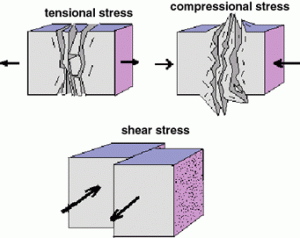
| Type of Stress | Associated Plate Boundary type | Resulting Strain | Associated fault and offset types |
| Tensional | divergent | Stretching and thinning | Normal |
| Compressional | convergent | Shortening and thickening | Reverse |
| Shear | transform | Tearing | Strike-slip |
This page titled Section 8.1: Stress and Strain was last modified on Wed, 28 May 2025 19:10:49 GMT and is shared under a CC BY-NC-SA 4.0 license and was authored, remixed, and/or curated by Chris Johnson, Matthew D. Affolter, Paul Inkenbrandt, and Cam Mosher (OpenGeology) via source content that was edited to the style and standards of the LibreTexts platform.
The book could not be loaded just now.