Opening the book…
Sensible heat transfer (H) into the air is dependent on the temperature gradient between the surface and the air above. An examination of the global distribution of sensible heat transfer reveals that it is at a maximum in the tropical and subtropical deserts. Here the high surface temperature conducts much heat into the air above. Sensible heat is lowest near the poles where the surface temperatures are quite cold.

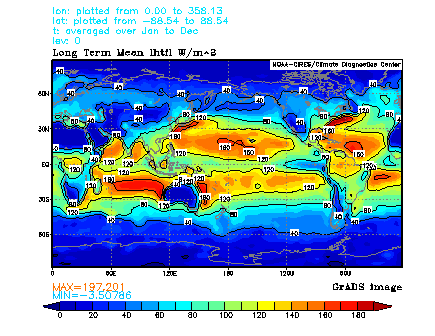
The maximum amount of latent heat transfer (LE) occurs over the subtropical oceans where there is a maximum of net radiation and, of course, water to evaporate. The lowest rates occur in desert locations. Even though there is ample available energy for LE, there is little water present. Off the east coast of midlatitude continents like North America, we'll find very high rates of latent energy transfer into the air. Here, dry air blows off the continent and over the warm ocean current that flows along the coast. This produces a large moisture gradient between the surface and the air above that induces evaporation and LE transfer.
2.5: Global Patterns of Sensible and Latent Heat Transfer is shared under a CC BY-NC-SA 4.0 license and was authored, remixed, and/or curated by LibreTexts.
The book could not be loaded just now.