Opening the book…
The large-scale currents at the ocean surface, such as the Gulf Stream from Florida to Europe, the Antarctic Circumpolar Current, and the Kuroshio from the Philippines to Japan, are all driven by the wind. In fact, it has been estimated that the winds do \(\sim\)1 TW worth of mechanical work on the oceans. How do the winds do this? As the wind blows over the ocean, it exerts a force on the ocean surface in the direction of the wind. This force, per unit ocean surface area, is what is called the wind stress (\(\tau_w\)). At the same time, the ocean water resists this wind stress through internal friction. According to Newton's law of viscosity, this frictional force per unit area is proportional to the velocity gradient in the direction perpendicular to the surface:
\[\tau_v = \rho K_v \dfrac{dv}{dz}.\]
Again, we use the turbulent diffusion coefficient \(K_v\), rather than a molecular viscosity. In steady state, the wind stress and the frictional force must cancel, that is: \(\tau_w=\tau_v\). Therefore, we have:
\[\tau_w = \rho K_v \dfrac{dv}{dz} \label{6.1}\]
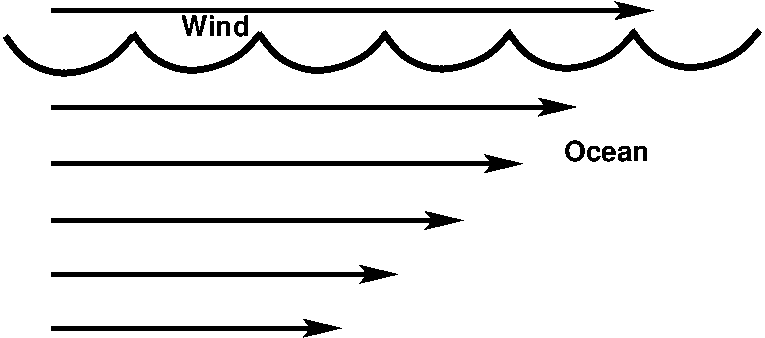
Overall, the force exerted by the wind on the ocean surface gives rise to a vertical velocity gradient in the upper boundary layer of the ocean, as depicted below. Essentially, the wind adds momentum to the ocean surface which is then transported downward through diffusion associated with the vertical momentum gradient.
This page titled 6: Wind Stress was last modified on Fri, 06 May 2022 19:17:31 GMT and is shared under a CC BY 4.0 license and was authored, remixed, and/or curated by Anne Willem Omta.
The book could not be loaded just now.