Opening the book…
Outcrop and Hand Sample Photos and Videos
No outcrop images available. This was collected near Independence, not too far away from the other Cranberry Gneiss sample (next page).
The classic interpretation of the Cranberry Gneiss is that it is a paragneiss (sedimentary protolith). This is true in many places, including sample S5 (next page). However, the Cranberry Gneiss on this page is pretty clearly an orthogneiss (igneous protolith). Field mappers in the area are now starting to distinguish between these two types of gneisses.
Thin Section Photos and Videos
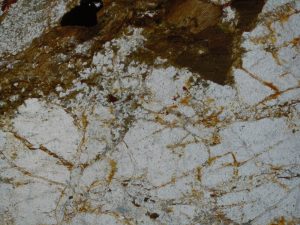
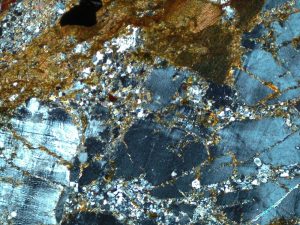
1st = plane polarized light; 2nd = cross-polarized light.
Spot 1
Biotite (brown), orthoclase, recrystallized quartz.
Spot 2
Biotite,quarts, magnetite, plagioclase, dusty orthoclase, a zircon (inside the magnetite at bottom right).
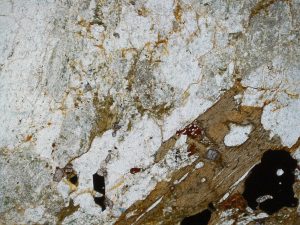

Entire thin section scan. 1st = ppl; 2nd = xpl.


This page titled 5.12: Cranberry Gneiss (Orthogneiss) was last modified on Fri, 06 May 2022 21:15:09 GMT and is shared under a CC BY-NC-SA 4.0 license and was authored, remixed, and/or curated by Elizabeth Johnson and Juhong Christie Liu (Virtual Library of Virginia) via source content that was edited to the style and standards of the LibreTexts platform.
The book could not be loaded just now.