4.1: Direction of a Moment

Engineering Statics: Open and Interactive · LibreTexts

0%

Contents

    Text

    Size
    100%
    Theme
    Typeface
    Line length
    Spacing

    From LibreTexts, under CC BY-NC-SA 4.0, as the source states it; its equations are written in TeX, which the PDF shows typeset. This page at LibreTexts.

    4.1: Direction of a Moment
    \(\require{cancel} \let\vecarrow\vec \renewcommand{\vec}{\mathbf} \newcommand{\ihat}{\vec{i}} \newcommand{\jhat}{\vec{j}} \newcommand{\khat}{\vec{k}} \DeclareMathOperator{\proj}{proj} \newcommand{\kg}[1]{#1~\text{kg} } \newcommand{\lbm}[1]{#1~\text{lb}_m } \newcommand{\slug}[1]{#1~\text{slug} } \newcommand{\m}[1]{#1~\text{m}} \newcommand{\km}[1]{#1~\text{km}} \newcommand{\cm}[1]{#1~\text{cm}} \newcommand{\mm}[1]{#1~\text{mm}} \newcommand{\ft}[1]{#1~\text{ft}} \newcommand{\inch}[1]{#1~\text{in}} \newcommand{\N}[1]{#1~\text{N} } \newcommand{\kN}[1]{#1~\text{kN} } \newcommand{\MN}[1]{#1~\text{MN} } \newcommand{\lb}[1]{#1~\text{lb} } \newcommand{\lbf}[1]{#1~\text{lb}_f } \newcommand{\Nm}[1]{#1~\text{N}\!\cdot\!\text{m} } \newcommand{\kNm}[1]{#1~\text{kN}\!\cdot\!\text{m} } \newcommand{\ftlb}[1]{#1~\text{ft}\!\cdot\!\text{lb} } \newcommand{\inlb}[1]{#1~\text{in}\!\cdot\!\text{lb} } \newcommand{\lbperft}[1]{#1~\text{lb}/\text{ft} } \newcommand{\lbperin}[1]{#1~\text{lb}/\text{in} } \newcommand{\Nperm}[1]{#1~\text{N}/\text{m} } \newcommand{\kgperkm}[1]{#1~\text{kg}/\text{km} } \newcommand{\psinch}[1]{#1~\text{lb}/\text{in}^2 } \newcommand{\pqinch}[1]{#1~\text{lb}/\text{in}^3 } \newcommand{\psf}[1]{#1~\text{lb}/\text{ft}^2 } \newcommand{\pqf}[1]{#1~\text{lb}/\text{ft}^3 } \newcommand{\Nsm}[1]{#1~\text{N}/\text{m}^2 } \newcommand{\kgsm}[1]{#1~\text{kg}/\text{m}^2 } \newcommand{\kgqm}[1]{#1~\text{kg}/\text{m}^3 } \newcommand{\Pa}[1]{#1~\text{Pa} } \newcommand{\kPa}[1]{#1~\text{kPa} } \newcommand{\aSI}[1]{#1~\text{m}/\text{s}^2 } \newcommand{\aUS}[1]{#1~\text{ft}/\text{s}^2 } \newcommand{\unit}[1]{#1~\text{unit} } \newcommand{\ang}[1]{#1^\circ } \newcommand{\second}[1]{#1~\text{s} } \newcommand{\lt}{<} \newcommand{\gt}{>} \newcommand{\amp}{&} \)

    In a two-dimensional problem the direction of a moment can be determined easily by inspection as either clockwise or counter-clockwise. A counter-clockwise rotation corresponds with a moment vector pointing out of page and is considered positive.

    In three-dimensions a moment vector may point in any direction in space and is more difficult to visualize. The direction is established by the right hand rule.

    To apply the right hand rule, first establish a position vector \(\vec{r}\text{.}\) pointing from the rotation center to the point of application of the force, or another point on its line of action. If you align your thumb with the position vector and your index finger with the force vector, then your middle finger points the direction of the moment vector \(\vec{M}\text{.}\) Alternately, you can align your index finger with the position vector and your middle finger with the force vector, and your thumb will point in the direction of the moment vector.

    undefined
    Figure 4.1.1. Two ways to apply the right hand rule to determine the direction of a moment.

    Another approach is the point-and-curl method. Start with your hand flat and fingertips pointing along the position vector \(\vec{r}\) pointing from the center of rotation to a point on the force’s line of action. Adjust your hand so the force vector \(\vec{F}\) pushes fingers into a curl. Your thumb then defines the direction of the moment \(\vec{M}\text{.}\)

    undefined

    Figure 4.1.2. Point-and-curl right-hand rule technique for moments.

    Consider the page shown below on a horizontal surface. Using these techniques, we see that a counter-clockwise moment vector points up, or out of the page, while the clockwise moment points down or in to the page. In other words, the counter-clockwise moment acts in the positive z direction and the clockwise moment acts in the −z direction.
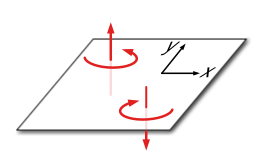
    A counter-clockwise moment symbol on a horizontal page, and the corresponding unit vector pointing up, also a similar clockwise moment pointing down.

    Figure 4.1.3. Moments in the plane of the page.

    Any of these techniques may be used to find the direction of a moment. They all produce the same result so you don’t need to learn them all, but make sure you have at least one method you can use accurately and consistently.


    This page titled 4.1: Direction of a Moment was last modified on Wed, 03 May 2023 04:14:40 GMT and is shared under a CC BY-NC-SA 4.0 license and was authored, remixed, and/or curated by Daniel W. Baker and William Haynes (Engineeringstatics) via source content that was edited to the style and standards of the LibreTexts platform.