Opening the book…
In Section 3.9, we used a stack diagram to represent the state of a program during a function call. The same kind of diagram can help interpret a recursive function.
Every time a function gets called, Python creates a frame to contain the function’s local variables and parameters. For a recursive function, there might be more than one frame on the stack at the same time.
Figure \(\PageIndex{1}\) shows a stack diagram for countdown called with n = 3.
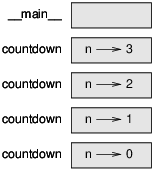
As usual, the top of the stack is the frame for __main__. It is empty because we did not create any variables in __main__ or pass any arguments to it.
The four countdown frames have different values for the parameter n. The bottom of the stack, where n=0, is called the base case. It does not make a recursive call, so there are no more frames.
As an exercise, draw a stack diagram for print_n called with s = 'Hello' and n=2. Then write a function called do_n that takes a function object and a number, n, as arguments, and that calls the given function n times.
This page titled 5.9: Stack diagrams for recursive functions was last modified on Tue, 01 Dec 2020 03:31:09 GMT and is shared under a CC BY-NC 3.0 license and was authored, remixed, and/or curated by Allen B. Downey (Green Tea Press) via source content that was edited to the style and standards of the LibreTexts platform.
The book could not be loaded just now.