Opening the book…
Truss joints can be identified using alphabets or numbers, depending on the preference of the analyst. However, consistency must be maintained in the chosen way of identification to avoid confusion during analysis. A bar force can be represented by any letter (\(F\) or \(N\) or \(S\)), with two subscripts designating the member. For example, the member force \(F_{AB}\) in the truss shown in Figure 5.4 is the force in the member connecting joints \(A\) and \(B\).
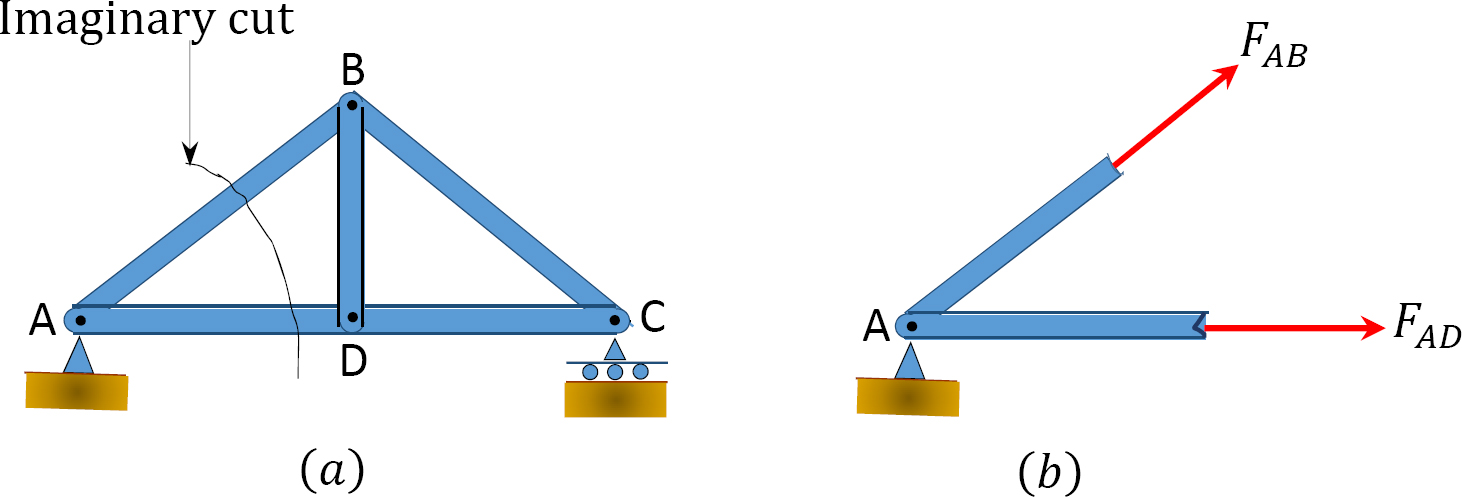
\(Fig. 5.4\). Joint identification (\(a\)) and bar force (\(b\)).
Example 5.1
Classify the trusses shown in Figure 5.5 through Figure 5.9 as stable, determinate, or indeterminate, and state the degree of indeterminacy when necessary.
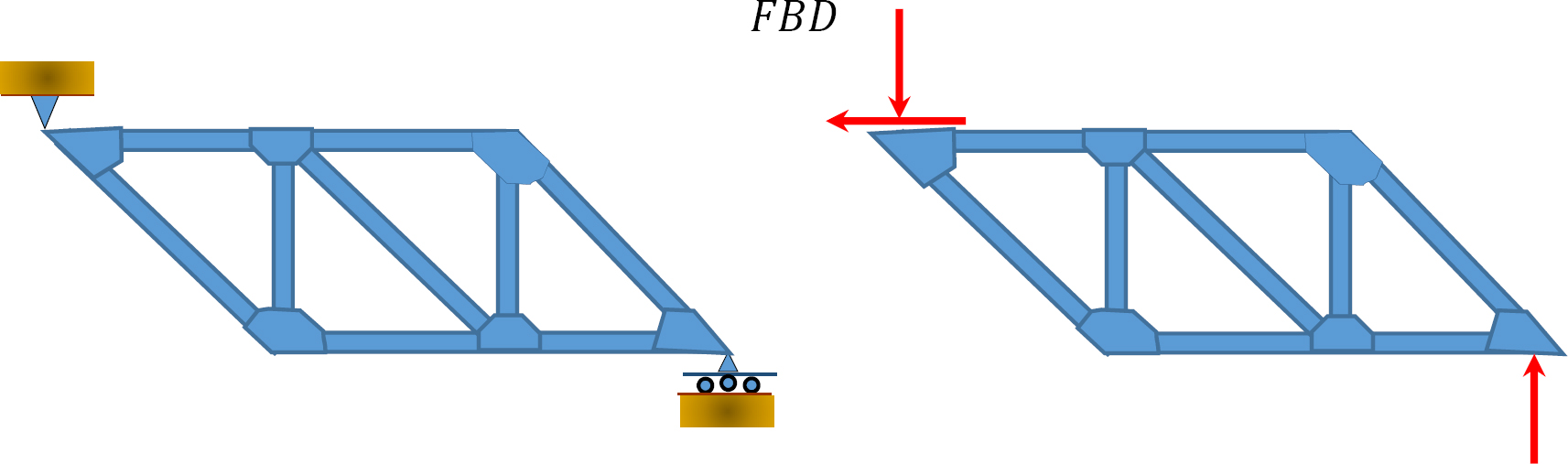
\(Fig. 5.5\). Truss.
\(r = 3\), \(m = 9\), \(j = 6\). From equation 3.5, \(9 + 3 = 2(6)\). Statically determinate.
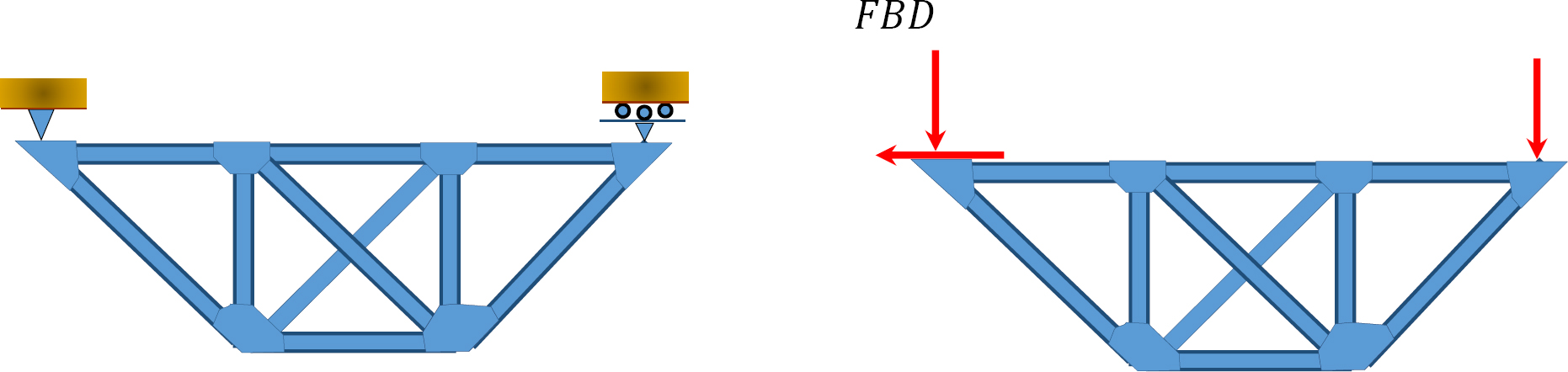
\(Fig. 5.6\). Truss.
\(r = 3\), \(m = 10\), \(j = 6\). From equation 3.5, \(10 + 3 > 2(6)\). Statically indeterminate to \(1^{\circ}\).
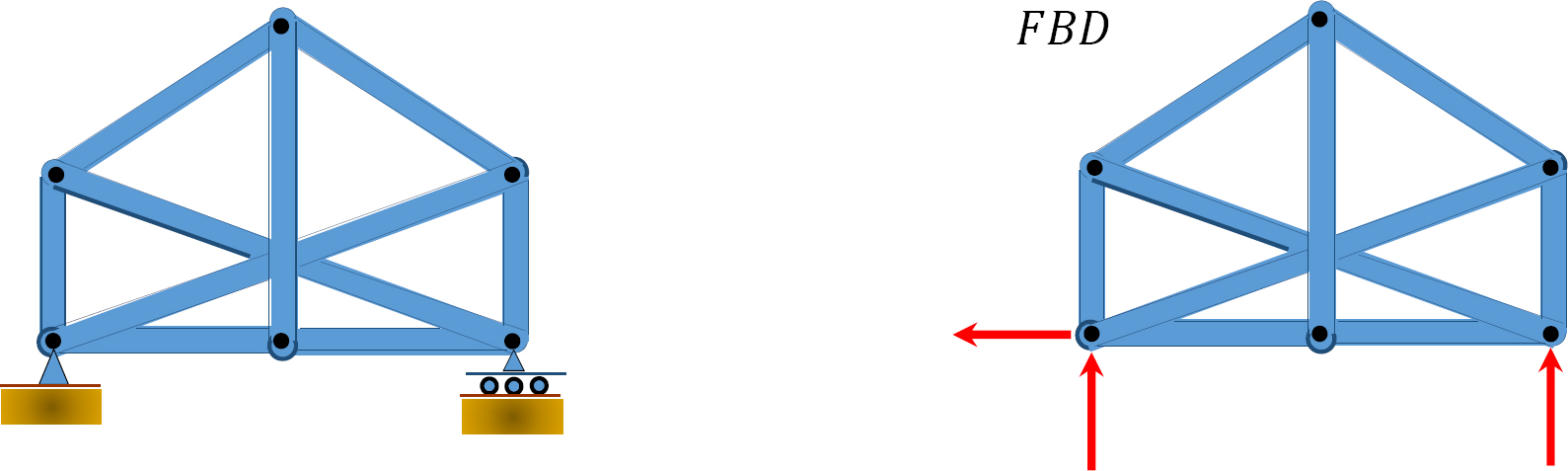
\(Fig. 5.7\). Truss.
\(r = 3\), \(m = 9\), \(j = 6\). From equation 3.5, \(9 + 3 = 2(6)\). Statically determinate.
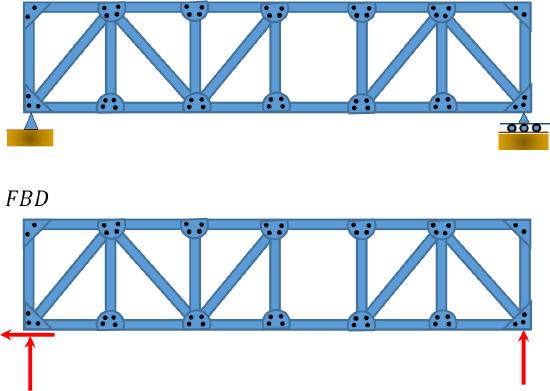
\(Fig. 5.8\). Truss.
\(r = 3\), \(m = 24\), \(j = 14\). From equation 3.5, \(24 + 3 < 2(14)\). Statically unstable.
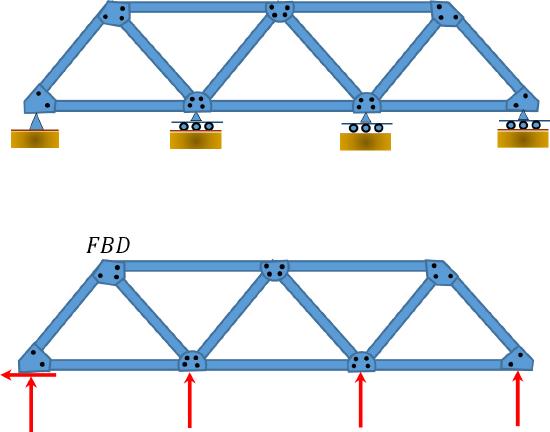
\(Fig. 5.9\). Truss.
\(r = 5\), \(m = 11\), \(j = 7\). From equation 3.5, \(11 + 5 > 2(7)\).
Statically indeterminate to the \(2^{\circ}\).
This page titled 5.5: Joint Identification and Member Force Notation was last modified on Thu, 15 Apr 2021 18:44:09 GMT and is shared under a CC BY-NC-SA 4.0 license and was authored, remixed, and/or curated by René Alderliesten (TU Delft Open) via source content that was edited to the style and standards of the LibreTexts platform.
The book could not be loaded just now.