Opening the book…
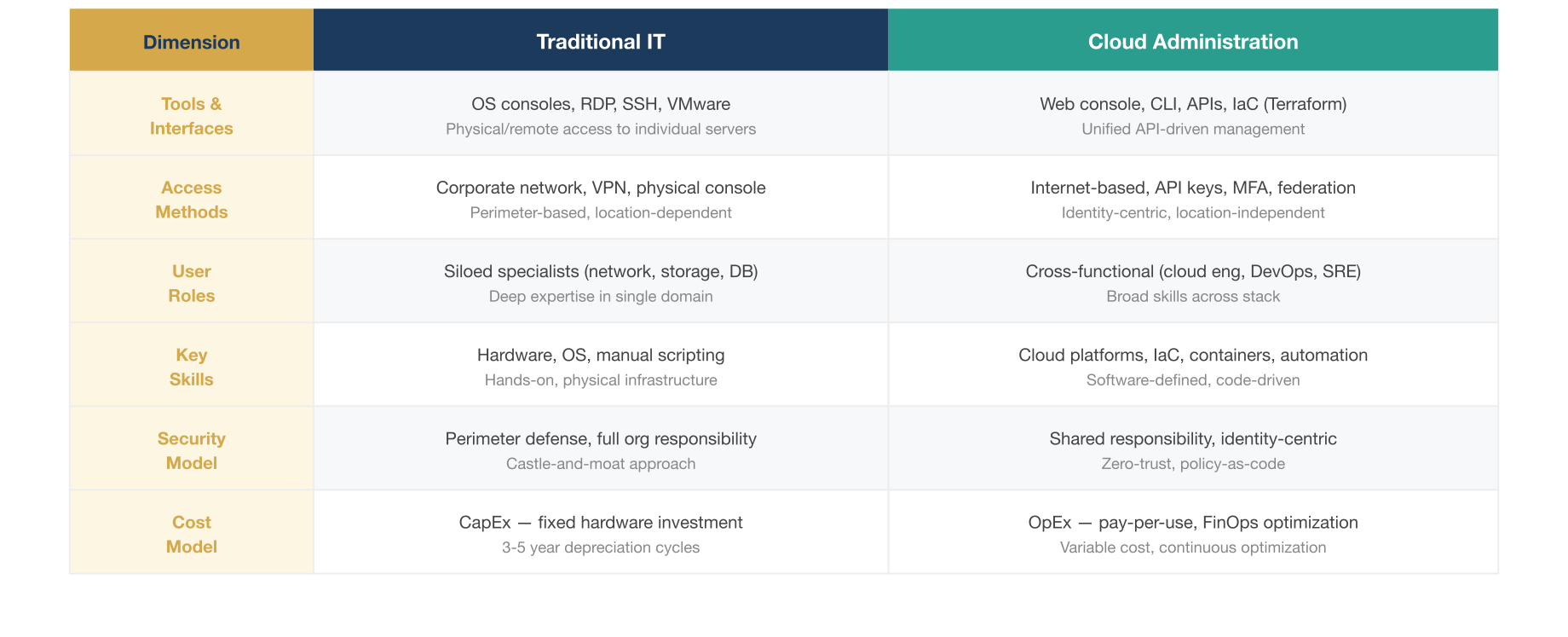
Cloud administration and traditional IT administration represent two different paradigms of managing technology resources. In summary, cloud administration is defined by abstraction, automation, and rapid scalability, using tools like web consoles, CLIs, and IAM policies, while traditional IT administration is grounded in hands-on management of physical assets, manual processes, and localized control. The comparison can be seen across multiple dimensions:
- Tools & Access: Cloud admins use unified consoles and APIs accessible from anywhere (with proper credentials), whereas traditional admins rely on on-site tools or remote logins tied to the corporate network. Both require secure methods (SSH, etc.), but cloud emphasizes key-based and identity federation methods, in contrast to the local accounts and VPN access of on-prem systems.
- Roles & Responsibilities: Cloud introduces new roles (cloud engineers, DevOps, SRE) that demand a blend of skills across development and operations, while reducing the need for some niche traditional roles (for example, a “tape backup administrator” is obsolete when using cloud storage). Traditional roles are evolving: network, storage, and server admins are learning to manage cloud equivalents and deal with more automation. Both in cloud and on-prem, the goal is system reliability and security, but how those are achieved differs greatly.
- Skills: Traditional IT professionals excel in hardware, OS, and specific software management, but the future lies in cloud skills – proficiency in cloud platforms, infrastructure as code, containerization, continuous deployment, and cross-domain knowledge. The need for ongoing learning is pronounced as cloud tech updates continuously. Cloud admins also need to develop more collaboration and higher-level planning skills, working closely with business objectives and application teams.
- Security: Security remains paramount in both models, but the mechanisms differ. Traditional security focuses on strong perimeter defense and internal access control, giving comfort of data being on-premises. Cloud security, by contrast, relies on strong identity management, encryption, and the shared diligence of both provider and customer. Cloud admins must configure a secure environment using the tools available (IAM, security groups, auditing), and traditional admins must secure the perimeter and internal systems – in both cases, missteps can be costly, but cloud offers more automated tools to help if used correctly.
-
Administrative Burden: Cloud has shifted much of the “mundane” burden (hardware failures, manual patching, etc.) off the admin’s plate, allowing focus on design, optimization, and business enablement. Traditional IT required significant time just to keep systems running; cloud frees IT staff from many of those chores, but in exchange, admins take on tasks like cost management and continuous architectural improvement.
For university students and aspiring IT professionals, understanding both models is valuable. Many organizations operate in hybrid modes, keeping some on-premises systems while using cloud services for others. As such, a modern IT administrator often needs to bridge the two worlds: applying classical IT knowledge (networking fundamentals, OS internals, security principles) in new cloud-centric ways. An example is troubleshooting: a traditional admin might troubleshoot a server by checking its logs and network cable; a cloud admin might troubleshoot an application by checking cloud service metrics, tracing through a distributed logging service, and perhaps liaising with cloud support if it’s an obscure platform issue. The core analytical skills are transferable, but the context is changed.
In conclusion, cloud administration vs traditional IT is not a case of one being strictly “better” – rather, they each have contexts where they fit. Traditional IT offers full control and might be necessary for certain sensitive workloads or where latency must be ultra-low (e.g., on a factory floor). Cloud administration offers agility, global scale, and rapid innovation, which is why it is overtaking traditional models in many domains. For project managers and technology leaders, the key is to manage this transition: ensuring that the IT team acquires cloud skills, implementing best practices, and addressing challenges such as security and cost oversight. The trend in industry is clear: cloud skills are in high demand and cloud platforms are continuously evolving with new services that abstract traditional admin tasks (for instance, serverless computing even abstracts the server management entirely). Therefore, mastering cloud administration while understanding the foundations of traditional IT administration will equip professionals to manage modern cloud projects effectively. By combining academic knowledge of systems and networks with practical expertise in cloud platforms (AWS, GCP, etc.), tomorrow’s IT administrators will be well-positioned to leverage the best of both worlds – delivering robust, scalable solutions that meet organizational needs in a fast-changing technology landscape.
This page titled 4.4: Conclusion was last modified on Tue, 22 Sep 2026 21:13:27 GMT and is shared under a CC BY 4.0 license and was authored, remixed, and/or curated by Felix Amoruwa.
The book could not be loaded just now.