Opening the book…
Netflix on AWS and Snapchat on Google Cloud
These case studies illustrate large-scale cloud computing in action, highlighting the service models, architecture choices, and benefits achieved.
Netflix on AWS: Cloud-Scale Microservices for Streaming
Netflix is a flagship example of a business that successfully bet on the cloud to deliver a superior product. As a streaming video provider, Netflix must handle huge volumes of data and traffic spikes (for example, when popular new content is released) while providing uninterrupted, high-quality service to users worldwide. Netflix decided to migrate from its own data centers to AWS after a serious database corruption incident in 2008 took down its DVD rental service for days. They realized they needed more resilient infrastructure and an architecture that could avoid single points of failure. The cloud, with its elasticity and distributed nature, was the answer.
Use of AWS Services: Netflix now uses a broad range of AWS’s offerings:
Compute: Netflix runs its application workloads on thousands of Amazon EC2 instances, across multiple AWS Regions. It heavily uses auto-scaling – when demand rises, AWS automatically launches more EC2 instances to handle the load; when demand falls, instances are terminated to save cost. As noted, Netflix at one point was using over 100,000 server instances on AWS. They also use Amazon EC2 Spot Instances for cost efficiency in non- critical workloads (taking advantage of spare AWS capacity at lower price, albeit with possible interruptions).
Storage and CDN: For the massive video files, Netflix relies on Amazon S3 for storing master copies of content. S3’s durability (11 nines) ensures the videos are safe. However, serving video to millions of users directly from S3 would be inefficient. Netflix created its own content delivery network called Open Connect – essentially deploying caches (servers) at ISP locations – but it also leverages AWS’s CloudFront CDN for certain content delivery and regional caching needs. Additionally, metadata (movie info, user data) is stored in various AWS database services.
Data and Databases: Netflix uses Amazon DynamoDB (a NoSQL database) for fast, distributed storage of key-value data (such as user preferences, viewing history, etc.) that needs to be globally accessible and highly available. They also use Amazon RDS (Relational Database Service) for some relational data needs, and Amazon Elasticache (in-memory cache) to cache popular data and reduce database load.
Microservices and Messaging: Netflix pioneered the microservices approach on AWS. They broke the application into many microservices (think of services like “Search”, “Recommendations”, “User Profile”, “Playback Session”, etc.). These communicate via REST and messaging. Netflix built a lot of its own middleware on top of AWS: for example, the Eureka service registry that runs on EC2 to help services find each other (service discovery), and the Hystrix library implemented within services to do circuit breaking on calls (stop calling a service that’s failing, etc.). They also rely on Amazon SQS (Simple Queue Service) for queuing tasks and Amazon SNS for pub-sub notifications between parts of the system.
Resilience Tools: To ensure resilience, Netflix infamously created “Chaos Monkey”, a tool that randomly terminates instances in production to test how the system responds. Running Chaos Monkey on AWS auto-scaled groups forces their microservices to be fault-tolerant (services must be redundant across multiple AZs so if one instance dies, others carry on). AWS’s multi-AZ and multi-region infrastructure made it straightforward for Netflix to deploy services in a resilient way (for example, they run active-active across at least three availability zones; if one zone has issues, traffic fails over to the others).
Analytics and Personalization: Netflix is a big data company in many ways – they collect logs of user interactions, streaming quality metrics, etc., and analyze this for recommendations and to improve the service. Netflix utilizes AWS EMR (Elastic MapReduce) and a variety of AWS big data tools (or their own equivalents on AWS infrastructure) to process petabytes of data daily. Machine learning models for recommendation might be trained using AWS GPU instances or AWS SageMaker. The outputs (recommended titles) are then served via microservices when a user logs in.
Security and Operations: Netflix takes advantage of AWS Identity and Access Management (IAM) for securely managing credentials and permissions for its services. It also uses VPCs to isolate its environments (production, testing, etc.) with strict security rules (for example, databases in private subnets not accessible from the internet). CloudTrail and CloudWatch provide auditing and monitoring of the AWS infrastructure usage.
Cloud-Native Benefits Realized: By using AWS, Netflix achieved remarkable scalability – it can stream to hundreds of millions of customers concurrently because AWS can scale out the necessary instances and network bandwidth on demand. In one instance, when “House of Cards” first launched, Netflix experienced a huge spike in traffic; AWS was able to add thousands of instances seamlessly to handle it. If Netflix had to provision that capacity in its own data centers, it would have needed to predict and invest heavily in hardware that might only be fully utilized occasionally.
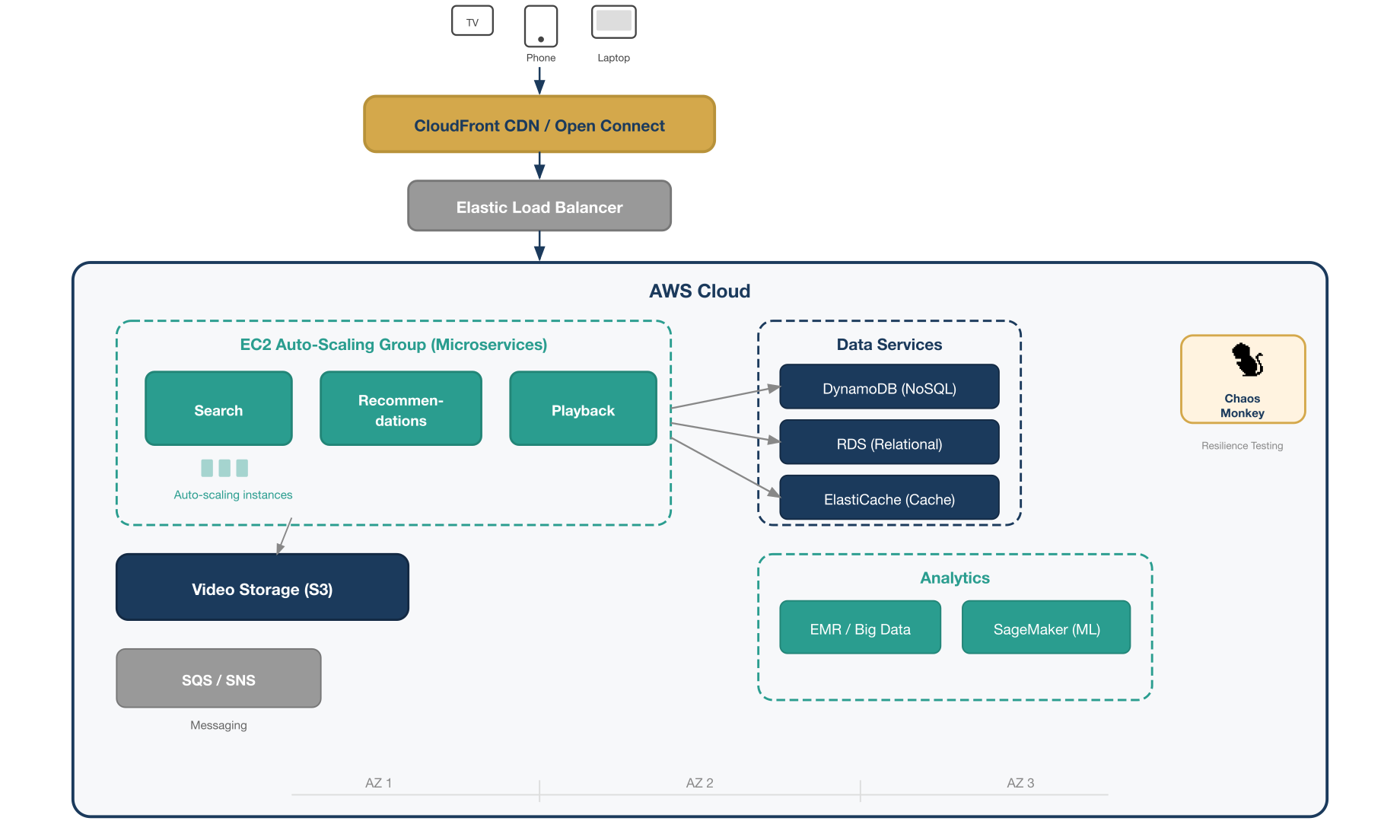
Here in Figure 3.10.1, we have an Architecture diagram showing how Netflix uses multiple AWS services together for streaming, storage, data management, and content delivery. At the top, three device icons representing a TV, Phone, and Laptop connect downward to a gold box labeled 'CloudFront CDN / Open Connect,' which connects to a gray box labeled 'Elastic Load Balancer.' Below is a large rectangle labeled 'AWS Cloud,' spanning three Availability Zones (AZ 1, AZ 2, AZ 3). Inside, a dashed box labeled 'EC2 Auto-Scaling Group (Microservices)' contains three teal service boxes: Search, Recommendations, and Playback, with small icons below indicating auto-scaling instances. These microservices connect to a 'Data Services' group containing DynamoDB (NoSQL), RDS (Relational), and ElastiCache (Cache). Below the microservices, a teal box labeled 'Video Storage (S3)' handles video content, and a gray box labeled 'SQS / SNS' provides messaging. A dashed box labeled 'Analytics' contains EMR / Big Data and SageMaker (ML). Outside the main architecture to the right, an icon labeled 'Chaos Monkey' represents Netflix's resilience testing tool. The diagram illustrates Netflix's end-to-end cloud-native architecture from user devices through content delivery, load balancing, microservices, data storage, and analytics.
Netflix’s microservices architecture on AWS also improved engineering velocity. Individual teams deploy features independently (using AWS automation like AMI baking and deployments through Spinnaker, a Netflix-built deployment tool). AWS’s API-driven approach means everything Netflix does is codified – from launching instances with specific AMIs, to scaling groups, to security group rules – enabling full infrastructure-as-code and continuous deployment. This agility allowed Netflix to push out hundreds of code changes a day, continuously improving the service, a competitive advantage in the fast-moving streaming market.
Reliability and Global Reach: AWS’s global regions also enabled Netflix to expand worldwide quickly. Netflix can deploy its platform in AWS regions closer to users (they primarily use US regions for core services but also have infrastructure in Europe, etc., and use AWS Edge Locations for their content CDN). The combination of multi-region redundancy (cross-region backups and failover) and multi-AZ resilience means Netflix can tolerate even rare events like a whole AWS region outage. In fact, Netflix designs for the possibility that an entire region goes down (using cross-region load balancing to shift users to another region if needed). Such robustness would be prohibitively expensive to do in owned data centers for all but the largest companies.
The takeaway is that Netflix effectively leverages all technical foundations of cloud: elastic compute, software-defined networking (for its complex service interconnects and secure isolation), virtualization (for multi-tenancy on AWS hardware), and cloud-native design (microservices, automation, DevOps) to deliver a highly successful service.
Netflix focused on building unique tools (Chaos Monkey, Eureka, etc.) on top of AWS rather than managing physical infrastructure, effectively operating at a higher level of the value chain.
Snapchat on Google Cloud: Global Scale and Analytics Focus
Snapchat, the multimedia messaging app by Snap Inc., provides another illustrative case of cloud adoption. Snapchat started around 2011 and quickly gained popularity for its ephemeral photo messages among young users. From inception, Snap chose not to build its own data centers but instead host everything on Google Cloud Platform (GCP). This was a notable endorsement for GCP in its early days, and in 2017 Snap deepened the relationship by committing to spend at least $2 billion on Google Cloud services over 5 years – making it one of GCP’s largest customers at the time.
Use of GCP Services:
Compute and Networking: Snapchat’s core application servers run on Google Compute Engine (GCE) instances. Snap uses GCE’s auto-scaling groups to adjust capacity based on user activity. Because social media usage patterns can spike when events happen (or at certain times of day), the ability to automatically scale compute was critical. GCP’s global fiber network also helps Snap deliver content (photos/videos) quickly between regions – a Snap taken in one country can be viewed by a friend across the world with minimal delay.
Storage: Google Cloud Storage (GCS) is used to store the billions of photos and videos (“Snaps”) that users send every day. Even though Snaps are ephemeral for users, Snap Inc. still needs to store them (at least until viewed or for some time) reliably. GCS provides the durability and throughput needed for this object storage. Additionally, Snap leverages Google’s geographically replicated storage to ensure data is durable across multiple data centers.
Data Analytics: Snap’s revenue model heavily involves advertising, which in turn relies on data analytics and personalization. Snap processes millions of data points to personalize content and ads . They use BigQuery, Google’s serverless data warehouse, to analyze user engagement data and ad metrics in near real-time. BigQuery’s ability to run fast SQL queries on huge datasets with no infrastructure to manage is ideal for Snap’s relatively small engineering team to derive insights quickly. Snap can join data like what filters are popular or how users interact with certain features, and feed that into product decisions or targeting algorithms.
Machine Learning: Features like Snapchat’s filters and lenses (augmented reality effects on faces) involve machine learning for facial recognition and tracking. Snap likely uses Google’s machine learning infrastructure (like TensorFlow and maybe Google’s TPUs via Cloud AI Platform) to train these models. In fact, Snap acquired a company that was a heavy TensorFlow user; with GCP, they could use Google’s ML APIs (Vision API, etc.) or train custom models for new AR effects.
Scalability and Performance: Snapchat’s growth meant at times they needed to rapidly scale. By using GCP, Snap could expand to serve over 300 million active users without needing to procure hardware. GCP’s multi-region presence allowed Snap to host services closer to major user bases (North America, Europe, Asia) to reduce latency. For a messaging app, low latency is key to good UX – users expect messages to send/receive in less than a second. Google’s backbone network helps achieve this by connecting Snap’s regional deployments efficiently.
Multi-Cloud Approach: While Google Cloud is Snap’s primary infrastructure, interestingly Snap is not 100% single-cloud. Snap also signed a significant agreement with AWS for some services (around $1 billion commitment). Snap has stated they are multi-cloud for redundancy and to optimize certain workloads. For instance, they might use specific AWS services where they excel, or simply have a backup arrangement. This multi-cloud usage is possible because Snap’s applications are containerized or otherwise designed to be cloud-agnostic to some extent. However, GCP remains the main engine for the bulk of Snapchat’s operations, including daily messaging, Discover content, and ads pipeline.
Outcomes and Reflections: By leaning on GCP, Snap as a relatively small company (in terms of engineering headcount compared to user count) was able to achieve global scale. They did not have to become experts in data center operations; instead they focused on app innovation (new filters, better user experiences). GCP’s ease of use may have also been a factor – Snap CEO Evan Spiegel once mentioned that being on Google Cloud allowed them to move fast with a lean team. Snap’s usage highlights GCP’s strengths: data analytics and machine learning. Snap can crunch enormous datasets for ad personalization or for features (like identifying trends among snaps) using BigQuery and AI APIs, which are services Google leads in.
Snapchat also showcases the cloud economic model: they treat infrastructure largely as an operating expense, tied to usage. In Snapchat’s IPO filings, they noted high cloud infrastructure costs, but also that those costs scale with user engagement (meaning if they spend more on Google Cloud, it’s because they have more users or usage, which correlates with revenue). This variable cost structure is attractive for startups that hope to achieve hypergrowth, because it avoids massive sunk costs. Snap basically outsourced infrastructure scaling risk to Google – if user demand spikes, Google Cloud handles it and Snap just pays for what they use. There is a risk too: heavy dependence on one provider, and large bills (Snap’s cloud costs run in the hundreds of millions per year). Snap manages that risk by multi-cloud strategy and presumably constant optimization (using reserved instance discounts, optimizing code to reduce resource needs, etc.).
From a technical foundation perspective, Snapchat leverages virtualization (their GCE instances and GKE clusters), networking (fast global routes, custom VPCs for internal comms), and cloud-native design (they iterate quickly with new features rolled out likely via containers or continuous integration). A specific example: when Snap introduced Snap Map (a feature showing friends on a map in real-time), that required a scalable geospatial backend. It’s likely they used Google’s cloud APIs for maps or geolocation, combined with a microservice to update and fetch friend locations. They didn’t need to stand up global servers for this – they added it on GCP and were confident it could scale to their user base overnight.
Conclusion from Use Cases: Both Netflix and Snapchat demonstrate how companies can harness the cloud’s technical foundations to deliver highly scalable, resilient services to millions of users. Netflix did it by re-architecting into microservices and exploiting AWS’s breadth of infrastructure and tools. Snapchat did it by starting cloud-native from day one and focusing on product differentiation while relying on GCP’s strengths in data and ML. In both cases, the cloud allowed relatively small teams to operate massive, distributed systems by abstracting away much of the undifferentiated heavy lifting (data center ops, hardware provisioning, low-level network engineering). These real-world stories underscore the importance of the cloud concepts discussed throughout this chapter: multi-tenancy, on-demand scaling, virtualization, distributed networking, and cloud-native design – all working in concert to enable business innovation.
This page titled 3.10: Real-World Use Cases and Case Studies was last modified on Tue, 22 Sep 2026 23:06:26 GMT and is shared under a CC BY 4.0 license and was authored, remixed, and/or curated by Felix Amoruwa.
The book could not be loaded just now.