Opening the book…
Topic 04 covers: 1) Describing a position vector; 2) Determining position vectors from given information; 3) Representing a force directed along a line using a position vector; 4) Calculating the magnitude and coordinate direction angles of the resultant force in 3D using position vectors.
This topic is essential for accurately representing forces in three-dimensional space using the given or measured geometric information.
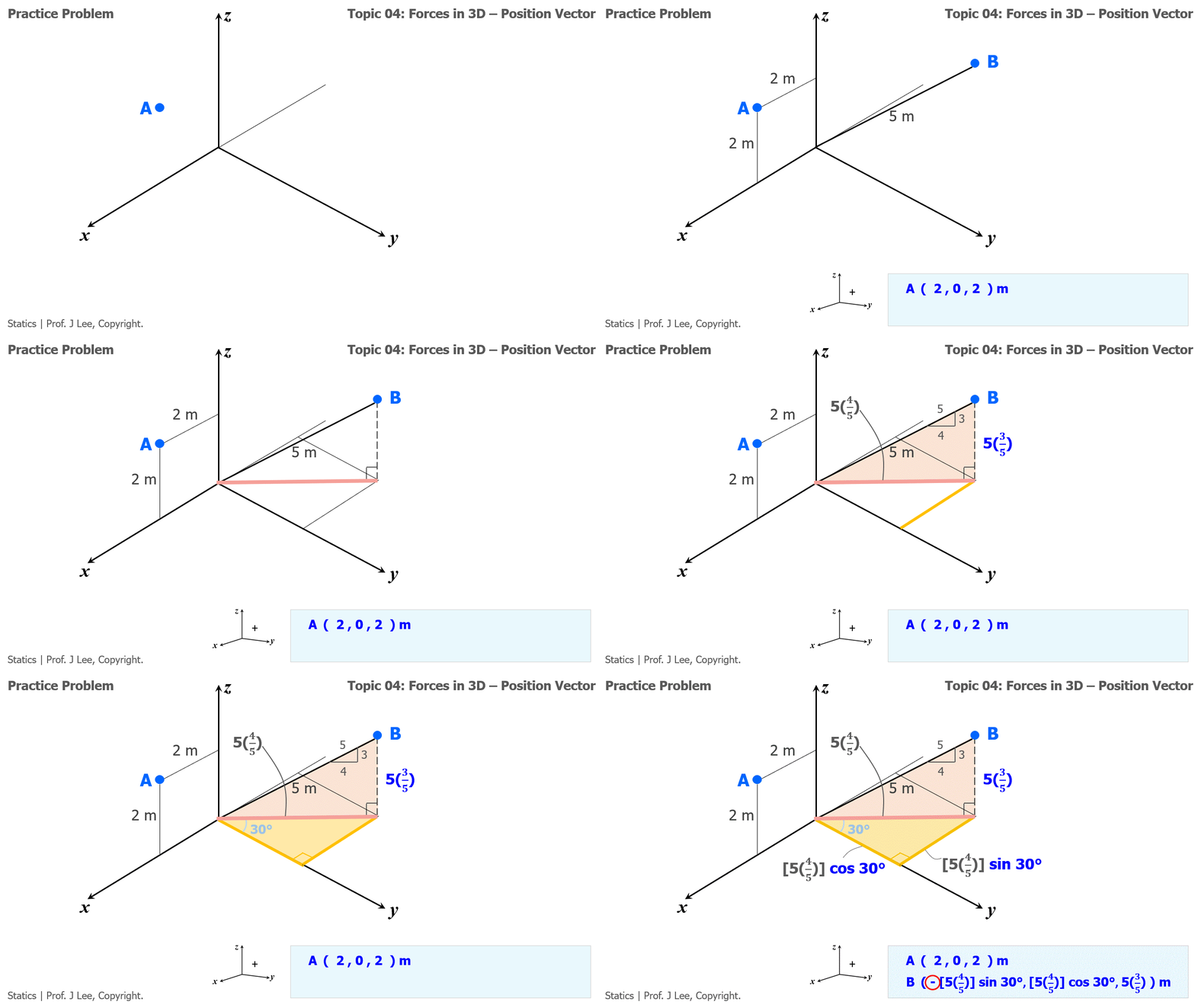
At the end of this topic, an animation is provided to demonstrate how to find the point coordinates using the given information. Additionally, an Extra Sheet is provided for "Fundamental Concepts of Space."


How to find the point coordinates using the given information
Extra Sheet for Fundamental Concepts of Space

This page titled Topic 04. Forces in 3D using Position Vectors was last modified on Wed, 29 Jan 2025 21:57:48 GMT and is shared under a CC BY-NC-SA license and was authored, remixed, and/or curated by JuEun Lee.
The book could not be loaded just now.