Opening the book…
- Chapter 1: The Chemical World
- 1.1: The Scope of Chemistry
- 1.2: Chemicals Compose Ordinary Things
- 1.3: Hypothesis, Theories, and Laws
- 1.4: The Scientific Method: How Chemists Think
- 1.5: A Beginning Chemist: How to Succeed
- Chapter 2: Measurement and Problem Solving
- 2.1: Taking Measurements
- 2.2: Scientific Notation: Writing Large and Small Numbers
- 2.3: Significant Figures: Writing Numbers to Reflect Precision
- 2.4: Significant Figures in Calculations
- 2.5: The Basic Units of Measurement
- 2.6: Problem Solving and Unit Conversions
- 2.7: Solving Multistep Conversion Problems
- 2.8: Units Raised to a Power
- 2.9: Density
- 2.10: Numerical Problem-Solving Strategies and the Solution Map
- 2.E: Measurement and Problem Solving (Exercises)
- Chapter 3: Matter and Energy
- 3.1: In Your Room
- 3.2: What is Matter?
- 3.3: Classifying Matter According to Its State: Solid, Liquid, and Gas
- 3.4: Classifying Matter According to Its Composition
- 3.5: Differences in Matter: Physical and Chemical Properties
- 3.6: Changes in Matter: Physical and Chemical Changes
- 3.7: Conservation of Mass: There is No New Matter
- 3.8: Energy
- 3.9: Energy and Chemical and Physical Change
- 3.10: Temperature: Random Motion of Molecules and Atoms
- 3.11: Temperature Changes: Heat Capacity
- 3.12: Energy and Heat Capacity Calculations
- 3.E: Exercises
- Chapter 4: Atoms and Elements
- 4.1: Experiencing Atoms at Tiburon
- 4.2: Indivisible: The Atomic Theory
- 4.3: The Nuclear Atom
- 4.4: The Properties of Protons, Neutrons, and Electrons
- 4.5: Elements: Defined by Their Numbers of Protons
- 4.6: Looking for Patterns: The Periodic Law and the Periodic Table
- 4.7: Ions: Losing and Gaining Electrons
- 4.8: Isotopes: When the Number of Neutrons Varies
- 4.9: Atomic Mass: The Average Mass of an Element’s Atoms
- Chapter 5: Molecules and Compounds
- 5.1: Sugar and Salt
- 5.2: Compounds Display Constant Composition
- 5.3: Chemical Formulas: How to Represent Compounds
- 5.4: A Molecular View of Elements and Compounds
- 5.5: Writing Formulas for Ionic Compounds
- 5.6: Nomenclature: Naming Compounds
- 5.7: Naming Ionic Compounds
- 5.8: Naming Molecular Compounds
- 5.9: Naming Acids
- 5.10: Nomenclature Summary
- 5.11: Formula Mass: The Mass of a Molecule or Formula Unit
- Chapter 6: Chemical Composition
- 6.1: How Much Sodium?
- 6.2: Counting Nails by the Pound
- 6.3: Counting Atoms by the Gram
- 6.4: Counting Molecules by the Gram
- 6.5: Chemical Formulas as Conversion Factors
- 6.6: Mass Percent Composition of Compounds
- 6.7: Mass Percent Composition from a Chemical Formula
- 6.8: Calculating Empirical Formulas for Compounds
- 6.9: Calculating Molecular Formulas for Compounds
- Chapter 7: Chemical Reactions
- 7.1: Grade School Volcanoes, Automobiles, and Laundry Detergents
- 7.2: Evidence of a Chemical Reaction
- 7.3: The Chemical Equation
- 7.4: How to Write Balanced Chemical Equations
- 7.5: Aqueous Solutions and Solubility: Compounds Dissolved in Water
- 7.6: Precipitation Reactions: Reactions in Aqueous Solution That Form a Solid
- 7.7: Writing Chemical Equations for Reactions in Solution: Molecular, Complete Ionic, and Net Ionic Equations
- 7.8: Acid–Base and Gas Evolution Reactions
- 7.9: Oxidation–Reduction Reactions
- 7.10: Classifying Chemical Reactions
- 7.11: The Activity Series
- Chapter 8: Quantities in Chemical Reactions
- 8.1: Climate Change: Too Much Carbon Dioxide
- 8.2: Stoichiometry
- 8.3: Making Molecules: Mole-to-Mole Conversions
- 8.4: Making Molecules: Mass-to-Mass Conversions
- 8.5: Limiting Reactant, Theoretical Yield, and Percent Yield
- 8.6: Limiting Reactant, Theoretical Yield, and Percent Yield from Initial Masses of Reactants
- 8.7: Enthalpy: A Measure of the Heat Evolved or Absorbed in a Reaction
- Chapter 9: Electrons in Atoms and the Periodic Table
- 9.1: Blimps, Balloons, and Models of the Atom
- 9.2: Light: Electromagnetic Radiation
- 9.3: The Electromagnetic Spectrum
- 9.4: The Bohr Model: Atoms with Orbits
- 9.5: The Quantum-Mechanical Model: Atoms with Orbitals
- 9.6: Quantum-Mechanical Orbitals and Electron Configurations
- 9.7: Electron Configurations and the Periodic Table
- 9.8: The Explanatory Power of the Quantum-Mechanical Model
- 9.9: Periodic Trends: Atomic Size, Ionization Energy, and Metallic Character
- Chapter 10: Chemical Bonding
- 10.1: Bonding Models and AIDS Drugs
- 10.2: Representing Valence Electrons with Dots
- 10.3: Lewis Structures of Ionic Compounds: Electrons Transferred
- 10.4: Covalent Lewis Structures: Electrons Shared
- 10.5: Writing Lewis Structures for Covalent Compounds
- 10.6: Resonance: Equivalent Lewis Structures for the Same Molecule
- 10.7: Predicting the Shapes of Molecules
- 10.8: Electronegativity and Polarity: Why Oil and Water Don’t Mix
- Chapter 11: Gases
- 11.1: Extra-Long Straws
- 11.2: Kinetic Molecular Theory: A Model for Gases
- 11.3: Pressure: The Result of Constant Molecular Collisions
- 11.4: Boyle’s Law: Pressure and Volume
- 11.5: Charles’s Law: Volume and Temperature
- 11.6: Gay-Lussac's Law: Temperature and Pressure
- 11.7: The Combined Gas Law: Pressure, Volume, and Temperature
- 11.8: Avogadro’s Law: Volume and Moles
- 11.9: The Ideal Gas Law: Pressure, Volume, Temperature, and Moles
- 11.10: Mixtures of Gases: Why Deep-Sea Divers Breathe a Mixture of Helium and Oxygen
- 11.11: Gases in Chemical Reactions
- Chapter 12: Liquids, Solids, and Intermolecular Forces
- 12.1: Interactions between Molecules
- 12.2: Properties of Liquids and Solids
- 12.3: Intermolecular Forces in Action: Surface Tension and Viscosity
- 12.4: Evaporation and Condensation
- 12.5: Melting, Freezing, and Sublimation
- 12.6: Types of Intermolecular Forces: Dispersion, Dipole–Dipole, Hydrogen Bonding, and Ion-Dipole
- 12.7: Types of Crystalline Solids: Molecular, Ionic, and Atomic
- 12.8: Water: A Remarkable Molecule
- Chapter 13: Solutions
- 13.1: Prelude - Tragedy in Cameroon
- 13.2: Solutions: Homogeneous Mixtures
- 13.3: Solutions of Solids Dissolved in Water: How to Make Rock Candy
- 13.4: Solutions of Gases in Water: How Soda Pop Gets Its Fizz
- 13.5: Solution Concentration: Mass Percent
- 13.6: Solution Concentration: Molarity
- 13.7: Solution Dilution
- 13.8: Solution Stoichiometry
- 13.9: Freezing Point Depression and Boiling Point Elevation: Making Water Freeze Colder and Boil Hotter
- 13.10: Osmosis: Why Drinking Salt Water Causes Dehydration
- Chapter 14: Acids and Bases
- 14.1: Sour Patch Kids and International Spy Movies
- 14.2: Acids: Properties and Examples
- 14.3: Bases: Properties and Examples
- 14.4: Molecular Definitions of Acids and Bases
- 14.5: Reactions of Acids and Bases
- 14.6: Acid–Base Titration: A Way to Quantify the Amount of Acid or Base in a Solution
- 14.7: Strong and Weak Acids and Bases
- 14.8: Water: Acid and Base in One
- 14.9: The pH and pOH Scales: Ways to Express Acidity and Basicity
- 14.10: Buffers: Solutions That Resist pH Change
- Describe the autoionization of water.
- Calculate the concentrations of \(\ce{H3O^{+}}\) and \(\ce{OH^{−}}\) in aqueous solutions, knowing the other concentration.
We have already seen that \(\ce{H2O}\) can act as an acid or a base:
\[\color{blue}{\underbrace{\ce{NH3}}_{\text{base}}} + \color{red}{\underbrace{\ce{H2O}}_{\text{acid}}} \color{black} \ce{<=> NH4^{+} + OH^{−}} \nonumber \]
where \(\ce{H2O}\) acts as an \(\color{red}{\text{acid}}\) (in red).
\[\color{red}{\underbrace{\ce{HCl}}_{\text{acid}}} + \color{blue}{\underbrace{\ce{H2O}}_{\text{base}}} \color{black} \ce{-> H3O^{+} + Cl^{−}} \nonumber \]
where \(\ce{H2O}\) acts as an \(\color{blue}{\text{base}}\) (in blue).
It may not surprise you to learn, then, that within any given sample of water, some \(\ce{H2O}\) molecules are acting as acids, and other \(\ce{H2O}\) molecules are acting as bases. The chemical equation is as follows:
\[\color{red}{\underbrace{\ce{H2O}}_{\text{acid}}} + \color{blue}{\underbrace{\ce{H2O}}_{\text{base}}} \color{black} \ce{<=> H3O^{+} + OH^{−}} \label{Auto} \]
This occurs only to a very small degree: only about 6 in 108 \(\ce{H2O}\) molecules are participating in this process, which is called the autoionization of water.
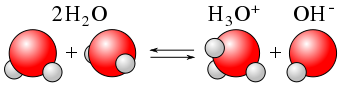
At this level, the concentration of both \(\ce{H3O^{+}(aq)}\) and \(\ce{OH^{−}(aq)}\) in a sample of pure \(\ce{H2O}\) is about \(1.0 \times 10^{−7}\, M\) (at room temperature). If we use square brackets—[ ]—around a dissolved species to imply the molar concentration of that species, we have
\[\color{red}{\ce{[H3O^{+}]}} \color{black}{ = } \color{blue}{\ce{[OH^{-}]}} \color{black} = 1.0 \times 10^{-7} \label{eq5} \]
for any sample of pure water because H2O can act as both an acid and a base. The product of these two concentrations is \(1.0\times 10^{−14}\):
\[\color{red}{\ce{[H3O^{+}]}} \color{black}{\times} \color{blue}{\ce{[OH^{-}]}} \color{black} = (1.0 \times 10^{-7})( 1.0 \times 10^{-7}) = 1.0 \times 10^{-14} \nonumber \]
- For acids, the concentration of \(\ce{H3O^{+}(aq)}\) (i.e., \(\ce{[H3O^{+}]}\)) is greater than \(1.0 \times 10^{−7}\, M\).
- For bases the concentration of \(\ce{OH^{−}(aq)}\) (i.e., \(\ce{[OH^{−}]}\)) is greater than \(1.0 \times 10^{−7}\, M\).
However, the product of the two concentrations—\(\ce{[H3O^{+}][OH^{−}]}\)—is always equal to \(1.0 \times 10^{−14}\), no matter whether the aqueous solution is an acid, a base, or neutral:
\[\color{red}{\ce{[H_3O^+]}} \color{blue}{\ce{[OH^{-}]}} \color{black} = 1.0 \times 10^{-14} \nonumber \]
This value of the product of concentrations is so important for aqueous solutions that it is called the autoionization constant of water and is denoted \(K_w\):
\[K_w = \color{red}{\ce{[H_3O^+]}} \color{blue}{\ce{[OH^{-}]}} \color{black} = 1.0 \times 10^{-14} \label{eq10} \]
This means that if you know \(\ce{[H3O^{+}]}\) for a solution, you can calculate what \(\ce{[OH^{−}]}\)) has to be for the product to equal \(1.0 \times 10^{−14}\); or if you know \(\ce{[OH^{−}]}\)), you can calculate \(\ce{[H3O^{+}]}\). This also implies that as one concentration goes up, the other must go down to compensate so that their product always equals the value of \(K_w\).
The degree of autoionization of water (Equation \ref{Auto})—and hence the value of \(K_w\)—changes with temperature, so Equations \ref{eq5} - \ref{eq10} are accurate only at room temperature.
What is \(\ce{[OH^{−}]}\)) of an aqueous solution if \(\ce{[H3O^{+}]}\) is \(1.0 \times 10^{−4} M\)?
Solution
| Steps for Problem Solving | |
|---|---|
| Identify the "given" information and what the problem is asking you to "find." |
Given: \(\ce{[H3O^{+}]} =1.0 \times 10^{−4}\, M\) Find: [OH−] = ? M |
| List other known quantities. | none |
| Plan the problem. |
Using the expression for \(K_w\), (Equation \ref{eq10}), rearrange the equation algebraically to solve for [OH−]. \[\left [ \ce{OH^{-}} \right ]=\dfrac{1.0\times 10^{-14}}{\left [ H_3O^+ \right ]} \nonumber \] |
| Calculate. |
Now substitute the known quantities into the equation and solve. \[\left [\ce{ OH^{-}} \right ]=\dfrac{1.0\times 10^{-14}}{1.0\times 10^{-4}}=1.0\times 10^{-10}M\nonumber \] It is assumed that the concentration unit is molarity, so \(\ce{[OH^{−}]}\) is 1.0 × 10⁻¹⁰ M. |
| Think about your result. | The concentration of the acid is high (> 1 x 10⁻⁷ M), so \(\ce{[OH^{−}]}\) should be low. |
What is \(\ce{[OH^{−}]}\) in a 0.00032 M solution of H2SO4?
- Hint
-
Assume both protons ionize from the molecule...although this is not the case.
- Answer
- \(3.1 \times 10^{−11}\, M\)
When you have a solution of a particular acid or base, you need to look at the formula of the acid or base to determine the number of H3O+ or OH− ions in the formula unit because \(\ce{[H_3O^{+}]}\) or \(\ce{[OH^{−}]}\)) may not be the same as the concentration of the acid or base itself.
What is \(\ce{[H_3O^{+}]}\) in a 0.0044 M solution of \(\ce{Ca(OH)_2}\)?
Solution
| Steps for Problem Solving | |
|---|---|
| Identify the "given" information and what the problem is asking you to "find." |
Given: \([\ce{Ca(OH)_2}] =0.0044 \,M\) Find: \(\ce{[H_3O^{+}]}\) = ? M |
| List other known quantities. |
We begin by determining \(\ce{[OH^{−}]}\). The concentration of the solute is 0.0044 M, but because \(\ce{Ca(OH)_2}\) is a strong base, there are two OH− ions in solution for every formula unit dissolved, so the actual \(\ce{[OH^{−}]}\) is two times this: \[\ce{[OH^{−}] = 2 \times 0.0044\, M = 0.0088 \,M.} \nonumber \] |
| Plan the problem. |
Use the expression for \(K_w\) (Equation \ref{eq10}) and rearrange the equation algebraically to solve for \(\ce{[H_3O^{+}]}\). \[\left [ H_3O^{+} \right ]=\dfrac{1.0\times 10^{-14}}{\left [ OH^{-} \right ]} \nonumber \] |
| Calculate. |
Now substitute the known quantities into the equation and solve. \[\left [ H_3O^{+} \right ]=\dfrac{1.0\times 10^{-14}}{(0.0088)}=1.1\times 10^{-12}M \nonumber \] \(\ce{[H_3O^{+}]}\) has decreased significantly in this basic solution. |
| Think about your result. | The concentration of the base is high (> 1 x 10⁻⁷ M) so \(\ce{[H_3O^+}]}\) should be low. |
What is \(\ce{[H_3O^{+}]}\) of an aqueous solution if \(\ce{[OH^{−}]}\) is \(1.0 \times 10^{−9}\, M\)?
- Answer
- 1.0 × 10⁻⁵ M
In any aqueous solution, the product of \(\ce{[H_3O^{+}]}\) and \(\ce{[OH^{−}]}\) equals \(1.0 \times 10^{−14}\) (at room temperature).
Contributions & Attributions
14.8: Water- Acid and Base in One is shared under a CC BY-NC-SA 4.0 license and was authored, remixed, and/or curated by LibreTexts.
The book could not be loaded just now.