Opening the book…
Many important reactions of carboxylic acids involve attack on the carbon of the carbonyl group by nucleophilic species. These reactions frequently are catalyzed by acids, because addition of a proton or formation of a hydrogen bond to the carbonyl oxygen makes the carbonyl carbon more vulnerable to nucleophilic attack. The following equations illustrate how an acid-catalyzed reaction operates with a neutral nucleophile (H−Nu)(H−Nu):
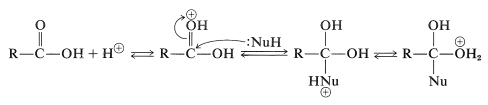
Subsequent cleavage of a C−OC−O bond and loss of a proton yields a displacement product:
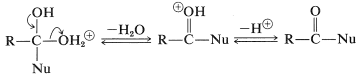
An important example of this type of reaction is the formation of esters, which was discussed previously in connection with the reactions of alcohols in Section 15-4D. Similar addition-elimination mechanisms occur in many reactions at the carbonyl groups of acid derivatives. A less obvious example of addition to carboxyl groups involves hydride ion (H⊖)(H⊖) and takes place in lithium aluminum hydride reduction of carboxylic acids (Sections 16-4E and 18-3C).
21.6: Introduction to Carboxylic Acid Derivatives is shared under a CC BY-NC-SA 4.0 license and was authored, remixed, and/or curated by LibreTexts.
The book could not be loaded just now.