Opening the book…
Glycol Cleavage
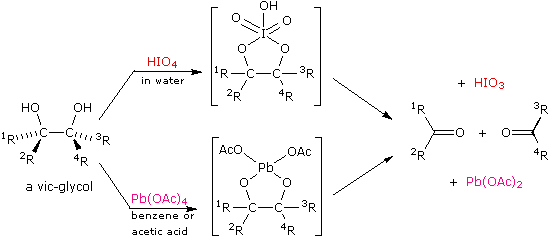
The vicinal glycols prepared by alkene hydroxylation (reaction with osmium tetroxide or permanganate) are cleaved to aldehydes and ketones in high yield by the action of lead tetraacetate (Pb(OAc)4) or periodic acid (HIO4). This oxidative cleavage of a carbon-carbon single bond provides a two-step, high-yield alternative to ozonolysis, that is often preferred for small scale work involving precious compounds. A general equation for these oxidations is shown below. As a rule, cis-glycols react more rapidly than trans-glycols, and there is evidence for the intermediacy of heterocyclic intermediates (as shown), although their formation is not necessary for reaction to occur.
Exercise
15. Predict the product of the reaction below.
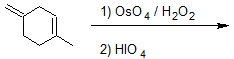
- Answer
-
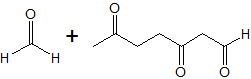
15.
Contributors and Attributions
William Reusch, Professor Emeritus (Michigan State U.), Virtual Textbook of Organic Chemistry
14.9: Cleavage of Diols is shared under a CC BY-NC-SA 4.0 license and was authored, remixed, and/or curated by LibreTexts.
The book could not be loaded just now.