Opening the book…
The 100 Year Mystery of Benzene
It took humans over 100 years to determine and confirm the structure of benzene. Why did it take so long? Why was there such a curiosity? The 1:1 ratio of carbon to hydrogen in the empirical formula and low chemical reactivity of benzene were a paradox to chemists in the early 1800's.
In 1825, Michael Faraday isolated an oily residue of gas lamps. Faraday called this liquid "bicarburet of hydrogen" and measured the boiling point to be 80°C. Additionally, Faraday determined the empirical formula to be CH. About nine years later, Eilhard Mitscherlich synthesized the same compound from benzoic acid and lime (CaO).
During the mid to late 1800's, several possible structures (shown below) were proposed for benzene.
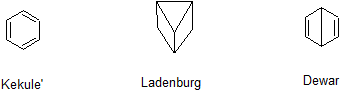
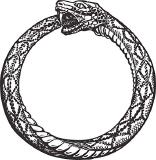
It was not until the 1930's that Kekule's structure was confirmed by X-ray and electron diffraction. During the end of Kekule's career he revealed that the structure came to him in a vision after enjoying a glass or two of wine by the fire in his favorite chair. His inspiration for the structure of benzene was derived from an ouroboros in the flames.
17.1: Introduction- The Discovery of Benzene is shared under a CC BY-NC-SA 4.0 license and was authored, remixed, and/or curated by LibreTexts.
The book could not be loaded just now.