Opening the book…
Perhaps one of the most spectacular chemical reactions involving a gas occurred on May 6, 1937, when the German airship Hindenburg exploded on approach to the Naval Air Station in Lakehurst, New Jersey. The actual cause of the explosion is still unknown, but the entire volume of hydrogen gas used to float the airship, about 200,000 m3, burned in less than one minute. Thirty-six people, including one on the ground, were killed. Hydrogen is the lightest known gas. Any balloon filled with hydrogen gas will float in air if its mass is not too great. This makes hydrogen an obvious choice for flying machines based on balloons—airships, dirigibles, and blimps.
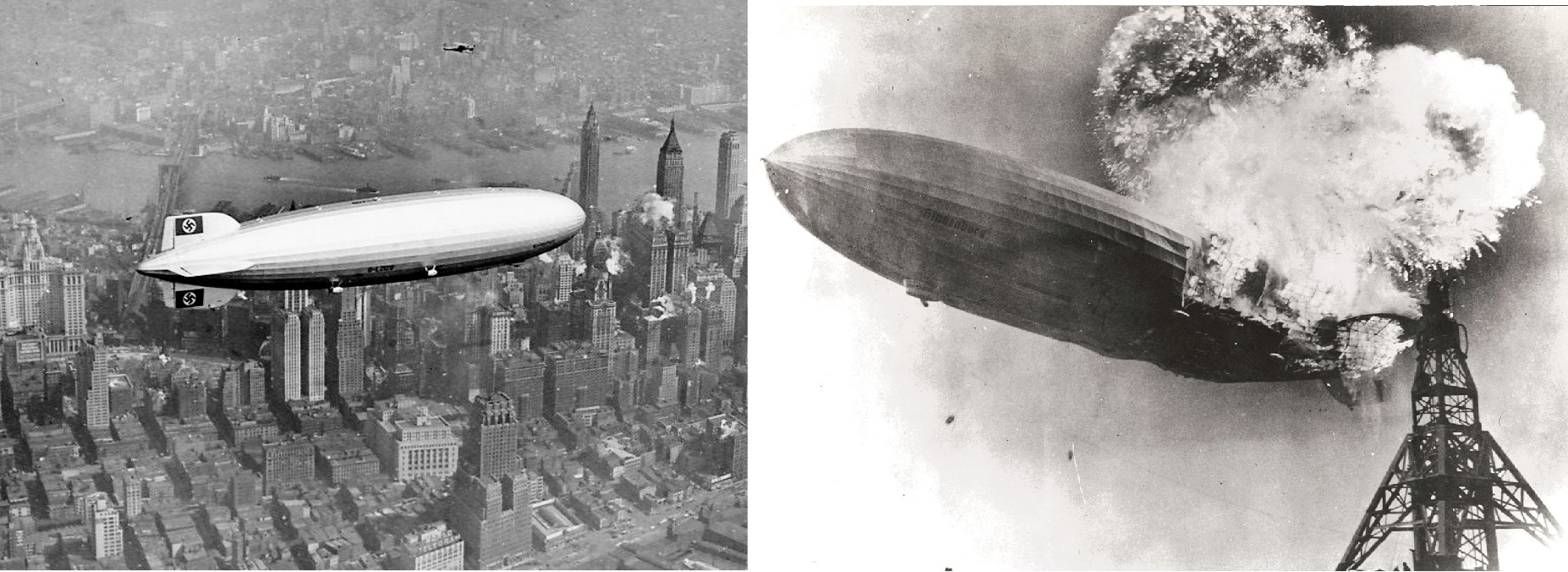
The German airship Hindenburg (left) was one of the largest airships ever built. However, it was filled with hydrogen gas and exploded in Lakehurst, New Jersey, at the end of a transatlantic voyage in May 1937 (right).
However, hydrogen also has one obvious drawback—it burns in air according to the well-known chemical equation:
\[\ce{2H_2(g) + O_2(g) → 2H_2O(ℓ)}\nonumber \]
So although hydrogen is an obvious choice, it is also a dangerous choice. Helium gas is also lighter than air and has 92% of the lifting power of hydrogen. Why, then, was helium not used in the Hindenburg? In the 1930s, helium was much more expensive. In addition, the best source of helium at the time was the United States, which banned helium exports to pre–World War II Germany. Today all airships use helium, a legacy of the Hindenburg disaster.
This page titled 6.1: Prelude to Gases was last modified on Fri, 23 Sep 2022 17:44:38 GMT and is shared under a CC BY-NC-SA 3.0 license and was authored, remixed, and/or curated by Staff via source content that was edited to the style and standards of the LibreTexts platform.
The book could not be loaded just now.