Opening the book…
Before getting to the main subject of this chapter—the reactions of alkenes—let’s take a brief look at how alkenes are prepared. The subject is a bit complex, though, so we’ll return to it later for a more detailed study. For the present, it’s enough to realize that alkenes are readily available from simple precursors—usually alcohols in biological systems and either alcohols or alkyl halides in the laboratory.
Just as the chemistry of alkenes is dominated by addition reactions, the preparation of alkenes is dominated by elimination reactions. Additions and eliminations are, in many respects, two sides of the same coin. That is, an addition reaction might involve the addition of HBr or H2O to an alkene to form an alkyl halide or alcohol, whereas an elimination reaction might involve the loss of HBr or H2O from an alkyl halide or alcohol to form an alkene.
The two most common elimination reactions are dehydrohalogenation—the loss of HX from an alkyl halide—and dehydration—the loss of water from an alcohol. Dehydrohalogenation usually occurs by reaction of an alkyl halide with strong base such as potassium hydroxide. For example, bromocyclohexane yields cyclohexene when treated with KOH in ethanol solution.
Dehydration is often carried out in the laboratory by treatment of an alcohol with a strong acid. For example, when 1-methylcyclohexanol is warmed with aqueous sulfuric acid in tetrahydrofuran (THF) solvent, loss of water occurs and 1-methylcyclohexene is formed.
In biological pathways, dehydrations rarely occur with isolated alcohols. Instead, they normally take place on substrates in which the −OH is positioned two carbons away from a group. In the biosynthesis of fats, for instance, β-hydroxybutyryl ACP is converted by dehydration to trans-crotonyl ACP, where ACP is an abbreviation for acyl carrier protein. We’ll see the reason for this requirement in Section 11.11.
One problem with elimination reactions is that mixtures of products are often formed. For example, treatment of 2-bromo-2-methylbutane with KOH in ethanol yields a mixture of two alkene products. What are their likely structures?
- Answer
-
2-Methyl-2-butene and 2-methyl-1-butene.
How many alkene products, including E,Z isomers, might be obtained by dehydration of 3-methyl-3-hexanol with aqueous sulfuric acid?
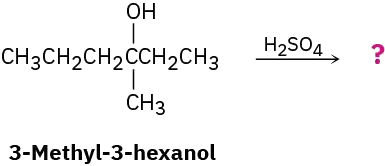
- Answer
-
Five.
This page titled 9.2: Preparation of Alkenes - A Preview of Elimination Reactions was last modified on Thu, 14 May 2026 21:02:02 GMT and is shared under a CC BY-NC-SA 4.0 license and was authored, remixed, and/or curated by OpenStax via source content that was edited to the style and standards of the LibreTexts platform.
The book could not be loaded just now.