Opening the book…
Introduction to stereochemistry
Stereochemistry is the study of the three-dimensional arrangement of atoms in molecules and their effects on the physical and chemical properties.
A major area of stereochemistry is the study of isomers.
Isomers
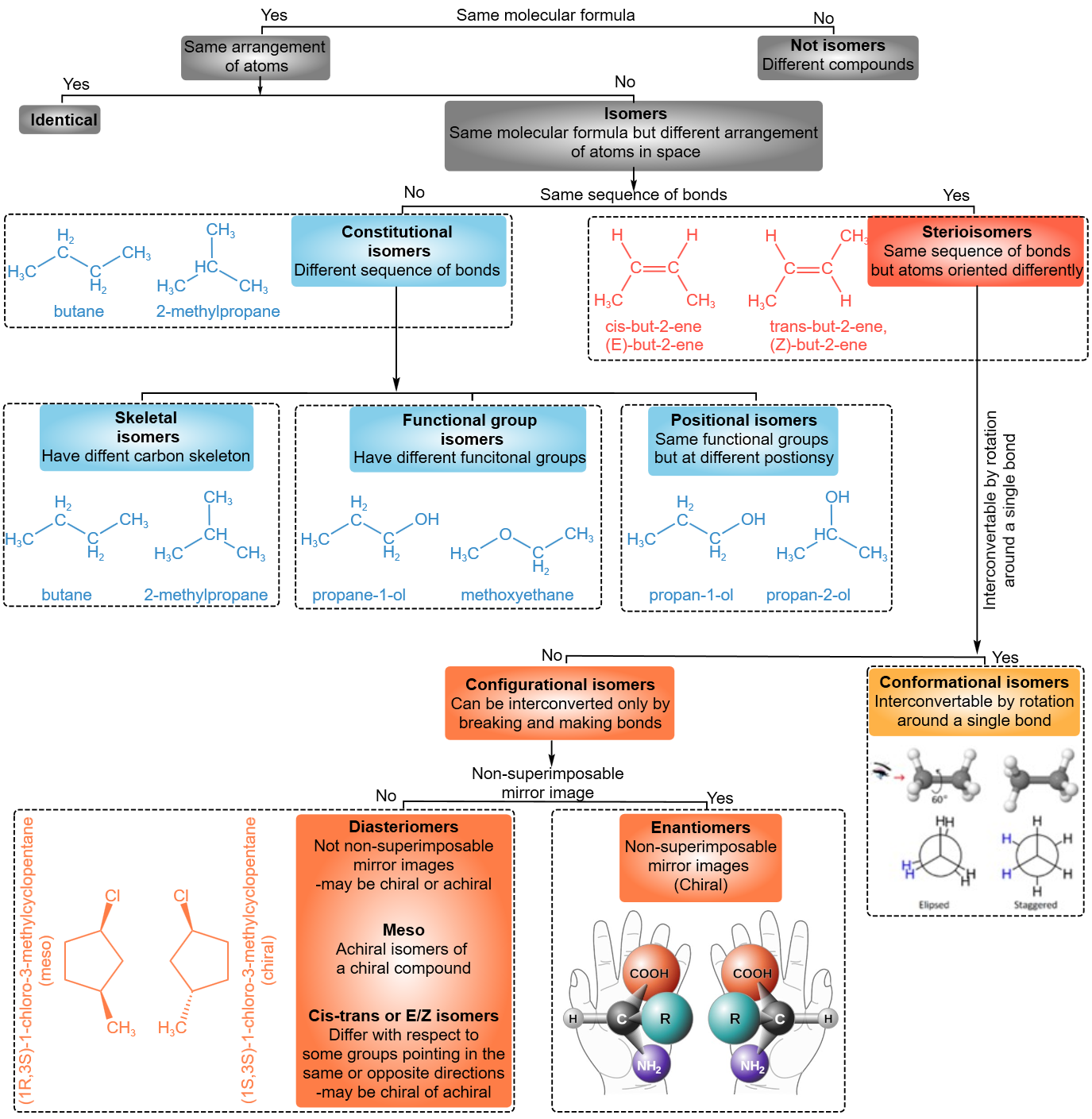
Isomers are species that have the same molecular formula, but the atoms in them are arranged differently in space.
Two major classes of isomers are constitutional isomers, in which the atoms are connected differently, and stereoisomers, in which the connectivity of the atoms is the same, but they are oriented differently in space. For example, ethanol \(\ce{H-\overset{\overset{\Huge{\ce{H}}}|}{\underset{\underset{\Huge{\ce{H}}}|}{C}}-\overset{\overset{\Huge{\ce{H}}}|}{\underset{\underset{\Huge{\ce{H}}}|}{C}}-\overset{\!\Large\:\cdot\:\!\cdot}{\underset{\!\Large\:\cdot\:\!\cdot}{O}}-H}\) and diethyl ether \(\ce{H-\overset{\overset{\Huge{\ce{H}}}|}{\underset{\underset{\Huge{\ce{H}}}|}{C}}-\overset{\!\Large\:\cdot\:\!\cdot}{\underset{\Large\:\cdot\:\!\cdot}{O}}-\overset{\overset{\Huge{\ce{H}}}|}{\underset{\underset{\Huge{\ce{H}}}|}{C}}-H}\) are costitutional isomers becuase they have the same forumula \(\ce{C2H6O}\) but their atoms aer connected differently. 
 On the other hand, the structures shown on the left and right margins are stereoisomers because they have the same molecular formula (\(\ce{C4H8}\)), the same atom connectivity, but the atoms are oriented differently in space.
Both constitutional isomers and stereoisomers have subclasses that are illustrated in Figure \(\PageIndex{1}\) and described in the following sections.
Constitutional isomers
Constitutional isomers, i.e., the isomers in which atoms are connected differently, have three major subclasses: skeletal isomers, functional group isomers, and positional isomers. These are described below.
Skeletal isomers

 Skeletal isomers, also called chain isomers, are constitutional isomers that differ primarily in the carbon backbone or the skeleton. Up to three \(\ce{C}\) atoms can be connected to give one alkane, methane, ethane, and propane, respectively, but four \(\ce{C's}\) can be arranged in two different ways with single bonds to yield butane or 2-methylpropane, as shown in the strutures on the right margin. The number of possible ways of arranging \(\ce{C's}\) in the backbone of alkanes increases exponentially as the number of \(\ce{C}\) atoms increases, as shown in Table \(\PageIndex{1}\). For example, six \(\ce{C's}\) can be arranged in five ways to yield five alkane isomers, as shown in Figure \(\PageIndex{2}\).
| Alkane: | Propane | Butane | Pentane | Hexane | Heptane | Octane | Nonane | Decane | Pentadecane | Eicosane | pentacosane |
| Molecular formula: | \(\ce{C3H8}\) | \(\ce{C4H10}\) | \(\ce{C5H12}\) | \(\ce{C6H14}\) | \(\ce{C7H16}\) | \(\ce{C8H16}\) | \(\ce{C9H20}\) | \(\ce{C10H22}\) | \(\ce{C15H32}\) | \(\ce{C20H42}\) | \(\ce{C25H52}\) |
| Number of constitutinal isomers: | 1 | 2 | 3 | 5 | 9 | 18 | 35 | 75 | 4,347 | 366,319 | 36,797,588 |
 hexae
 2-methylpentane
 3-methylpentane
 2,2-dimethylbutane
 2,3-dimethylbutane
Functional group isomers
Functional group isomers are constitutional isomers that differ in their functional groups. For example, propanal \(\ce{ H-\overset{\overset{\Huge{\ce{H}}}|}{\underset{\underset{\Huge{\ce{H}}}|}{C}}-\overset{\overset{\Huge{\ce{H}}}|}{\underset{\underset{\Huge{\ce{H}}}|}{C}}-\overset{\!\!\overset{\Huge {\:\ce{O}}}|\!\!|\,}{C}-H}\) having an aldehyde \(\ce{ R-\overset{\!\!\overset{\Huge{\:\ce{O}}}|\!\!|\,}{C}-H}\) functional group is a functional group isomer of propanone \(\ce{ H-\overset{\overset{\Huge{\ce{H}}}|}{\underset{\underset{\Huge{\ce{H}}}|}{C}}-\overset{\!\!\overset{\Huge{\:\ce{O}}}|\!\!|\,}{C}-\overset{\overset{\Huge{\ce{H}}}|}{\underset{\underset{\Huge{\ce{H}}}|}{C}}-H}\) that has a ketone \(\ce{ R-\overset{\!\!\overset{\Huge {\:\ce{O}}}|\!\!|\,}{C}-R'}\) functional group. Another example is ethanol \(\ce{H-\overset{\overset{\Huge{\ce{H}}}|}{\underset{\underset{\Huge{\ce{H}}}|}{C}}-\overset{\overset{\Huge{\ce{H}}}|}{\underset{\underset{\Huge{\ce{H}}}|}{C}}-{O}-H}\) that has an alcohol \(\ce{-OH}\) functional group is a functional group isomer of diethyl ether \(\ce{H-\overset{\overset{\Huge{\ce{H}}}|}{\underset{\underset{\Huge{\ce{H}}}|}{C}}-{O}-\overset{\overset{\Huge{\ce{H}}}|}{\underset{\underset{\Huge{\ce{H}}}|}{C}}-H}\) that has an ether \(\ce{R-O-R'}\) functional group.
Positional isomers
Positional isomers are constitutional isomers that differ in the position of a functional group or a substituent within the skeleton of the compound. For example, Figure \(\PageIndex{3}\) shows four positional isomers of compounds having formula \(\ce{C5H12O}\) that differ in the position of the alcohol \(\ce{-OH}\) group on the skeleton of the compound.
 3-methylbutan-1-ol, a primary alcohol
 3-methylbutan-2-ol, a secondary alcohol
 2-methylbutan-2-ol, a tertiary alcohol
 2-methylbutan-1-ol, a primary alcohol
Comparing the properties of constitutional isomers
Constitutional isomers are different compounds with different physical and chemical properties.
For example, melting point (mp) and boiling point (bp) of propanal (\(\ce{CH3-CH2-\overset{\!\!\overset{\Huge {\:\ce{O}}}|\!\!|\,}{C}-H}\), mp -81 oC, bp 48 oC) are significantly different from its functional group isomer propanone (\(\ce{CH3-\overset{\!\!\overset{\Huge {\:\ce{O}}}|\!\!|\,}{C}-CH3}\), mp -95 oC, bp 56 oC).
Both aldehydes and ketones have a set of common chemical reactions due to common carbonyl \(\ce{-\overset{\!\!\overset{\Huge {\:\ce{O}}}|\!\!|\,}{C}-}\) group in them, but \(\ce{H}\) on the carbonyl \(\ce{C}\) of an aldehyde \(\ce{R-\overset{\!\!\overset{\Huge {\:\ce{O}}}|\!\!|\,}{C}-H}\) makes it a different funtional group with a different set of chemical reactions than ketones \(\ce{R-\overset{\!\!\overset{\Huge {\:\ce{O}}}|\!\!|\,}{C}-R'}\). For example, aldehydes \(\ce{R-COH}\) are oxidized into carboxylic acids \(\ce{R-COOH}\) by several oxidizing agnet, while ketones \(\ce{R-\overset{\!\!\overset{\Huge {\:\ce{O}}}|\!\!|\,}{C}-R'}\) usually do not. This property is used in the silver mirror test to distinguish between aldehydes and ketones. In the silver mirror test, Tollens' reagent \(\ce{Ag(NH3)2OH}\) is added to an aldehyde or a ketone in a test tube. The reagent oxidizes aldehydes at the cost of reducing silver ion \(\ce{Ag^+}\) into solid silver \(\ce{Ag}\) that deposits on the inner walls of the test tube as a silver mirror, by the following general reaction.
\[\ce{2[Ag(NH3)2]^{+} + R-CHO + H2O -> 2Ag(s) + 4NH3 + R-COOH + 2H^{+}}\nonumber\]
 The silver mirror test will be positive for propanal because it is an aldehyde, as illustrated in the test tube on the left side in the figure on the right margin (Copyright; FK1954, Public domain, via Wikimedia Commons). However, it will be negative for its functional group isomer, propanone, because the latter is a ketone, as illustrated in the test tube on the right side in the figure on the right margin.
 The difference in physical and chemical properties is not limited to functional group isomers; it applies to all constitutive isomers. Functional groups have a characteristic set of chemical properties, but they are typically affected, usually in a predictable manner, by the environment surrounding the group. For example, alcohol group \(\ce{-OH}\) can be substituted by chloride \(\ce{-Cl}\), but under different conditions for primary, secondary, and tertiary alcohols. This reaction can be monitored without any instrument for small alcohols \(\ce{R-OH}\) that are soluble in water, because the product alkyl halide \(\ce{R-Cl}\) is water insoluble, making the solution turbid. Lucas test uses the reagent \(\ce{ZnCl2}\) in concentrated \(\ce{HCl}\), to distinguish between primary, secondary, and tertiary alcohols, based on the following reaction.
\[\ce{R-OH + HCl ->[\ce{ZnCl2}][\Delta] R-Cl + H2O}\nonumber\]
The solution in the Lucas test becomes turbid almost immediately for tertiary alcohols, becomes turbid after about five minutes for secondary alcohols, and stays clear for primary alcohols, except when heated. The figure on the left margin illustrates a Lucas test negative in the test tube on the left and positive, making the solution turbid in the test tube on the right (Copyright: Talos & Andel, CC BY-SA 3.0, via Wikimedia Commons). Table \(\PageIndex{4}\) compares some physical and chemical properties of alcohol positional isomers having formula \(\ce{C5H12O}\).
| Structure: | |
|
|
|
| IUPAC name: | 3bnmethylbutan-1-ol | 3-methylbutan-2-ol | 2-methylbutan-2-ol | 2-methylbutan-1-ol |
| Classification (primary, secondary, or tertiary) | primary | secondary | tertiary | primary |
| Physical properties (mp, bp): | mp 117 oC, bp 131.1 oC | mp 117 oC, bp 131.1 oC | mp 117 oC, bp 131.1 oC | mp 117 oC, bp 131.1 oC |
| Chemical property (Lucas test): | Will not respond without heating | Positive test in about five minutes | Positive test almost immediately | Will not respond without heating |
The difference in chemical properties is not limited to isomers of functional group-containing compounds, but it applies to almost all constitutional isomers. For example, skeletal isomers of alkanes that lack functional groups, but still exhibit distinct physical and chemical properties. Alkanes are relatively inert in chemical reactions due to the absence of functional groups; however, they do undergo some chemical reactions. They are found in petroleum and their primary use is as fuels, i.e., combustion.

 Octane rating is a measure of the performance of gasoline in an internal combustion engine -the higher the number, the better the fuel burns. The structure shown on the left margin is 2,2,4-Trimethylpentane (mp -107.4 oC, bp 99.3 oC) that has an octane number of 100, while its skeletal isomer, octane (mp -57.4 oC, bp 125.6 oC, shown on the right margin), has an octane number of -15. This data shows a significant difference in both physical and chemical properties of these skeletal isomers of alkanes.
 The combustion reaction of hexane is shown below, where \(\Delta \text H^{\circ}\) is the change in enthalpy (heat released) when 1 mol of hexane is completely burned in oxygen.
 \(\ce{ + 9\frac{1}{2}O2 -> 6CO2 + 7H2O \;\;\;\Delta H^{\circ} = 4163 kj/mol}\)
When the same reaction is repeated with its branched isomer 2-methyl pentane, the \(\Delta \text H ^ {\circ}\) is 5 kJ/mol less, and with more branched isomer 2,2-dimethylbutane, the \(\Delta \text H ^ {\circ}\) is 9 kJ/mol less, as shown in the reaction equations below.
 \(\ce{ + 9\frac{1}{2}O2 -> 6CO2 + 7H2O \;\;\;\Delta H^{\circ} = 4158 kj/mol}\)
 \(\ce{ + 9\frac{1}{2}O2 -> 6CO2 + 7H2O \;\;\;\Delta H^{\circ} = 4154 kj/mol}\)
Since the products in the three cases are exact same, the differences in \(\Delta \text H ^ {\circ}\) allows estimating relative stability of the isomers, i.e., 2-methylpentane is five kJ/mol more stable than hexane and 2,2-dimethylbutane is nine kJ/mol more stable than hexane. In general, the more branched isomers of alkane are more stable, as illustrated in the figure on the right margin (Copyright; public domain).
The purpose of the above discussion is to highlight the importance of understanding the structural features of organic compounds being described in these early chapters. It will help in understanding the characteristic reactions of functional groups and how they are affected predictably by their environment and by the stability of the species involved.
Stereoisomers

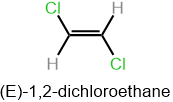 Stereoisomers are the isomers that have the same sequence of bonds, but the atoms or groups of atoms are oriented differently in space.
For example, the two structures of 1,2-dichloroethane shown on the right margin are stereoisomers differing in the orientation of \(\ce{-H}\) and \(\ce{-Cl}\) substituents around the \(\ce{C=C}\) bond. The (E) and (Z) in the names are stereodescriptors that will be explained in a later section. There are two major classes of stereoisomers: conformational isomers and configurational isomers, which are briefly described next and further detailed later.
Conformational isomers
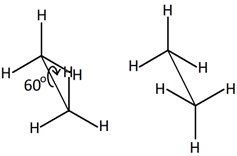
 Conformations are different structures of the same molecule that result from rotation around single bonds.
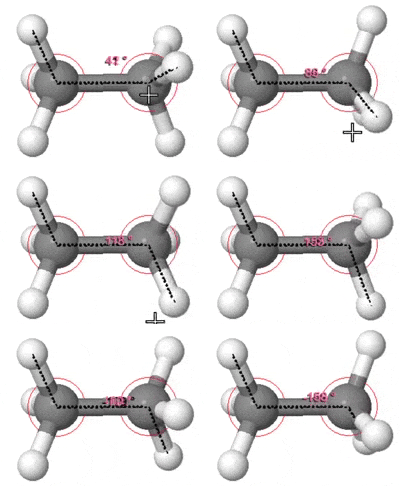
For example, the two structures shown on the left margin (copyright: public domain) are conformations of ethane \(\ce{CH3-CH3}\) in which three \(\ce{H}\) atoms on one \(\ce{C}\) are oriented differently relative to three \(\ce{H}\) atoms on the other \(\ce{C}\). It is a result of \(60^\circ\) rotation around \(\ce{C-C}\) bond. Figure on the right margin (prepared by using Chemagic, copyright: public domain) demonstrates rotation around \(\ce{C-C}\) bond of ethane.
All conformers of the same compound are not equal in energy, and there are energy barriers for interconversion; however, the energy barriers are usually low, allowing the conformations to interconvert rapidly at room temperature.
Different conformations that exist at distinct potential energy minima are called conformational isomers or conformers.

 For example, the two conformations of butane shown on the right margin are conformational isomers because they exist at distinct potential energy minima. The two structures of ethane shown before are not conformational isomers, because ethane has only one potential energy minimum; the other structure exists at the energy maximum. The study of the energetics of bond rotations, resulting in the formation of conformers, is referred to as conformational analysis. Conformational analysis helps to understand the mechanisms, outcomes, and rates of certain reactions, as well as to assess the medical effects of drugs.
The term "conformational isomer" is introduced here, without a full explanation, to complete the listing of isomer types. However, it will be explained in a later section during the description of the conformational analysis of ethane, butane, and cycloalkanes.
Configurational isomers
Configurational isomers are stereoisomers that can be interconnected only by breaking and making some bonds.

 For example, (E)-butan-2-ene and (Z)-butane-2-ene, shown on the right margin, are configurational isomers of butan-2-ene in which \(\ce{-H}\) and \(\ce{-CH3}\) substituents are oriented differently. The (E) and (Z) are stereodescriptors that are described later. Unlike conformational isomers, which are different structures of the same molecule that exist in equilibrium with each other, configurational isomers are different compounds that can be separated. The specific arrangement of atoms in each configurational isomer is called its configuration. The configuration is defined by stereodescriptors in UPAC nomenclature, which is described later.
There are two major classes of configurational isomers: enantiomers and diastereomers.
 Enantiomers are stereoisomers that are related as nonsuperimposable mirror images of each other.
For example, D-glyceraldehyde and L-glyceraldehyde, shown on the right margin, are enantiomers because they are stereoisomers that are nonsuperimposable mirror images of each other. D and L in the names of glyceraldehyde are stereodescriptors that are described later.
Diastereomers are stereoisomers that are not enantiomers.
For example, (E)-butan-2-ene and (Z)-butan-2-ene, shown above, are not enantiomers; i.e., they are not nonsuperimposable mirror images of each other. In other words, stereoisomers are either enantiomers when they are related as nonsuperimposable mirror images of each other, or they are diastereomers when they are not nonsuperimposable images of each other. Every molecule has its mirror image, but when the molecule and its mirror image are superimposable on each other, they are called identical, i.e., they are the same compound, just rotated by 180\(^\circ\). The following section provides a detailed explanation of configurational isomers.
This page titled 3.1: Introduction to stereochemistry was last modified on Tue, 18 Aug 2026 12:59:30 GMT and is shared under a Public Domain license and was authored, remixed, and/or curated by Muhammad Arif Malik.
The book could not be loaded just now.