Opening the book…
Chirality in nature
 A large number of compounds in living things are chiral. For example, amino acids, which are the building blocks of proteins and carbohydrates, are chiral. Macromolecules, such as proteins and nucleic acids, are also chiral. Chirality is also observed on a macro-scale, e.g., our hands, feet, and ears are chiral. Similarly, horns and spots in deer, as shown in Figure \(\PageIndex{1}\).
Stereospecific reactions in living things
Chiral objects have the same physical properties except when they interact with another chiral object, where the interaction is enantiomorph-selective. For example, an achiral tennis ball fits equally in the right-hand and left-hand gloves, but a chiral left-hand glove fits only on the left hand, and a right-hand glove fits only on the right hand. Similarly, chemical reactions of enantiomers are the same with achiral reagents, but stereospecific with chiral reagents.
Most chemical reactions in living organisms are stereospecific, meaning that one stereoisomer selectively reacts and one is selectively produced.
For example, the human digestion enzyme chymotrypsin has 268 chiral centers and 2268 possible stereoisomers, but only one isomer is produced in the human body. The enzyme-catalyzed reactions are often stereospecific because their binding sites are chiral, and only one enantiomer fits in them nicely for the reaction, as illustrated in Figure \(\PageIndex{1}\).
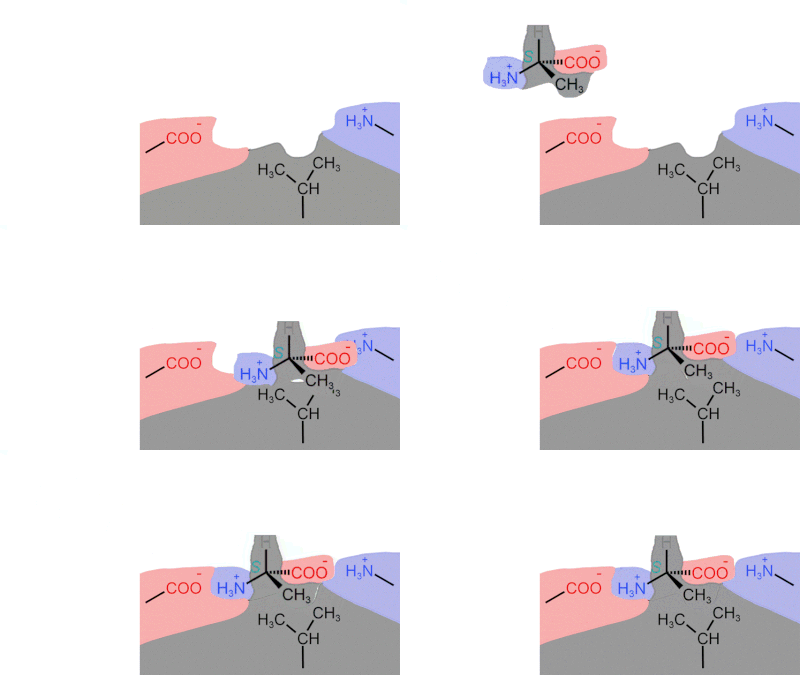 L-alanine matches with the enzyme, fits on it, and reacts,
 but R-alanine does not match, and is repelled without reacting.
According to the three-point interaction model, three substituents on a chiral center typically have the proper geometry, size, and polarity to match the corresponding three spaces in the reactive site of the enzyme. This matching allows one enantiomer to bind selectively on the enzyme surface and undergo a stereoselective reaction, as illustrated in Figure \(\PageIndex{1}\). The three-point interaction model usually explains enantiomer selectivity of biochemical reactions mediated by chiral enzyme catalysts.
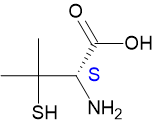
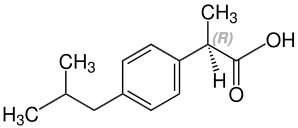
Chirality manifests not only in enantioselective reactions but also in various other biological activities, such as taste, flavor, odor, and drug action, as their receptors possess chiral binding sites. Examples, illustrated in the figure below, include:
- L-aspartame tastes sweet and is used as an artificial sweetener, but D-aspartame is tasteless,
- R-(-)-carvone smells like spearmint, and S-(+)-carvone smells like caraway,
- R-(+)-limonene smells like orange and lemon, and S-(-)-limonene smells like a spruce tree,
- (S)-penicillamine has antiarthritic activity, and (R)-penicillamine is toxic, and
- S-ibuprofen has anti-inflammatory action, and R-ibuprofen is inactive.
 carvone
 limonene

 penicillamine
 ibuprofen
Prochirality
When an achiral object interacts with a chiral object, there is usually no differentiation between the enantiomorphs. For example, a chiral plane tennis ball fits in the left hand and the right hand the same. However, some objects, like a cup of coffee, do differentiate between the enantiomorphs. For example, the coffee cup shown in Figure \(\PageIndex{2}\) a) is positioned to fit in the right hand. If a person holds it with the right hand, takes a sip, and leaves a lip mark on it, it becomes a chiral object shown in Figure \(\PageIndex{2}\) c). The coffee cup shown in Figure \(\PageIndex{2}\) b) is positioned to fit in the left hand. If the same person holds it with the left hand, takes a sip, and leaves a lip mark on it, it becomes a chiral object shown in Figure \(\PageIndex{2}\) d), which is an enantiomorph of c).
 a)
 b)
 c)
 d)
Symmetry of achiral objects that interact differently with enantiomers, like a cup of coffee with left and right hands, is broken with one change that converts them into chiral objects, as illustrated in Figure \(\PageIndex{2}\).
The same is true for molecules. For example, an \(sp^2\)-\(\ce{C}\) with three different substituents becomes chiral with one addition, as shown in Figure \(\PageIndex{3}\) a) and an \(sp^3)\)-\(\ce{C}\) with two same and two different substituents becomes chiral with substitution of one of the two same substituents, as shown in Figure \(\PageIndex{3}\) b).
 a)
 b)
Prochirality is the geometric property of an achiral object or molecule that is capable of becoming chiral in a single desymmetrization step. A prochiral molecule is an achiral molecule that becomes chiral after a single-step reaction, e.g., by addition or by substitution of a single group on it.
For example, the property of a plane cup of coffee to become chiral by making a mark on it, as shown in Figure \(\PageIndex{2}\), is prochirality. Figure \(\PageIndex{3}\) shows examples of prochiral molecules that become chiral by an addition or a substitution step.
A prochiral molecule that has an \(sp^2\)-atom with three different substituents is trigonal planar with two phases: a Re and a Si phase. The following steps assign -stereodescriptor to a prochiral phase.
- Assign priority 1, 2, and 3 (1 is the highest and 3 is the lowest priority) to the three substituents by CIP sequence rules, then
- draw a circular arrow from 1 to 2 to 3.
- If the arrow is clockwise, the face you are looking at is Re-face.
- If the arrow is counterclockwise, the face you are looking at is Si-face.
A simple method is the right-hand rule: curl the fingers of the right hand from 1 to 2, or from 2 to 3, or from 3 to 1; the thumb of the right hand points to Re-face, and the opposite to it is Si-face. For example, in \(\ce{CH3COH}\) shown in Figure \(\PageIndex{3}\) a), the priority#1 is \(\ce{=O}\), #2 is \(\ce{-CH3}\), and #3 is \(\ce{-H}\). Re-face is the bottom, and Si-face is at the top.
 Addition of a substituent from Re-face produces a chiral molecule, and addition of the same substituent from Si-face produces its enantiomer, as shown in Figure \(\PageIndex{3}\) a). An addition to a Re-face doesn't necessarily create a chirality center with R-configuration; it can be R or S, depending on the priority order after the new substituent is added. For example, addition of \(\ce{^{-}CN}\) to the Re-face of the aldehyde in Figure \(\PageIndex{3}\) a) produces R-enantiomer, but addition of \(\ce{H}\) to the Re-face of the ketone in the figure on the right margin produces S-enantiomer.
A prochiral molecule that has an \(sp^3\)-atom has two same and two different substituents.
- Raise the priority of one of the identical substituents over the other, keeping their priority order the same relative to the two different substituents. For example, if the two identical substituents are \(\ce{H's}\), replace one with a higher priority deuterium \(\ce{D}\) isotope.
- Assign R/S-stereodescriptor to the new chirality center created by the previous step.
- If the configuration of the new chirality center is R, the substituent that got the priority raised over the other is pro-R, and the other is pro-S.
- If the configuration of the new chirality center is S, the substituent that has had its priority raised is pro-S, and the other is pro-R.
Figure \(\PageIndex{3}\) b) is an applied example of the above rules, where two \(\ce{H's}\) are the same substituents. Replacing Replacing
Recognition of prochirality by chiral reagents
Chiral reagents, like chiral enzymes, recognize prochirality and interact with the prochiral parts, i.e., Figure \(\PageIndex{3}\) (left) arrives with Re-phase facing a hypothetical chiral enzyme that has a reactive site of size, shape, and intermolecular interactions suitable to hold the Re-phase. The aldehyde will be held in the active site and react from the Si-phase. Since the product is a different shape, it is released, refreshing the active site for the next cycle of reaction. If the aldehyde arrives with Si-phase facing the catalyst, it will not fit in the active site and will bounce off without reacting, as illustrated in Figure \(\PageIndex{4}\) (right).

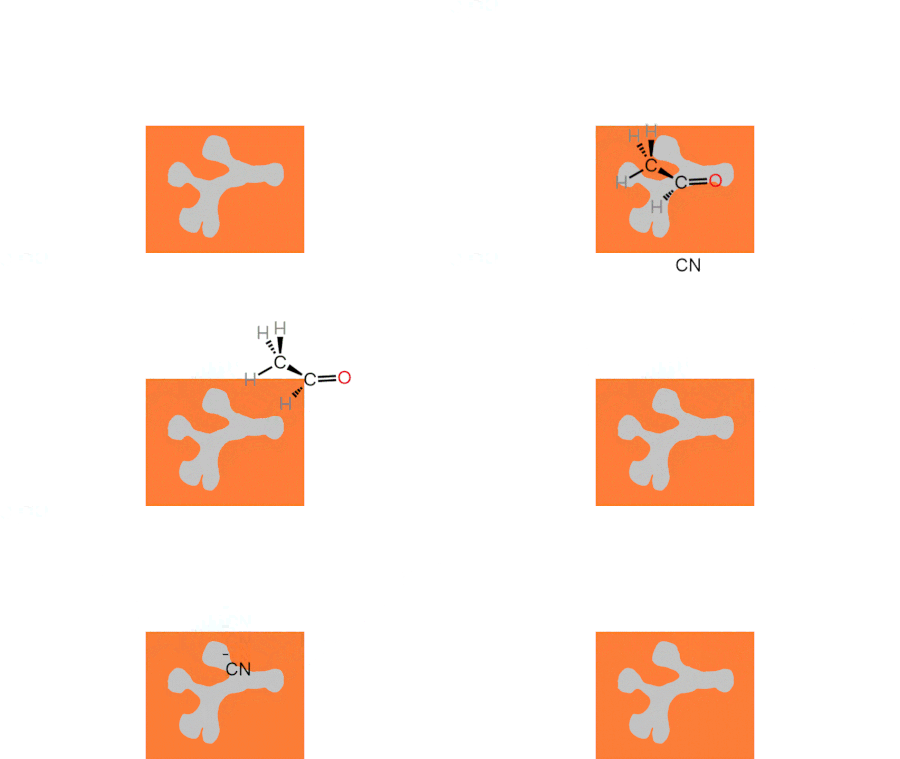
Similarly, if the prochiral substrate has \(sp^3\)-atom having two same and two different substituents, the two different substituents and either the pro-R or the pro-S substituent will fit on the active site, allowing selective production of one enantiomer.
Resolution of enantiomers
Chiral compounds synthesized in living things are usually pure enantiomers, but those synthesized in the laboratory are usually a 50:50 mixture of the two enantiomers.
A 50:50 mixture of two enantiomers is an optically inactive racemic mixture. The experimental process of separating the enantiomers from a mixture is called the resolution of the enantiomers.
The discovery of molecular chirality is associated with the recrystallization of racemic potassium ammonium tartarate salt. Louis Pasteur carried out the recrystallization and noticed that there were two types of crystals, which were mirror images of each other. He separated the crystals by hand-picking using tweezers, dissolved them separately in water, and found that one was dextrorotatory and the other was levorotatory. He concluded from this observation that the molecules constituting the two types of crystals were also asymmetric, i.e., enantiomers.
Recrystallization is one of the methods for resolving enantiomers, but it works only in a few cases. Since the enantiomers have the same physical and chemical properties, except when interacting with another chiral reagent, the resolution process usually involves a chiral reagent, called a resolving agent.
Resolution by forming diastereomer salts
 Most of the organic compounds are either acidic, e.g., those with carboxylic acid \(\ce{-COOH}\) groups, or basic, e.g., those with amine \(\ce{-NH2}\) groups. Acids neutralize bases by forming salts, e.g., a carboxylic acid neutralizes an amine, forming ammonium carboxylate salt, as shown in the following general reaction.
\(\ce{R-COOH + R'-NH2 -> R-CO\overset{-}{O} H2\overset{+}{N}-R'}\)
If there is a racemic mixture of a carboxylic acid, it will make a diastereomer salt by neutralization with a pure enantiomer of an amine resolving agent. Similarly, if there is a racemic mixture of an amine, it will make a diastereomer salt by neutralization with a pure enantiomer of an acid resolving agent. The diastereomeric salts have different physical properties that allow their separation. For example, suppose there is a racemic mixture of 1-phenylethylamine. It can react with (S)-(-)-malic acid forming diasteromer salt: (R)-1-phenylethylammonium (S)-malate, which is less soluble and crystalize out, and (S)-1-phenylethylammonium (S)-malate, which is more soluble and stays in the solution, as illustrated in the figure on the right margin. Filtration can separate the diastereomer salts, then the enantiomers of 1-phenylethylamine can be regenerated by adding \(\ce{HCl}\) solution. (S)-(-)-malic acid is a resolving agent in this example.
Common resolving agents include (+)-tartaric acid, (-)-malic acid, (+)-camphoric acid, (+)-phenylethylamine, (-)-phenylethylamine, etc., as shown blow.
 |
 |
 |
 |
 |
| (2R,3R)-(+)-tartaric acid | (S)-(-)-malic acid | (1R,3S)-(+)-camphoric acid | (R)-(+)-phenylethylamine | (S)-(-)-phenylethylamine |
Enzymes are also used as resolving agents. For example, a racemic mixture of ethyl esters of naproxen forms crystals that are insoluble in water. The racemic mixture is treated with esterase enzyme in an alkaline solution. The enzyme hydrolysis of the S-ester and the product S-naproxen dissolves in water. R-ester remains insoluble, which is separated by filtration.
Resolution by chiral-chromatography
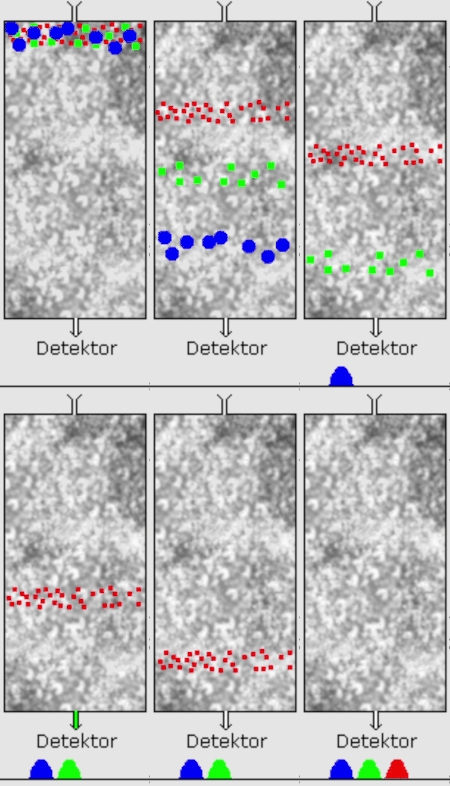 Chromatography is a separation technique in which a mixture is passed through a porous or beaded stationary phase by flowing a solvent through the medium. The compounds in the mixture that have a greater tendency to dissolve in the solvent and a lesser tendency to adsorb on the stationary phase travel with the solvent faster than the others. It results in the separation of the mixture, as illustrated in the figure on the right margin (Copyright: Modified from Beige, Public domain, via Wikimedia Commons).
In chiral chromatography, the solid phase is chiral or its surface is made chiral by chemical modification. The chiral-stationary phase interacts with the enantiomers in the mixture differently, resulting in their separation.
Enantioselective synthesis
No matter how efficient the resolution of an enantiomer is, it results in the waste of the unwanted enantiomer. Therefore, there is a growing trend of using enantioselective synthesis, i.e., synthesis involving chiral reagents or chiral catalysts that produce the desired enantiomer or the desired diastereomer either exclusively or in preference over the other stereoisomers. For example, \(\beta\)-ketones can be reduced by \(\ce{H2}\) in the presence of a chiral catalyst, into chiral alcohols by enantioselective synthesis. The chiral catalyst is a complex of a pure enantiomer of chiral ligands, e.g., \(\ce{RuCl2[(R)-BINAP]}\), where the chiral ligand is ([1,1′-Binaphthalene]-2,2′-diyl)bis(diphenylphosphane), commonly known as BINAP. The general reaction is the following.

This page titled 3.8: Chirality related topics was last modified on Fri, 22 Aug 2025 01:45:32 GMT and is shared under a Public Domain license and was authored, remixed, and/or curated by Muhammad Arif Malik.
The book could not be loaded just now.