Opening the book…
Summary of competition between \(S_{N}2\), \(E2\), \(S_{N}1\), and \(E1\)
When a substrate with a leaving group on a polar \(\sigma\)-bond, like alkyl halides \(\ce{R-X}\), has a nucleophilic center that can undergo nucleophilic substitution by \(S_{N}2\) or \(S_{N}1\). Most of them have \(\beta H\) that is acidic enough to undergo elimination by \(E2\) or \(E1\). However, factors such as the type of substrate, base/nucleophile, solvent, and temperature affect these reactions differently. These differences allow predicting the major organic product in most cases as listed in Table \(\PageIndex{1}\) and summarized below.
- Methyl (\(\ce{CH3-X}\)) substrates reacts only by \(S_{N}2\) and inversion of configuration with moderate or strong nucleophiles. Methyl substrates either react very slowly by \(S_{N}2\) or do not react with weak nucleophiles like \(\ce{H{2}O, ROH}\).
- Strong base/bulky nucleophile like \(\ce{t-BuO^-}\) react with primary, secondary, and tertiary substrates by \(E2\) elimination, yielding Hofmann major product (less substituted alkene).
- Primary (\(\ce{R-CH2-X}\)) substrates react with with strong base/strong nucleophiles like \(\ce{RO^{-}, HO^{-}}\) by \(S_{N}2\) and inversion of configuration along with minor Zaitsev product (less substitued alkene) by \(E2\); and with weak base/strong nucleophile like \(\ce{I^{-}, Br^{-}, CN^{-}, HS^{-}}\) by \(S_{N}2\) and inversion of configuration. They either react very slowly by \(S_{N}2\) or do not react with weak base/weak nucleophile like \(\ce{H{2}O, ROH}\).
- Secondary (\(\ce{R2CH-X}\)) substrates react with strong base/strong nucleophiles like \(\ce{RO^{-}, HO^{-}}\) by \(E2\) yielding Zaitsev product (less substitued alkene); with weak base/strong nucleophile like \(\ce{I^{-}, Br^{-}, CN^{-}, HS^{-}}\) by \(S_{N}2\) and inversion of configuration; and with weak base/weak nucleophile like \(\ce{H{2}O, ROH}\) slowly by \(S_{N}1\) with racemization/\(E1\) -Zaitsev (more substituted alkene), where elimination is favored by heating.
- Tertiary (\(\ce{R3C-X}\)) react with strong base/strong nucleophiles like \(\ce{RO^{-}, HO^{-}}\) by \(E2\) yielding Zaitsev product (less substitued alkene); with weak base/strong nucleophile like \(\ce{I^{-}, Br^{-}, CN^{-}, HS^{-}}\) by \(S_{N}1\) -racemization; and with weak base/weak nucleophile like \(\ce{H{2}O, ROH}\) slowly by \(S_{N}1\) -racemization/\(E1\) -Zaitsev (more substituted alkene), where elimination is favored by heating.
| Substrate Type | Strong Base / Strong Nucleophile (\(\ce{RO^{-}, HO^{-}}\)) | Strong Base / Bulky Nucleophile (\(\ce{t-BuO^-}\)) | Weak Base / Strong Nucleophile (\(\ce{I^{-}, Br^{-}, CN^{-}, HS^{-}}\)) | Weak Base / Weak Nucleophile (\(\ce{H{2}O, ROH}\)) |
|---|---|---|---|---|
| Methyl (\(\ce{CH3-X}\)) | \(S_{N}2\), (Substitution -inversion) | \(S_{N}2\) (Substitution -inversion) | \(S_{N}2\) (Substitution -inversion) | No reaction / Extremely slow \(S_{N}2\) |
| Primary (\(\ce{R-CH2-X}\)) | \(S_{N}2\) (Major -inversion) + minor \(E2\) -Zaitsev | \(E_{2}\) (Elimination - Hofmann) | \(S_{N}2\) (Substitution -inversion) | \(S_{N}2\) -inversion (Very slow) / No reaction |
| Secondary (\(\ce{R2CH-X}\)) | \(E2\) (Elimination major -Zaitsev) | \(E2\) (Elimination - Hofmann) | \(S_{N}2\) (Substitution -inversion) | \(S_{N}1\) -racemization /\(E1\) -Zaitsev product mixture (slow) |
| Tertiary (\(\ce{R3C-X}\)) | \(E2\) (Elimination -Zaitsev) | \(E2\) (Elimination - Hofmann) | \(S_{N}1\) (Substitution -racemization) | \(S_{N}1\) -racemization /\(E1\) -Zaitsev product mixture (heat favors \(E1\)) |
Allylic and benzylic substrates
Allylic and benzylic substrates are more reactive for all four pathways \(S_{N}2\), \(E2\), \(S_{N}1\), and \(E1\) than the corresponding nonallylic and nonbenzylic substrates. This is because resonance is stronger than hyperconjugation. Further, in elimination pathways, a conjugated new \(\pi\)-bond is always formed in preference over the other due to resonance stabilization.
The major or exclusive product can, in most cases, be predicted using the following rules.
- Primary allylic or benzylic electrophilic \(\ce{C}\) do not have \(\beta H\) on any \(sp^3\)\(\ce{C}\) and can not undergo \(E2\) or \(E1\) reaction. Therefore, they yields an \(S _ {N2} \) product with inversion except when the reagent is a weak base/weak nucleophile in a polar protic solvent they yield an \(S_{N}1\) product with racemization.
- Strong bulky bases like \(\ce{t-BuO^{-}}\) exclusively favor \(E2\) for a secondary and tertiary allylic or benzylic electrophilic \(\ce{C}\).
- Strong base/strong nucleophile like \(\ce{RO^{-}}\), \(\ce{^{-}OH}\) favor \(E2\) as major along with some \(S_{N}2\) minor product for a secondary and tertiary allylic or benzylic electrophilic \(\ce{C}\).
- Weak base/strong nucleophile like \(\ce{I^-}\), \(\ce{Br^-}\), \(\ce{RS^-}\), favor \(S_{N2}\) for secondary and \(S_{N}1\) for tertiary allylic or benzylic electrophilic \(\ce{C}\).
- Weak base/weak nucleophile like \(\ce{H2O}\), \(\ce{ROH}\) in polar protic solvents favor \(S_{N}1\) with racemization and \(E1\) mixture product.
Flow chart to predict the major product
Figure \(\PageIndex{1}\) is the flow chart that can predict the major product between \(S_{N}2\), \(E2\), \(S_{N}1\), and \(E1\) in the majority of cases. Note the following while using this chart.
- Solvent is not mentioned in the flow chart, but it is understood that in the cases of \(S_{N}2\) the solvent is polar aprotic and for \(S_{N}1\) and \(E1\) it is usually polar protic. \(E2\) can operate with polar aprotic and with polar protic, which is usually the conjugated acid of the base employed.
- If the electrophilic center is chiral, \(S_{N}2\) causes inversion of configuration and \(S_{N}1\) causes partial or full racemization.
- If the base is strong and bulky, like \(\ce{t-BuO^{-}}\), it favors \(E2\) and a less stable Hofmann product (less substituted alkene) due to steric hindrance preventing the other.
- \(E1\) and \(E2\) prefer the more stable Zaitsev product (more substituted alkene) over the less stable Hofmann product (less substituted product), except when the base is bulky.
- Allylic and benzylic substrates are more reactive across all pathways and are treated separately, as shown in pink boxes at the end of the chart.
- \(E1\) and \(E2\) are not possible for primary electrophilic \(\ce{C}\) of an allylic and benzylic substrate because there is no \(\beta H\) on any \(sp^{3}\ce{C}\).
- \(E1\) and \(E2\) on allylic and benzylic substrates produce a conjugated new \(\pi\)-bond in preference over the other due to resonance stabilization.

Examples of predicting the major product
Example #1 shown below is a methyl substrate (box #1) reacting with a stronger base/nucleophile. \(S_{N}2\) product is predicted via boxes #1, #3, & #6. Example #2 is a reaction of a strong bulky base (box #2) that is predicted to yield the major Hofmann product and the minor Zaitsev product via boxes #2 & #5.
 Example #1, flow chart box #6
 Example #2, flow charge box #5
Now move to box #4 -primary substrates. Example #3 is a strong base/strong nucleophile reagent that is predicted to yield \(S_{N}2\) major and \(E2\) minor products, as indicated in boxes #9 & #10. Example #4 is a weak base/strong nucleophile in a polar aprotic solvent, tetrahydrofuran (THF), that is predicted to yield an \(S_{N}2\) exclusive product, as indicated by boxes #11 & #12. Example #5 is a weak base/weak nucleophile that is predicted to yield a slow \(S_{N}2\) exclusive product or no reaction, as indicated by boxes #13 & #14.
 Example #3, flow charge box #10
 Example #4, flow charge box #12
 Example #5, flow charge box #14
The next three examples are secondary substrates belonging to box #8. Example #6 is a strong base/strong nucleophile that gives the major product by \(E2\) and the minor product by \(S _ {N} 2 \) as mentioned in boxes #16 & #17. Example #7 is a weak base/strong nucleophile in a polar aprotic solvent, acetone, that yields the \(S_{N}2\) product exclusively, as mentioned in boxes #18 & #19. Example #8 is a weak base/weak nucleophile in a polar protic solvent that undergoes \(S_{N}1\) product with racemization, as mentioned in boxes #20 & #21.
 Example #6, flow chart box #17
 Example #7, flow charge box #19
 Example #8, flow charge box #21
The next three examples are tertiary substrates belonging to box #15. Example #9 is a strong base/strong nucleophile that undergoes \(E2\) exclusively, as mentioned in boxes #23 & #24. Example #10 is a moderate base/strong nucleophile that is at the borderline with weak base/strong nucleophile and yields an \(S_{N}1\) product by an extremely slow reaction, as mentioned in boxes #25 & #26. Example #11 is a weak base/weak nucleophile in a polar protic solvent that usually yields the major product by \(S_{N}1\) and the minor by \(E1\), as mentioned in boxes #27 & #28.
 Example #9, flow chart box #24
 Example #10, flow charge box #26
 Example #11, flow charge box #28
The next examples are allylic or benzylic substrates that begin at box #22 in the flow chart. The following two examples are benzylic with primary electrophilic center, for which go from box #22 to #30, then #39. Example #12 is with a strong nucleophile causing \(S_{N}2\), according to box #40. Example #13 is with a weak base/weak nucleophile that undergoes \(S_{N}1\), according to box #41.
 Example #12, flow chart box #40
 Example #13, flow charge box #41
For example #14, follow boxes #22, #30, #31, & #32, because it is a benzylic tertiary substrate reacting with a strong bulky base \(\ce{DBN}\) that always yields \(E2\) as the major product, which is the exclusive product in this case. Example 15 is the same route in the flow chart, as it is a benzylic secondary substrate reacting with a strong base/strong nucleophile. According to box #32, it yields \(E2\) as the major product along with a minor \(S_{N}2\) product.
 Example #14, flow chart box #32
 Example #15, flow charge box #32
Example #16 is an allylic secondary substrate reacting with a weak base/strong nucleophile in a polar aprotic solvent. Follow the box #22, #30, #31, #32, #34, to #35, it predicts \(S_ {N}2\) as the major product, as shown below.
 Example #16, flow chart box #35
Example #17 is a secondary benzylic substrate reacting with a weak base/weak nucleophile in a polar protic solvent. Following boxes #22, #30, #31, #33, #37, to #38, that predicts a mixture \(S_{N}1\) and \(E1\) products, which is shown below.
 Example #17, flow chart box #38
\(E1_{cb}\) mechanism
Two elimination pathways, \(E1\) and \(E2\) are described so far. \(E1\) works on tertiary or more-branched secondary substrates and good leaving groups that leave in the first step, which is rate-determining, as shown below.

Base removes a\(\beta \ce{H}\) in the second fast step. Basicity is not a critical factor; often, weak bases are employed because the \(\beta \ce{H}\) becomes acidic enough due to the inductive effect of \(\ce{\overset{+}{C}}\).
\(E2\) works on all types of substrates, primary, secondary, and tertiary. It requires a moderate to strong base, a more acidic \(\beta \ce{H}\), and a moderate to good leaving group because all of these are involved in a single step, as shown below.

The following reaction fails; \(E1\) fails because \(\ce{^{-}OH}\) is a bad leaving group, \(E2\) fails becaues of poor leaving group and \(\beta \ce{H}\) is not acidic enough to react even with the strong base \(\ce{^{-}OH}\).

What if the leaving group is bad but there is an electron-withdrawing group (EWG) that makes the \(\beta \ce{H}\) acidic enough to be removed by the base employed? The answer is yes; the elimination process occurs but by a different mechanism, called \(E_{1cb}\), shown in Figure \(\PageIndex{1}\).

In \(E_{1cb}\), the acidic \(\beta\ce{H}\) leaves in the first step, forming a conjugate base of the substrate as an intermediate. The lone pair on the conjugate base then pushes out the leaving group in the second step. The anion is in a relatively high-energy state and can push out even the bad leaving group as \(\ce{^{-}OH}\) in this case. The first step is fast, and the second is slow, rate-determining in this case, as illustrated by its energy diagram in Figure \(\PageIndex{2}\).

The mechanism shown in Figure \(\PageIndex{1}\) is called \(E_{1cb}\), where \(E\) stands for \(elimination\), \(1\) for \(unimolecular\,rate\text{-}degerming\,step\) and \(cb\) for \(conjugate\,base\,intermediate\). Note: the rate-determining step is unimolecular in \(E_{1cb}\), but the overall rate law (not shown here) is often not unimolecular. Further, in some variations of \(E_{1cb}\) the first step is the rate-determining step. The characteristic features of \(E_{1cb}\) are that it is a stepwise process in which a \(\beta\ce{H}\) leaves first, followed by departure of the leaving group in a later step.
Figure \(\PageIndex{3}\) shows that \(E_{1cb}\) requires a bad leaving group with an electron-withdrawing group that can make the \(\beta \ce{H}\) acidic enough by induction or resonance effect. For example, \(\ce{-CH2CH3}\) in Figure \(\PageIndex{3}\) a) is an electron-donating group (EDG) by hyperconjugation, \(\ce{-OCH3}\) in b) is EDG by resonance, they fail \(E_{1cb}\), while \(\ce{-\overset{\!\!\overset{\Huge {\:\ce{O}}}|\!\!|\,}{C}-CH3}\) in c), \(\ce{-\overset{\!\!\overset{\Huge {\:\ce{O}}}|\!\!|\,}{N}^{+}\!\!\!\!-O^{-}}\) in d), and \(\ce{-C#N}\) in e) are EWG that make \(E_{1cb}\) succed in these cases.
 a)
 b)
 c)
 d)
 e)
In the above examples of \(E_{1cb}\), alcohol and carbonyl groups are involved, which are common in biochemicals. Therefore, \(E_{1cb}\) is common in biochemical reactions. \(E_{1cb}\) is not so common in laboratory chemical reactions, but it is involved in some important mechanisms involving carbonyl compounds, as in the above examples, and a few others, for example, in the synthesis of an alkyne from a haloalkene and nucleophilic aromatic substitution shown in Figure \(\PageIndex{4}\) and described in later chapters.
 a)

Note that \(E_{1cb}\) works on substrate with \(sp^2\ce{C}\) as in the examples in Figure \(\PageIndex{4}\), but such substrates do not under go any of the \(S_{N}2\), \(E2\), \(S_{N}1\), and \(E1\), as described before. This is because leaving groups become worse leaving groups on \(sp^2\ce{C}\) and \(\beta\ce{H}\) is more acidic on \(sp^2\ce{C}\) than on \(sp^3\ce{C}\). These features favor \(E_{1cb}\) and prohibit \(S_{N}2\), \(E2\), \(S_{N}1\), and \(E1\).
Another unique difference of \(E_{1cb}\) from \(E1\) and \(E2\) is that, when there is a choice, preference for the less substituted alkene (Hofmann product) over the more substituted alkene (Zaitsev product) in \(E_{1cb}\). In the cases of \(E1\) and \(E2\), the stability of the alkene product dictates the preference for the \(\beta\ce{H}\) removal in the product-determining step. A more substituted alkene is the more stable product formed in preference over the other. In the case of \(E_{1cb}\), the selectivity is dictated by the stability of the carbanion intermediate formed upon removal of the \(\beta\ce{H}\). The stability order of carbocation is: \(\overrightarrow{primary\,\ce{\overset{+}{C}} < secondary\,\ce{\overset{+}{C}} < tertiary\,\ce{\overset{+}{C}}}\), which is dictated by hyperconjugation. The effect of hyperconjugation is opposite in a carbanion, i.e., it destabilizes it. Consequently, the order of stability of carbanions: \(\overrightarrow{tertiary\,\ce{\overset{-}{C}} < secondary\,\ce{\overset{-}{C}} < primary\,\ce{\overset{-}{C}}}\). As a result, removal of \(\beta\ce{H}\) from a less substituted \(\ce{C}\), leading to a less substituted alkene (Hofmann product), is preferred in \(E_{1cb}\) over the more substituted (Zaitsev product).
 \(E1\) is one extreme in which \(\ce{C-X}\) bond of leaving group breaks first, \(E2\) is in the middle in which the \(\beta\ce{C-H}\) and the \(\ce{C-X}\) break simultaneously, and \(E_{1cb}\) and the other extreme in which the \(\beta\ce{C-H}\) breaks first. In reality, one elimination mechanism may have a partial character of the other. For example, in some \(E2\) reactions \(\ce{C-X}\) bond is broken more than \(\beta\ce{C-H}\) in the transition state making it nearer to \(E1\) and in others \(\beta\ce{C-H}\) bond may be broken more than \(\ce{C-X}\) making it nearer \(E_{1cb}\). Figure \(\PageIndex{5}\) shows that in the \(E2\) reations of 2-halohexanes, when the halo group is excellent leaving \(\ce{-I}\) the product is is predomanntly hex-2-ene, i.e., Zaitsev product characteristic of \(E1\). When excellent leaving \(\ce{-I}\) is replaced with good leaving \(\ce{-Br}\) or moderately good leaving \(\ce{-Cl}\) the dominance of the Zaitsev product diminishes. For a bad leaving group \(\ce{-F}\), it switches in favor of the Hofmann product, i.e., characteristic of \(E_{1cb}\). These experimental results indicate that in these \(E2\) reactions, \(\ce{C-I}\) bond is broken more than \(\beta\ce{C-H}\) in the transtiion state, leaning it to \(E1\), but \(\beta\ce{C-H}\) is broken more than \(\ce{C-F}\), leaning it to \(E_{1cb}\), as illustrated in the figure on the right margin.

Figure \(\PageIndex{5}\): Illustration of change of major product from hex-2-ene -a Zaitsev product characteristic of \(E1\) to hex-1-ene -a Hofmann product characteristic of \(E_{1cb}\) in the following \(E2\) reactions of 2-halohexanes. (Ref: based on the data taken from: Jones, M., Jr., & Fleming, S. A. (2014). Organic Chemistry (5th international student ed.). W. W. Norton & Company. Copyright; Public domain)
\(\ce{\underset{\Large\color{red}2-Halohexane,\,where\,\ce{X\text{ = }I,\,Br\,Cl,\,or\,F} }{CH3-CH2-CH2-CH2-\overset{\overset{\Huge{\ce{X}}}|}{C}H-CH3}->[\ce{^{-}OCH3}][\ce{CH3OH}] \underset{\Large\color{blue}Hex-2-ene\,(Zaitsev\,product)}{CH3-CH2-CH2-CH=CH-CH3} + \underset{\Large\color{orange}Hex-1-ene\,(Hofmann\,product)}{CH3-CH2-CH2-CH2-CH=CH2}}\)
Table \(\PageIndex{6}\) compares the characteristics of the major elimination pathways described in this chapter.
|
Feature |
E1 Mechanism |
E2 Mechanism |
E1cB Mechanism |
|
Steps |
Two steps |
One step (concerted) |
Two steps |
|
Intermediate |
Carbocation |
None (transition state only) |
Carbanion (conjugate base) |
|
Rate Law |
Rate = \(k[\text{Substrate}]\) |
Rate = \(k[\text{Substrate}][\text{Base}]\) |
Rate depends on conjugate base formation/reactivity |
|
Role of Base |
Weak base (acts in step 2) |
Strong base (acts in step 1) |
Strong or moderate base (deprotonates first) |
|
Leaving Group |
Good leaving group |
Good to moderate leaving group |
Poor leaving group |
|
Substrate Acidity |
Not critical |
Moderate acidity at β-carbon |
High acidity at β-carbon (stabilized carbanion) |
| Product selectivity | Zaitsev (major) | Zaitsev (major), stereoselective due to peri-planar geometry requirement | Hofmann (major) |
Neighboring group participation (NGP)
Neighboring group participation is defined as:
Neighboring group participation (NGP) is defined as the direct interaction of the reaction center with a lone pair, a \(\sigma\)-bonding, or \(\pi\)-bonding electron pair contained within the parent molecule but conjugated with the reaction center.
Usually, the participation of a neighboring group increases the reaction rate (a phenomenon called anchimeric assistance) and also results in product stereochemistry that differs from that of a normal reaction. In the following two examples are \(S_{N}2\) reactions; the first reaction is 600 times faster than the second. This is because the first reaction proceeds via neighboring-group participation, whereas the second is a typical \(S_{N}2\) reaction.
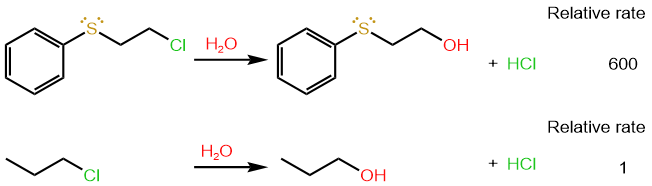
Figure \(\PageIndex{7}\) shows that this neighboring group participation involves two consecutive \(S_{N}2\) steps: sulfide group \(\ce{R-S-R}\) displaces halide \(\ce{-Cl}\) in the first intramolecular \(S_{N}2\) step, followed by water substituting sulfonium ion in the second \(S_{N}2\) step, and finally an acid-base reaction removes the acidic proton from oxonium ion, yielding the final product. The overall reaction is significantly faster because the sulfide group is an excellent nucleophile in the first step that converts a moderate chloride \(\ce{-Cl}\) group into an excellent leaving group, the sulfonium ion, that reacts fast in the second step with a water nucleophile, compared to water slowly displacing chloride in the normal reaction.

Figure \(\PageIndex{8}\) shows another example of neighboring group participation in a trans-isomer occurring 670 times faster and with retention of configuration via two consecutive \(S_{N}2\) steps, compared to the regular single-step \(S_{N}2\) reaction of its cis isomer with inversion of configuration. The neighboring group can participate by a five-membered ring intermediate in the trans-isomer, but it is geometrically too far to participate in the case of the cis-isomer.

A well-known example of a neighboring-group participation reaction similar to the above is the rapid reaction of mustard gas, bis(2-chloroethyl)sulfide, with water when it is used as a chemical warfare agent. It reacts with water in the mucous membranes of the eye, nose, and throat to produce \(\ce{HCl}\), which then burns and blisters the sensitive tissues by the following rapid reaction.
\(\ce{Cl-CH2-CH2-S-CH2-CH2-Cl + \color{blue}2H2O \color{black}-> HO-CH2-CH2-S-CH2-CH2-OH + \color{red}2HCl}\)
Neighboring group participation is illustrated by the examples of \(S_{N}2\) reactions here, but it should be noted that it is not limited to this mechanism; it occurs in several other mechanisms, which will be described in later chapters.
This page titled 6.6: Competition between SN2, E2, SN1, and E1 reactions was last modified on Wed, 19 Aug 2026 19:53:34 GMT and is shared under a Public Domain license and was authored, remixed, and/or curated by Muhammad Arif Malik.
The book could not be loaded just now.