Opening the book…
Autoxidation is the spontaneous degradation of substances by oxidation with atmospheric oxygen at ambient conditions. The process begins when heat, light, a fraction, or some catalytic process introduces some radicals. The radicals are reactive species that react with ambient molecules in a free radical chain reaction mechanism. One radical can cause hundreds of molecules to react in propagation steps.
General mechanism of autoxidation
Free radical reaction mechanisms generally have initiation, propagation, and termination steps. Sometimes, a chain branching step also occurs, converting one radical into two radicals, which results in an increase in radicals. General mechanisms of autooxidation of organic chemicals, food stuff, polymers, plastics, etc., are the following.
Initiation: \(\ce{R-H + \overset{\huge\cdot}{I}nitiator -> \overset{\huge\cdot}{R} + H-Initiator}\)
Propagation: \(\ce{\cancel{ \overset{\huge\cdot}{R}} + \overset{\huge\cdot}{O}-\! \overset{\huge\cdot}{O} -> \cancel{R-O-\overset{\huge\cdot}{O}}}\)
\(\ce{\cancel{R-O-\!\overset{\huge\cdot}{O}} + H-R -> R-O-O-H + \cancel{\overset{\huge\cdot}{R}}}\)
Overall reaction: \(\ce{R-H + \overset{\huge\cdot}{O}-\!\overset{\huge\cdot}{O} -> R-O-O-H}\)
Branching: \(\ce{R-O-O-H -> R-\overset{\huge\cdot}{O} + \overset{\huge\cdot}{O}-H}\)
Termination: \(\ce{\overset{\huge\cdot}{R} + \overset{\huge\cdot}{R} -> R-R}\)
The \(\ce{\overset{\huge\cdot}{I}nitiator}\) is introduced by heat, light, fractions, or some catalytic process. Oxygen is a diradical \(\ce{ :\!\overset{\color{red}\Large\cdot}{\underset{\Large\cdot\cdot}{O}}-\overset{\color{red}\Large\cdot}{\underset{\Large\cdot\cdot}{O}}\!:}\), which is represented as \(\ce{\overset{\huge\cdot}{O}-\! \overset{\huge\cdot}{O}}\) in the reaction equations above. The \(\ce{R-H}\) can be any organic compound. Particularly, the allylic or benzylic \(\ce{H}\) in biochemicals found in food stuff, polymeric materials, or other organic substances are more reactive and susceptible to autoxidation.
Examples of autoxidation
Chemicals are susceptible to autoxidation if stored for a long time and exposed to atmospheric oxygen. Particularly, autoxidation of ethers, shown below, produces an explosive hydroperoxide product, which has caused several explosion accidents in laboratories.
Ether: 
Compounds that contain benzylic or allylic \(\ce{H}\) usually have a short shelf-life due to autoxidation, e.g., autoxidation of cumene shown below.

Polymers and plastics are degraded by autoxidation processes. Food is also degraded by autoxidation. For example, fats have long hydrocarbon chains with some \(\ce{C=C}\) bonds. The allylic \(\ce{H}\) in the alkene part is prone to autoxidation, producing hydroperoxides that are responsible for the rancid smell of aged oils and fats, as shown below.

Antioxidants as food additives
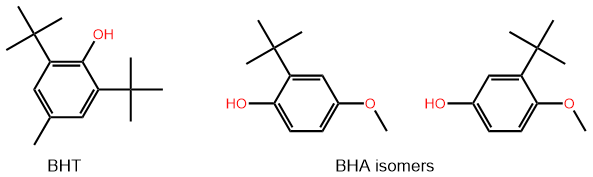 Stored foods have a limited shelf life due to autoxidation through radical reactions. A single radical can convert thousands of biochemicals in food to unwanted and toxic by-products through radical chain propagation steps.
Antioxidants are added to increase the shelf life of foods. Antioxidants are substances that scavenge radicals by converting them into resonance-stabilized and sterically hindered radicals that react very slowly compared to the initial radicals. Examples of antioxidants include butylated hydroxytoluene (BHT) and butylated hydroxyanisol (BHA), shown on the right margin. For example, any reactive radical \(\ce{\overset{\huge\cdot}{R}}\) reacts with BHA and abstracts its phenolic \(\ce{-OH}\) hydrogen, converting it into a resonance-stabilized radical that reacts slow due to being stabilized and sterically hindered by bulky butyl group, as shown in Figure \(\PageIndex{1}\).

Natural antioxidants in living biochemical systems
Two radicals can combine in a termination step: \(\ce{\overset{\huge\cdot}{R} + \overset{\huge\cdot}{R} -> R-R}\). If the radical \(\ce{\overset{\huge\cdot}{R}}\) is a polymer molecule, this reaction cross-links two polymer chains, resulting in hardening of the polymer. Similar reactions happen in biopolymers. For example, hardening of skin with age is one consequence of the radial reactions in living things.
 Radicals can be generated within or enter the biochemical systems of living things. Each radical can convert thousands of useful biochemicals into unwanted or toxic by-products through chain propagation steps. The biochemical systems have a mechanism of scavenging the unwanted radicals through natural antioxidants. For example, \(\alpha\)-tocopherol, a form of vitamin E, has a phenolic \(\ce{-OH}\) group similar to BHT and BHA, as shown in the figure on the right margin. Vitamin E reacts with radicals and converts into a resonance-stabilized and slow-reacting radical, practically terminating the chain propagation steps.
Vitamin E has a long hydrophobic tail that makes it a hydrophobic molecule that is soluble in fatty parts of living things, like cell membranes and fat layers. Vitamin C has a number of \(\ce{-OH}\) groups, making it hydrophilic and water soluble. Vitamin C is an example of natural antioxidants that scavange harmful radicals in blood and other watery parts of living things, as shown in the reaction below.

The slow rate of radicals scavenged by natural antioxidants like vitamin E in hydrophobic parts or by vitamin C in hydrophilic parts of biochemical systems gives the body enough time to excrete them before they can do more damage.
5.6: Autoxidation is shared under a not declared license and was authored, remixed, and/or curated by LibreTexts.
The book could not be loaded just now.