Opening the book…
Drawing Lewis structures, or line-bond structures, and describing delocalized electrons by resonance and resonance hybrid is a graphical way of representing organic molecules. Names are given to things to represent them in words. The same applies to organic molecules; they are assigned names to represent them in words. For example, ethanol is a molecule that has the following Lewis structure: \(\ce{H-\overset{\overset{\Huge{\ce{H}}}|}{\underset{\underset{\Huge{\ce{H}}}|}{C}}-\overset{\!\large\:\cdot\:\!\cdot}{\underset{\!\large\:\cdot\:\!\cdot}{O}}-H}\), or the following line bond structure:  . Before systematic nomenclature was developed, organic compounds were known by common names. The International Union of Pure and Applied Chemistry (IUPAC) has developed a systematic nomenclature, called the IUPAC nomenclature or systematic nomenclature of organic compounds. Systematic names are assigned so that each organic molecule has a unique name, such that one may be able to draw the structure from the name and deduce the name from the structure.
Systematic nomenclature is based on the name of the \(\ce{C}\) chain and the name of the reactive part of the molecule, called a functional group. Chemical reactions involve the making and breaking of chemical bonds that usually take place in the functional groups. Therefore, the making and breaking of chemical bonds, followed by functional groups, are described next before describing IUPAC nomenclature.
Basic chemical reaction types
Chemical reactions, i.e., making and breaking of chemical bonds, are divided into two major classes, homolytic and heterolytic bond making and breaking, as described next.
Homolytic bond making and breaking
A covalent bond is formed by sharing valence electrons, one from each atom, e.g., as in the formation of \(\ce{Cl2}\) molecule by the following reaction: \[\ce{{\LARGE :}\overset{\Huge{\cdot\cdot}}{\underset{\Huge{\cdot\cdot}}{Cl}}{\LARGE\cdot} + {\LARGE \cdot}\overset{\Huge{\cdot\cdot}}{\underset{\Huge{\cdot\cdot}}{Cl}}{\LARGE :} -> {\LARGE :}\overset{\Huge{\cdot\cdot}}{\underset{\Huge{\cdot\cdot}}{Cl}}-\overset{\Huge{\cdot\cdot}}{\underset{\Huge{\cdot\cdot}}{Cl}}{\LARGE :} }\nonumber\] Movement of valence electrons in chemical reactions is shown by curly arrows \(\huge\curvearrowright\). The tail of the arrow is placed where the electrons to be moved are located, and the head points where the electrons move to (\(\text {tail} {\huge\curvearrowright}\text head\)). Regular curly arrows \(\huge\curvearrowright\) show movement of two electrons, a lone pair or a \(\pi\)-bonding pair, and curly half-headed arrows  show movement of a single electron.
Bond formation, in which both atoms contribute one electron to form a covalent bond, is known as homolytic bond formation. e.g.,
 .
The reverse of it, i.e., bond breaking, in which both fragments receive one electron, is called homolytic bond breaking, e.g.,
 .
Energy released during homolytic bond making is the same amount of energy needed for homolytic bond breaking, which is called the bond dissociation energy (BDE).
Heterolytic bond making and breaking
Bond formation in which both the bonding electrons are donated by one atom is known as heterolytic bond formation, e.g.,

Reverse of it, i.e., bond breaking, in which both the bonding electrons are received by one of the fragments, is called heterolytic bond breaking, e.g.,

Energy needed for heterolytic bond breaking is not the same as in homolytic bond breaking, because the products of the two are different. Heterolytic bond breaking typically occurs in polar bonds, where the bonding electrons are transferred to the more electronegative atom, whereas homolytic bond breaking usually takes place in nonpolar bonds. This is because the atomic orbital of the more electronegative atom is closer in energy to the molecular orbital. In contrast, in a nonpolar bond, the atomic orbitals of both atoms are about the same distance away from the molecular orbital in terms of energy, as shown in Figure \(\PageIndex{1}\). Furthermore, most chemical reactions in biological systems, as well as in the laboratory, occur in solution, where polar solvents stabilize charges, making heterolytic processes more favorable. Therefore, the reactive sites in organic molecules, called functional groups, are usually associated with polar bonds between \(\ce{C}\) and heteroatoms like \(\ce{O}\), \(\ce{N}\), halogens, etc.

Functional groups
A functional group is a group of atoms in an organic molecule that is associated with a characteristic set of chemical properties.
A functional group usually contains polar bonds, e.g., alkyl halide \(\ce{(R)3\overset{\delta{+}}{C}{-}\overset{\delta{-}}{Cl}}\), alcohol \(\ce{(R)3\overset{\delta{+}}{C}{-}\overset{\delta{-}}{O}{-}\overset{\delta{+}}{H}}\), carbonyl \(\ce{(R)2\overset{\delta{+}}{C}{=}\overset{\delta{-}}{O}}\), etc., or a combination of these, e.g., carboxylic acid \(\ce{R-\!\!{\overset{\overset{\huge\enspace\!{\overset{\Large{\delta{-}}}{\Huge\ce{O}}}}|\!\!|\enspace}{\underset{\delta{+}}{\ce{C}}}}\!\!-\overset{\delta{-}}{O}-\overset{\delta{+}}{H}}\), which is a combination of a carbonyl and an alcohol groups, and acid halid \(\ce{R-\!\!{\overset{\overset{\huge\enspace\!{\overset{\Large{\delta{-}}}{\Huge\ce{O}}}}|\!\!|\enspace}{\underset{\delta{+}}{\ce{C}}}}\!\!-\overset{\delta{-}}{Cl}}\), which is a combination of a carbonyl and an alkyl halide groups, etc., where \(\ce{R}\) represents the rest of the organic molecule. Functional groups usually react through heterolytic chemical processes, known as the polar reaction mechanism.
Organic compounds containing only \(\ce{C}\) and \(\ce{H}\) atoms are called hydrocarbons. Hydrocarbons that have only single bonds are called alkanes, those having at least one double \(\ce{C=C}\) bond are called alkenes, and those having at least one triple \(\ce{C\equiv C}\) bond are called alkynes. The \(\pi\)-bonds in \(\ce{C=C}\) and \(\ce{C\equiv C}\) are also called unsaturation. Since \(\pi\)-bond is weaker than a \(\sigma\)-bond and its electrons are relatively less tightly held by the nuclei, they are easily donated in chemical reactions. Therefore, \(\ce{C=C}\) and \(\ce{C\equiv C}\) are functional groups. Alkanes are the least reactive class of organic compounds as they do not have functional groups. Alkanes typically react through a homolytic chemical process, known as the free radical mechanism.
The structure and names of the most common functional groups in organic compounds are described in the next section about organic nomenclature. Further details are provided in the next chapters.
Introduction to IUPAC nomenclature
This introduction to the IUPAC nomenclature is extracted from: IUPAC, Pure Appl. Chem. 2020, https://doi.org/10.1515/pac-2019-
0104. The IUPAC names are generated using ACD/ChemSketch (freeware). The structures are drawn using KingDraw for PC.
The structure of the IUPAC nomenclature of an organic compound, with the parts labeled, is shown in Figure \(\PageIndex{2}\) and described next.
- It is the parent chain, which is usually the longest carbon chain on which a characteristic functional group is present.
- It is a suffix representing unsaturation, i.e., it tells whether \(\ce{C}\) atoms have only single bonds or also have double or triple bonds.
- Represents the suffix of the senior functional group.
- It is an alphabetical list of prefixes representing branches on the parent chain or non-senior functional groups, collectively called substituents.
- The locant that tells the position on the parent chain of a substituent is listed next to it; the numbers are listed in increasing order, separated by commas, and are distinguished from alphabets by hyphens.
- It is a multiplier telling how many times the substituted attached to it is repeated; the multiplier is not counted in alphabetization of the substituents, and
- is a stereodescriptor preceded by the locant number of the stereogenic center if present in a molecule and enclosed in brackets. When parts of a name belong together, they are enclosed in brackets in the nesting order {[( )]}.

Naming simple organic compounds needed in this course is described in the next section, starting with hydrocarbons, followed by compounds containing non-characteristic functional groups, and finally, compounds containing characteristic functional groups. Note: stereodescripters are ignored in this chapter and will be described and added to the nomenclature in the next chapter.
Nomenclature of hydrocarbons
 Hydrocarbons are organic compounds containing only \(\ce{C}\) and \(\ce{H}\) atoms. They are divided into two major classes: i) aliphatic, which do not have any aromatic ring, and ii) aromatic, which contain at least one aromatic ring, most often a benzene ring, \(\ce{C6H6}\) a six-\( \ce{C}\) chain containing alternate single and double bonds. The aliphatic hydrocarbons are divided into three sub-classes: i) alkane containing only single \(\ce{C-C}\) bonds, ii) alkene containing at least one double \(\ce{C=C}\), and alkyne containing at least one triple \(\ce{C\equiv C}\) bond, as illustrated in the figure on the right.
Straight-chain alkane
IUPAC name of a straight chain has to parts: stem name, listed in Table \(\PageIndex{3}\) that tells how many \(\ce{C}\) atoms are in the chain and suffix -ane where -e tells it is a hydrocarbn and -an- tells it is an alkane.
For example, \(\ce{CH3CH2CH2CH2CH3}\) is pentane, where pent- is the stem name for five-\(\ce{C}\) chain and -ane is the suffix for an alkane. Similarly, \(\ce{CH4}\) is methane, \(\ce{CH3CH3}\) is ethane, \(\ce{CH3CH2CH3}\) is propane, and so on.
| Number of carbons | 1 | 2 | 3 |
4 |
5 | 6 | 7 | 8 | 9 | 10 | 11 | 12 | 13 | 14 | 15 | 16 | 17 | 18 | 19 | 20 |
|---|---|---|---|---|---|---|---|---|---|---|---|---|---|---|---|---|---|---|---|---|
| Stem name | Meth | Eth | Prop | But | Pent | Hex | Hept | Oct | Non | Dec | Undec | Dodec | Tridec | Tetradec | Pentadec | Hexadec | Heptadec | Octadec | Nonadec | Icos |
A straight chain alkene is usually drawn as a zigzag line, but rotation is allowed around each single bond, which may change it into a wiggle-waggle line bond structure, as shown in Figure \(\PageIndex{4}\).



Branched alkane
- Find the longest continuous \(\ce{C}\)-chain and name it as a straight chain alkane; it is the parent chain in the IUPAC name of the compound.
- If there is a tie, preference goes to the chain with more branches.
- Name all of the branches as straight chain alkanes, but with the suffix -ane replaced with -yl for the branch name; list the branches, referred to as substituents, alphabetically before the parent name with no spaces between the names.
- If the same branch appears more than once, list it once with a multiplier prefix. The multiplier prefixes are listed in Table \(\PageIndex{5}\).
- Number the \(\ce{C}\) atoms of the parent chain from #1 for one end, continuously increasing till the other end, beginning from the end that assigns a lower number to the point of attachment of the first branch.
- If there is a tie, preference goes to the branch that is first in alphabetical order.
- If there is still a tie, the preference goes to the third branch.
- If there is a tie, preference goes to the branch that is first in alphabetical order.
- Insert the locant number, which is the point of attachment of the branch on the parent chain, before the branch name, separated by hyphens from the alphabet.
- If a branch is repeated, list the locant number of each in increasing numeric order, separated by commas before the multiplier prefix.
- If a repeat branch is on the same locant, repeat the locant number.
- If a branch is repeated, list the locant number of each in increasing numeric order, separated by commas before the multiplier prefix.
- If a branch is further branched, name it by the above four rules with the following changes.
- Numbering of the parent chain in the branch begins from the end that assigns a lower number to the \(\ce{C}\) attached to the parent chain of the compound.
- Suffix -ane is replaced with -yl with a locant number before it, which is the number of the \(\ce{C}\) in the branch that is attached to the parent chain of the compound.
- The entire name of the branch is enclosed in brackets and listed in alphabetical order, along with other branches, preceded by its locant number.
| No | Simple | Complex | No | Simple | Complex | No | Simple | Complex | No | Simple | Complex |
| 2 | di | bis | 5 | penta | pentakis | 8 | octa | octakis | 11 | undeca | undecakis |
| 3 | tri | tris | 6 | hexa | hexakis | 9 | nona | nonakis | 12 | dodeca | dodecakis |
| 4 | tetra | tetrakis | 7 | hepta | heptakis | 10 | deca | decakis | 20 | icosa | icosakis |
| *Example simple: dipropyl, example complex: bis(2-methylpropyl). | |||||||||||
The rules #1 to 5 above are explained through application to the following examples. 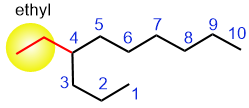
The structure shown in the figure on the right is 4-ethyldecane —numbers in blue show the numbering of the parent chain in this and the following structures. Here is the breakdown of the nomenclature: the parent chain is "decane" (not nonane, rule#1); the branch name is "ethyl" note ethane and listed before the parent "ethyldecane" with no space between the words by rule#2; numbering begins from the end that assigns #4 to the branch (not from the other end that will assign it #7) rule#3, and its final name after applying rule#4 is "4-ethyldecane".
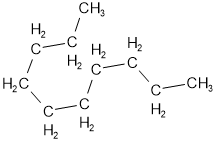
 The structure in the figure on the left is 3-ethyl-2-methylhexane. Here is the breakdown of the nomenclature: the parent chain is the one with two branches, not the one with one branch (rule#1, if there is a tie, preference goes to the chain with more branches); the branches are listed in alphabetic order (not by the locant number) rule#2, and the locant nuber of each branch is inserted before the branch name (rule#4).
 The structure in the figure on the right is 3-ethyl-5-methylheptane. Numbering from either side gives #3 to the first substituent. The tie is broken by giving preference to ethyl, which alphabetically comes before methyl (Rule#3).
 The structure on the left is 3,3,4-trimethylhexane. The numbering from either side is the same for the first substituent, so preference is given to the third substituent (rule#3). Methyl substituent repeats three times, so it is listed once with a multiplier of three (Rule#2). Methyl substituent repeats on #3, so the locant number is also repeated (rule#4).
 The structure on the right is 5-(2-methylpentan-3-yl)decane. Numbers in blue represent the numbering of the parent, and numbers in orange represent the numbering in the branch chain. Here is its breakup. The longest chain is ten-\(\ce{C}\) atoms, so the parent name is decane. Numbering of the parent begins from left to assign a lower number to the branch. The branch is complex, so it is named according to rule#5: Numbering from either side assigns #3 to the point of attachment to the parent, so numbering begins from left to give preference to the methyl branch. The prefix -ane is replaced with -yl with locant, i.e., the point of attachment from the branch to the parent is inserted before the prefix (3-yl). The branch name is enclosed in brackets and listed before the parent name, preceded by its locant number on the parent (5-).
Cycloalkane
Open-chain aliphatic hydrocarbons are called acyclic, and those containing a cyclic structure are cyclic hydrocarbons. The rules of the acyclic alkanes, but with the following change, name a cycloalkane.
- A cycloalkane with no substituent on it has the same name as a straight-chain alkane containing the same number of \(\ce{C}\) atoms, but with the prefix cyclo- attached.
- A cycloalkane with one branch is named by listing the branch name before the parent cycloalkane name, without locant number or space.
- According to the current IUPAC rules, cyclic structure is the parent name, even if the branch has more \(\ce{C}\) atoms, except when there is a characteristic group or other factor that can change the preference. (Note: in earlier versions, between cyclic and acyclic, the one with more \(\ce{C}\) atoms was the parent.
- A cycloalkane with two branches is named by listing the branch names in alphabetical order before the parent name, preceded by their locant numbers.
- The branch alphabetically first receives locant #1, and the numbering proceeds clockwise or counterclockwise, whichever assigns a lower number to the second branch.
- A cycloalkane with more than two branches is named by listing the branch names in alphabetical order before the parent name, preceded by their locant numbers, where the locant number#1 and the direction to proceed clockwise or counterclockwise is chosen such that the total of the set of locant numbers is the lowest possible.
The application of the above rules is explained with examples in Figure \(\PageIndex{6}\). The structure on the left in Figure \(\PageIndex{6}\) is three-\(\ce{C}\) cycle named cyclopropane by rule#1. The next one has one methyl branch and is named methylcyclohexane by rule#2. The location number for one branch is not needed, as it is always #1. The next structure is named 1-ethyl-3-methylcyclopentane by rule#3; it has two branches, numbering begins from ethyl, which is alphabetically before methyl, and numbering continues counterclockwise to assign a lower number to the methyl branch. The next structure is named 2-ethyl-1,4-dimethylcyclohexane by rule#4: locant of methyl near ethyl is chosen #1 and continued counterclockwise to achieve the lowest total of the set of locant numbers (\(1+2+4 = 7\)). All other options will have a higher total set of locant numbers, e.g., 1-ethyl-2,5-dimethylcyclohexane (\(1+2+5=8\)) and 3-ethyl-1,4-dimethylcyclohexane (\(3+1+4=8\)). The structure on the right in Figure \(\PageIndex{6}\) is named (4-methylhexyl)cyclobutane by rule#4: cyclobutane is the parent instead of hexane because the cyclic structure has preference over acyclic if other factors are the same. The branch is complex, so it is named by rule#5 of branched alkane rules.
 cyclopropane
 methylcyclohexane
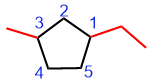 1-ethyl-3-methylcyclopentane
 2-ethyl-1,4-dimethylcyclohexane
 (4-methylhexyl)cyclobutane
Bicycloalkane
Compounds containing more than one cyclic structure are called polycyclic. Nomenclature of bicycloalkenes, i.e., alkanes containing two cyclic structures, is described here. There are four major classes of bicycloalkanes, as shown in Figure \(\PageIndex{7}\). Isolated rings have no atoms in common. They are named by the rules of alkanes and cycloalkanes, by selecting a larger ring as the parent and the smaller a substituent. For example, the structure on the left in Figure \(\PageIndex{7}\) is cyclobutylcyclopentane.
 cyclobutylcyclopentane
 spiro[4.2]heptane
 bicyclo[4.3.0]nonane
 bicyclo[4.3.2]undecane
The second class consists of spiro-rings that share one atom in common. The spiro-rings have two bridges comprising carbons that are not common between the rings. They are named by using the prefix spiro, followed by the number of atoms in each bridge in decreasing numeric order, separated by a period, and enclosed in square brackets, followed by the name of the straight chain alkane corresponding to the total number of carbon atoms in the compound. For example, the structure in Figure \(\PageIndex{7}\), 2nd from left, is spiro[2,4]heptane: 2,4 represents two carbons in the smaller and four in the larger bridge, and heptane because it has a total of seven \(\ce{C}\) atoms. Note that the shared \(\ce{C}\) is not counted in any bridge.
The 3rd major class is fused rings that have two atoms and one covalent bond in common. The common atoms connect the three bridges and are called bridgehead carbons. Their name begins with the prefix bicyclo, followed by the number of atoms in each bridge in decreasing order, separated by a period, and enclosed in square brackets, followed by the name of the straight chain alkane corresponding to the total number of carbon atoms in the compound. For example, the 3rd structure from left in Figure \(\PageIndex{7}\) is bicyclo[4.3.0]nonane. It has four carbons in the largest bridge, three in the second largest, and the middle bridge without any carbon is the smallest, which makes [4.3.0] part of the name, and there are a total of nine carbons, which is represented by nonane in the last part of the name. Note that the bridgehead carbons do not count in any bridge.

 The 4th class is bridged rings that have more than two atoms in common, i.e., all three bridges have one or more \(\ce{C}\) each. Bridged rings are more common in natural products than the other bicycloalkanes. Their name begins with the prefix bicyclo, followed by the number of atoms in each bridge in decreasing order, separated by a period, and enclosed in square brackets, followed by the name of the straight chain alkane corresponding to the total number of carbon atoms in the compound. for example, structure on the right in Figure \(\PageIndex{7}\) is bicyclo[4.3.2]undecane. Numbering, if needed, starts from a bridgehead, goes through the largest bridge first, followed by the 2nd largest, and finally through the smallest bridge. For example, the figure on the left, which is 1-methylbicyclo[4.3.2]undecane, and the figure on the right, which is 8-ethyl-6-methylbicyclo[3.2.1]octane, show the numbers in blue fonts.
 The designations primary, secondary, tertiary, and quaternary for carbons and for hydrogens on them are illustrated in the figure on the right, and described below.
- The terminal \(\ce{C}\), i.e., the \(\ce{C}\) with only one single bond with another \(\ce{C}\) is a primary carbon.
- The \(\ce{C}\) with two single bonds to other \(\ce{C}\) atoms is a secondary carbon.
- The \(\ce{C}\) with three single bonds to other \(\ce{C}\) atoms is a tertiary carbon.
- The \(\ce{C}\) with four single bonds to other \(\ce{C}\) atoms is a quaternary carbon.
- A \(\ce{H}\) on a primary \(\ce{C}\) is a primary hydrogen, a \(\ce{H}\) on a secondary \(\ce{C}\) is a secondary hydrogen, and a \(\ce{H}\) on a tertiary \(\ce{C}\) is a tertiary hydrogen. A quaternary \(\ce{C}\) does not have any \(\ce{H}\) on it.
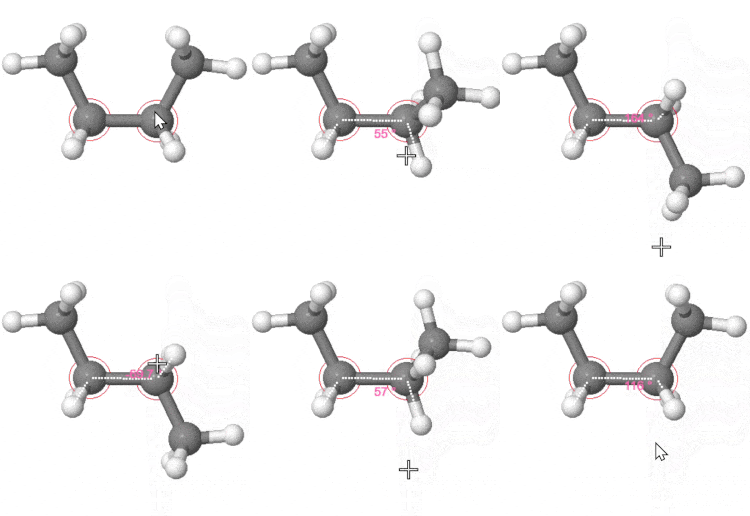 There is almost free rotation possible around a single bond, as shown for \(\ce{\overset{3}{C}-\overset{4}{C}}\) bond of butane in the figure on the right (prepared using https://chemagic.org/molecules/amini.html, Copyright: Public domain). However, the rotation around \(\ce{C-C}\) bonds of a cycloalkane is restricted due to the carbon-bridge connecting the bonds. Rotation around a double bond (\(\ce{C=C}\)) is also restricted because a \(\pi\)-bond weakens when the \(p\)-orbitals are not aligned and breaks completely when they are at a 90° angle from each other. Therefore, two groups on any two \(\ce{C}\) atoms of a cycloalkane ring or on the two \(\ce{C}\) atoms of a \(\ce{C=C}\) pointing in the same direction are called in a cis-relationship, and those pointing in the opposite direction are called in a trans-relationship.
 For example, cis-1,2-cyclopentane and trans-1,2-cyclopentane, shown in the figure on the right, are different compounds having the same molecular formula, i.e., they are isomers. Such isomers, which have the same atom-connectivity but different orientations, are called stereoisomers.
Stereoisomers need stereodescriptors in their IUPAC nomenclature. The cis/trans were stereodescriptors before, but they have been replaced with new stereodescriptors in the current IUPAC nomenclature. Still, cis/trans terms are used to describe the orientation of two groups relative to each other. The stereodescriptors and the IUPAC nomenclature with the stereodescriptors will be described in the next chapter.
Common branch names accepted in IUPAC nomenclature

 Some common names that are often used in literature are accepted in IUPAC nomenclature. They will be mentioned when used in this course. Some alkyl branch names accepted in IUPAC nomenclature are shown in Table \(\PageIndex{7}\). These branch names should be better committed to memory.
For example, 6-(3-methylbutyl)undecane and isopentylundecane are both IUPAC names of the same structure shown on the left, and 4-methyl-5-(propan-2-yl)octane and 4-isopropyl-5-methyloctane are both IUPAC names of the same structure shown on the right.
| Structure: |  |
 |
 |
 |
 |
 |
 |
 |
 |
| Common name: | isopropyl | sec-butyl | isobutyl | tert-butyl | isopentyl | neopentyl | |||
| Systematic name: | propyl | (propan-2-yl) | butyl | (butan-2-yl) | (2-methylpropyl) | (1,1-dimethylethyl) | pentyl | (3-methylbutyl) | (2,2-dimethylpropyl) |
| * Iso- and neo- are merged with the name and counted in alphabetization, but sec- and ter- are italicized and not counted in alphabetization of the branch name. Either one can be used in an IUPAC name. (Copyright; Public domain) | |||||||||
This page titled 2.3: Organic nomenclature -alkanes was last modified on Tue, 18 Aug 2026 13:13:58 GMT and is shared under a Public Domain license and was authored, remixed, and/or curated by Muhammad Arif Malik.
The book could not be loaded just now.