Opening the book…
The three-dimensional shape of a molecule has an impact on its physical and chemical properties. In this lab activity, you will investigate why molecules and ions have the shape they do. This is the first block in understanding molecular shapes. As you advance in chemistry courses, you will learn how molecular shape can impact how effective medicines are as well as why enzymes in your body work.
For this discussion, we will begin with simple binary molecules and ions that have one central atom. The central atom is the atom to which all the other atoms are bonded. This will be the atom whose geometry we are investigating.
Why do these molecules or ions adopt the shapes they do? We can answer this by noticing that there is Valence Shell Electron Pair Repulsion (VSEPR). In other words, we notice that the electrons in the outermost shell (valence electrons) of an atom determine the geometry of that atom. We defined a covalent bond as sharing pairs of electrons. We will also assume that electrons that are nonbonding also exist in pairs (this assumption is true for many molecules, but not all). This is where the “pair” comes from. Finally, as we are discussing electrons, we know they have a negative charge. Like charges repel or push away from each other.
Each bonding region and each nonbonded pair of electrons counts as a region of electron density that can repel other areas of electron density. What is meant by a bonding region is a “side” of the central atom as represented in the Lewis structure. Thus, a bonding region may contain a single bond, double bond, or triple bond. Because of this, a bonding region may contain 2, 4, or 6 electrons and still be one bonding region. For this discussion, a nonbonding region will be a lone pair of electrons.
When the structure of molecules is determined by x-ray diffraction, the nucleus of atoms can be seen, but the electrons cannot. Thus, when we determine the shape of a molecule, we are describing the location of the atoms in space. The effect of the nonbonding electrons helps determine the shape, but we do not expressly name the location of all the electron groups.
Linear – Two atoms attached to the central atom, no nonbonding electrons on central atom
If a central atom has two regions of electron density, the farthest apart these regions can be from each other is 180°. This arrangement will cause all the atoms to be in a line. Thus, the name of this shape is linear. The bond angle will be 180°. This can be shown using the letter A for the central atom and R for the attached group, as shown in Figure \(\PageIndex{1}\).
 Figure \(\PageIndex{1}\)
Trigonal Planar – Three atoms attached to the central atom, no nonbonding electrons on central atom
If a central atom has three regions of electron density, the farthest apart these regions can be from each other is 120°. This arrangement will cause all the atoms to be in a triangle, with the central atom in the center of the triangle and the surrounding atoms at the corners of the triangle. Triagonal means three and planar means that it is all in one plane. Hence the name trigonal planar is used to describe this shape. The bond angle will be 120°, as shown in Figure \(\PageIndex{2}\).
 Figure \(\PageIndex{2}\)
Bent – Two atoms attached to the central atom, one pair of nonbonding electrons on central atom
As noted with the trigonal planar shape, the furthest apart three regions of electron density can be is 120°. However, the nonbonding electrons fill more space than the bonding electrons. Thus, the bond angle between the atoms is slightly less than 120°. Because an x-ray of the molecule only shows the atoms, we describe this shape as bent, as shown in Figure \(\PageIndex{3}\).
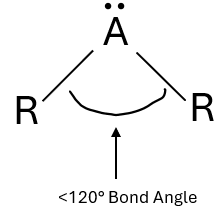 Figure \(\PageIndex{3}\)
Tetrahedral – Four atoms attached to the central atom, no nonbonding electrons on central atom
The first three shapes we have described can be depicted in one plane and are thus easy to visualize on paper. When four atoms are attached to a central atom, it is easy to think that they would be spread out in a square. This error does not account for the electron density spreading out in three dimensions, not two.
The four regions of electron density will spread out to have the central atom in the middle and the four groups attached at the vertices of a tetrahedron. The tetrahedron shape is shown below in Figure \(\PageIndex{4}\). It is a solid that has four vertices and four sides. Each side looks like a triangle.
 Figure \(\PageIndex{4}\)
The bond angle between the groups is 109.5°, as shown in Figure \(\PageIndex{5}\). To show this shape in two dimensions, a wedge is used to depict the group that is coming out of the page and a dash is used to depict the group going back behind the page.
 Figure \(\PageIndex{5}\)
Trigonal Pyramidal – Three atoms attached to the central atom, one pair of nonbonding electrons on central atom
As seen with the tetrahedral shape, four regions of electron density can spread out 109.5° from each other in space. Again, a nonbonding pair of electrons will take up more space than bonding electrons and push the groups around the central atom just a little bit closer together. Thus, the bond angle in the trigonal pyramidal shape will be less than 109.5°. This shape can be depicted with one group on a dash, one on a wedge and one in the plane to help emphasize that the atoms are not all in one plane, as shown in Figure \(\PageIndex{6}\).
 Figure \(\PageIndex{6}\)
Bent – Two atoms attached to the central atom, two pairs of nonbonding electrons on central atom
This shape, shown in Figure \(\PageIndex{7}\) is similar to the bent structure with only one nonbonding pair of electrons. The difference is that the bond angle is less than 109.5°. This is due to there being four regions of electron density instead of three as there are two sets of lone pairs on the central atom.
 Figure \(\PageIndex{7}\)
This page titled 7.4: Background- Molecular Shape was last modified on Mon, 03 Nov 2025 03:24:10 GMT and is shared under a CC BY-NC-SA license and was authored, remixed, and/or curated by Georgia Fritz.
The book could not be loaded just now.