Opening the book…
As shown in the figure, photons from separate sources, a and b, arrive simultaneously at the first beam splitter of a Mach-Zehnder interferometer (MZI).
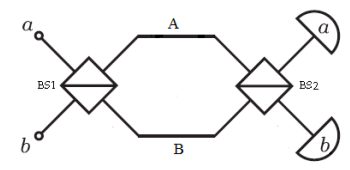
Because the photons are indistinguishable they don't possess separate identities, and we are forced by quantum mechanical principles to represent their collective state at the beam splitter (BS) by the following entangled wave function. The plus sign in this superposition indicates that photons are bosons; their wave functions are symmetric with respect to the interchange of the photon labels.
\[ | \Psi \rangle = \frac{1}{ \sqrt{2}} \left[ |a \rangle_1 |b \rangle_2 + |b \rangle_1 |a \rangle_2 \right] \nonumber \]
The following vector representations are used for the photon states, |a> representing presence in the upper arm of the MZI and |b> presence in its lower arm.
\[ |a \rangle = \begin{pmatrix} 1 \\ 0 \end{pmatrix} \nonumber \]
\[ |b \rangle = \begin{pmatrix} 0 \\ 1 \end{pmatrix} \nonumber \]
Writing Ψ in tensor format yields,
\[ | \Psi \rangle = \frac{1}{ \sqrt{2}} \left[ \begin{pmatrix} 1 \\ 0 \end{pmatrix} \otimes \begin{pmatrix} 0 \\ 1 \end{pmatrix} + \begin{pmatrix} 0 \\ 1 \end{pmatrix} \otimes \begin{pmatrix} 1 \\ 0 \end{pmatrix} \right] = \frac{1}{ \sqrt{2}} \left[ \begin{pmatrix} 0 \\ 1 \\ 0 \\ 0 \end{pmatrix} + \begin{pmatrix} 0 \\ 0 \\ 1 \\ 0 \end{pmatrix} \right] = \frac{1}{ \sqrt{2}} \begin{pmatrix} 0 \\ 1 \\ 1 \\ 0 \end{pmatrix} \nonumber \]
\[ \Psi = \frac{1}{ \sqrt{2}} \begin{pmatrix} 0 \\ 1 \\ 1 \\ 0 \end{pmatrix} \nonumber \]
There are four detector states after the exit channels of the MZI (|aa>, |ab>, |ba>, |bb>), which are shown below in tensor format.
\[ | aa \rangle = \begin{pmatrix} 1 \\ 0 \end{pmatrix} \otimes \begin{pmatrix} 1 \\ 0 \end{pmatrix} = \begin{pmatrix} 1 \\ 0 \\ 0 \\ 0 \end{pmatrix} \nonumber \]
\[ aa = \begin{pmatrix} 1 \\ 0 \\ 0 \\ 0 \end{pmatrix} \nonumber \]
\[ | ab \rangle = \begin{pmatrix} 1 \\ 0 \end{pmatrix} \otimes \begin{pmatrix} 0 \\ 1 \end{pmatrix} = \begin{pmatrix} 0 \\ 1 \\ 0 \\ 0 \end{pmatrix} \nonumber \]
\[ ab = \begin{pmatrix} 0 \\ 1 \\ 0 \\ 0 \end{pmatrix} \nonumber \]
\[ | ba \rangle = \begin{pmatrix} 0 \\ 1 \end{pmatrix} \otimes \begin{pmatrix} 1 \\ 0 \end{pmatrix} = \begin{pmatrix} 0 \\ 0 \\ 1 \\ 0 \end{pmatrix} \nonumber \]
\[ ba = \begin{pmatrix} 0 \\ 0 \\ 1 \\ 0 \end{pmatrix} \nonumber \]
\[ | bb \rangle = \begin{pmatrix} 0 \\ 1 \end{pmatrix} \otimes \begin{pmatrix} 0 \\ 1 \end{pmatrix} = \begin{pmatrix} 0 \\ 0 \\ 0 \\ 1 \end{pmatrix} \nonumber \]
\[ bb = \begin{pmatrix} 0 \\ 0 \\ 0 \\ 1 \end{pmatrix} \nonumber \]
The matrix operator representing the beam splitter:
\[ BS = \frac{1}{ \sqrt{2}} \begin{pmatrix} 1 & i \\ i & 1 \end{pmatrix} \nonumber \]
The following calculations show fermionic behavior for the photons. They never arrive at the same detector. (Kronecker is Mathcad's command for tensor matrix multiplication.)
\[ \left( \left| aa^T \text{kronecker} (BS,~BS) \text{kronecker} (BS,~BS) \Psi\right| \right)^2 = 0 \nonumber \]
\[ \left( \left| ab^T \text{kronecker} (BS,~BS) \text{kronecker} (BS,~BS) \Psi\right| \right)^2 = 0.5 \nonumber \]
\[ \left( \left| ba^T \text{kronecker} (BS,~BS) \text{kronecker} (BS,~BS) \Psi\right| \right)^2 = 0.5 \nonumber \]
\[ \left( \left| bb^T \text{kronecker} (BS,~BS) \text{kronecker} (BS,~BS) \Psi\right| \right)^2 = 0 \nonumber \]
This page titled 7.37: Entangled Photons Can Behave Like Fermions was last modified on Wed, 11 Jan 2023 07:23:49 GMT and is shared under a CC BY 4.0 license and was authored, remixed, and/or curated by Frank Rioux via source content that was edited to the style and standards of the LibreTexts platform.
The book could not be loaded just now.