Opening the book…
\[
\mathrm{n}_{1} :=1 \qquad \mathrm{n}_{2} :=2 \\ \Psi(x) :=\sqrt{2} \cdot \sin \left(n_{1} \cdot \pi \cdot x\right) \qquad \Phi(x) :=\sqrt{2} \cdot \sin \left(n_{2} \cdot \pi \cdot x\right)
\nonumber \]
Calculate the average separation, |x1 - x2|, for two fermions and two bosons in a 1D box of unit length.
Fermions have antisymmetric wave functions:
\[
\Psi_{\mathrm{f}}\left(\mathrm{x}_{1}, \mathrm{x}_{2}\right) :=\frac{\Psi\left(\mathrm{x}_{1}\right) \cdot \Phi\left(\mathrm{x}_{2}\right)-\Psi\left(\mathrm{x}_{2}\right) \cdot \Phi\left(\mathrm{x}_{1}\right)}{\sqrt{2}}
\nonumber \]
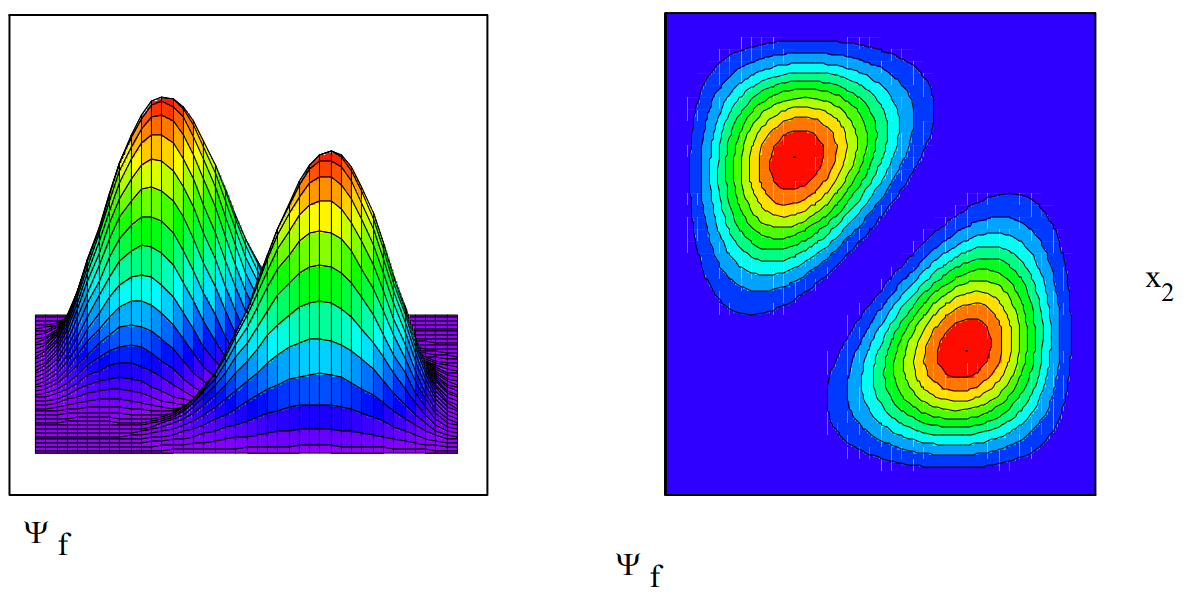
The average particle separation for indistinquishable fermions:
\[
\int_{0}^{1} \int_{0}^{1} \Psi_{\mathrm{f}}\left(\mathrm{x}_{1}, \mathrm{x}_{2}\right) \cdot\left|\mathrm{x}_{1}-\mathrm{x}_{2}\right| \cdot \Psi_{\mathrm{f}}\left(\mathrm{x}_{1}, \mathrm{x}_{2}\right) \mathrm{dx}_{1} \mathrm{dx}_{2}=0.383
\nonumber \]
The particles are correlated so as to keep them apart.
\[
\mathrm{N} :=40 \qquad \mathrm{i} :=0 . . \mathrm{N} \\ x_{1_{i}} :=\frac{1}{N} \quad j :=0 \ldots N \qquad x_{2} :=\frac{j}{N} \\ \Psi_{\mathrm{f}_{\mathrm{i}, \mathrm{j}}} :=\Psi_{\mathrm{f}\left(\mathrm{x}_{\mathrm{1_{i}}}, \mathrm{x}_{2_{j}}\right)^{2}}
\nonumber \]
Bosons have symmetric wave functions:
\[
\Psi_{\mathrm{b}}\left(\mathrm{x}_{1}, \mathrm{x}_{2}\right)=\frac{\Psi\left(\mathrm{x}_{1}\right) \cdot \Phi\left(\mathrm{x}_{2}\right)+\Psi\left(\mathrm{x}_{2}\right) \cdot \Phi\left(\mathrm{x}_{1}\right)}{\sqrt{2}}
\nonumber \]
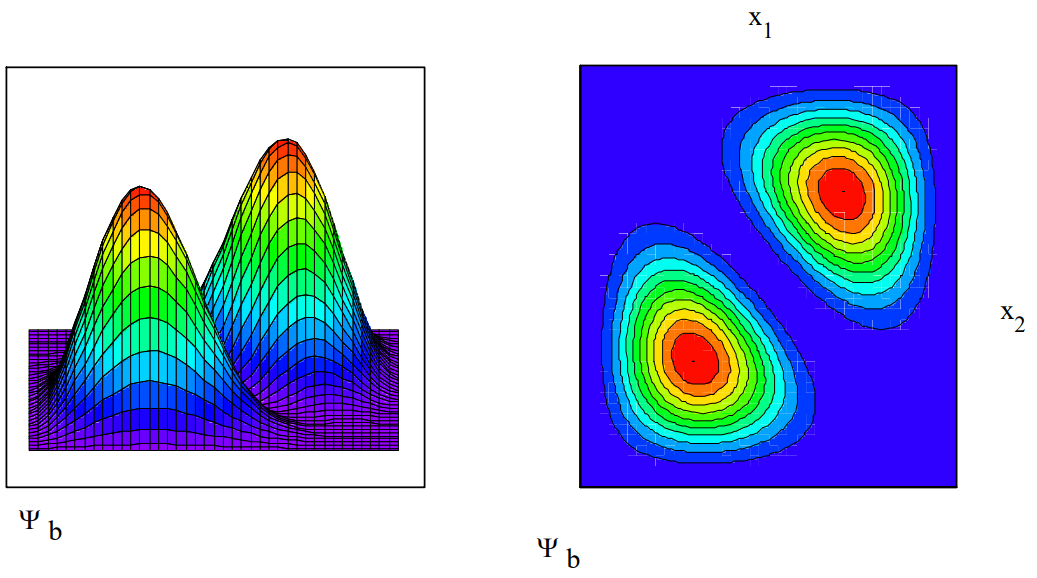
The average particle separation for indistinquishable bosons:
\[
\int_{0}^{1} \int_{0}^{1} \Psi_{\mathrm{b}}\left(\mathrm{x}_{1}, \mathrm{x}_{2}\right) \cdot\left|\mathrm{x}_{1}-\mathrm{x}_{2}\right| \cdot \Psi_{\mathrm{b}}\left(\mathrm{x}_{1}, \mathrm{x}_{2}\right) \mathrm{dx}_{1} \mathrm{dx}_{2}=0.157
\nonumber \]
The particles are correlated so as to bring them closer together.
\[
\mathrm{N} :=40 \qquad \mathrm{i} :=0 . . \mathrm{N} \\ x_{1_{i}} :=\frac{1}{N} \quad j :=0 \ldots N \qquad x_{2} :=\frac{j}{N} \\ \Psi_{\mathrm{b}_{\mathrm{i}, \mathrm{j}}} :=\Psi_{\mathrm{b}\left(\mathrm{x}_{\mathrm{1_{i}}}, \mathrm{x}_{2_{j}}\right)^{2}}
\nonumber \]
All fundamental particles (electrons, neutrons, protons, photons, etc.) are either bosons or fermions. Composite entities such as the elements also fall into these two categories. The fundamental distinction is spin: bosons have integer spin (0, 1, 2, ...) while fermions have half-integer spin (1/2, 3/2, ....).
The dramatic difference in behavior between bosons and fermions has led to a sociology of fundamental particles. Bosons are social and gregarious, while fermions are antisocial and aloof.
This page titled 1.85: The Difference Between Fermions and Bosons was last modified on Wed, 11 Jan 2023 07:23:10 GMT and is shared under a CC BY 4.0 license and was authored, remixed, and/or curated by Frank Rioux via source content that was edited to the style and standards of the LibreTexts platform.
The book could not be loaded just now.