Opening the book…
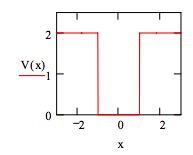
Definite potential energy: \( V(x) := if [(x \geq -1) \cdot (x \leq 1), 0, 2]\)
Display potential energy:
Choose trial wavefunction: \( \psi (x, \beta ) := ( \frac{2 \cdot \beta}{ \pi} )^{ \frac{1}{4}} \cdot (- \beta \cdot x^{2})\)
Demonstrate that the trial wavefunction is normalized.
\( \int_{- \infty}^{ \infty} \psi (x, \beta )^{2} dx\) assume, \( \beta > 0 \rightarrow 1\)
Evaluate the variational integral:
\( E( \beta ) := \int_{- \infty}^{ \infty} \psi (x, \beta ) \cdot - \frac{1}{2} \cdot \frac{d^{2}}{dx^{2}} \psi (x, \beta ) dx ... |_{simplify}^{assume,~ \beta > 0} \rightarrow \frac{1}{2} \cdot \beta + 2 - 2 \cdot erf(2^{ \frac{1}{2}} \cdot \beta^{ \frac{1}{2}})\)
Minimize the energy integral with respect to the variational parameter, \( \beta\).
\( \beta\) := 1 \( \beta\) := Minimize(E, \( \beta\)) \( \beta\) = 0.678 E( \( \beta\)) = 0.538
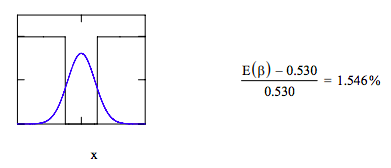
Display wavefunction in the potential well and compare result with the exact energy, 0.530 Eh.
Calculate the fraction of time tunneling is occurring.
\( 2 \cdot \int_{1}^{ \infty} \psi (x, \beta )^{2} dx = 0.1\)
This page titled 10.5: Variational Method for a Particle in a Finite Potential Well was last modified on Sat, 24 Sep 2022 17:07:32 GMT and is shared under a CC BY 4.0 license and was authored, remixed, and/or curated by Frank Rioux via source content that was edited to the style and standards of the LibreTexts platform.
The book could not be loaded just now.