Opening the book…
Numerical Solutions for Schrödinger's Equation
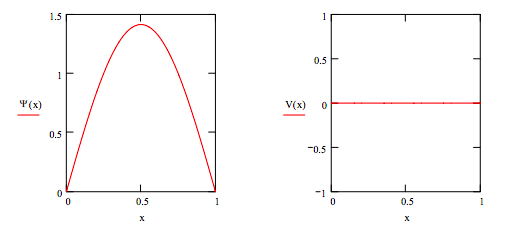
Integration limit: xmax := 1 Effective mass: \( \mu\) := 1
Potential energy: V(x) := 0
Numerical integration of Schrödinger's equation:
Given: \( \frac{1}{2 \mu} \frac{d^{2}}{dx^{2}} \Psi (x) + V(x) \Psi (x) = E \Psi (x)\) \( \Psi (0) = 0\) \( \Psi '(0) = 0.1\)
\( \Psi := Odesolve (x, x_{max}\) Normalize wave function: \( \Psi (x) := \frac{ \Psi (x)}{ \sqrt{ \int_{0}^{x_{max}}} \Psi (x)^{2}dx}\)
Enter energy guess: E = 4.934
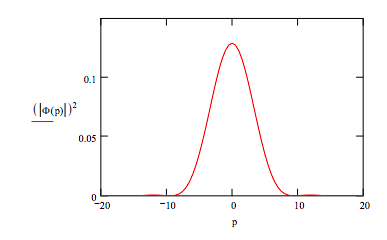
Fourier transform coordinate wave function into momentum space:
p := -20, -19.5 .. 20
\( \Phi (p) := \frac{1}{2 \mu} \int_{0}^{x_{max}} exp(-i \cdot p \cdot x) \cdot \Psi (x) dx\)
This page titled 9.2: Particle in an Infinite Potential Well was last modified on Sat, 24 Sep 2022 17:07:27 GMT and is shared under a CC BY 4.0 license and was authored, remixed, and/or curated by Frank Rioux via source content that was edited to the style and standards of the LibreTexts platform.
The book could not be loaded just now.