Opening the book…
The Dirac delta function expressed in Dirac notation is: \(\Delta(x - x_1) = \langle x | x_1 \rangle \). The \(\langle x | x_1 \rangle\) bracket is evaluated using the momentum completeness condition. See the Mathematical Appendix for definitions of the required Dirac brackets and other mathematical tools used in the analysis that follows.
\[\langle x | x_{1}\rangle=\int_{-\infty}^{\infty}\langle x | p\rangle\langle p | x_{1}\rangle d p=\frac{1}{2 \pi} \int_{-\infty}^{\infty} \exp (i p x) \exp \left(-i p x_{1}\right) d p=\frac{1}{2 \pi} \int_{-\infty}^{\infty} \exp \left[i p\left(x-x_{1}\right)\right] d p \nonumber \]
Evaluation of this integral over a finite range of momentum values shows that the delta function is small except in the immediate neighborhood of x1. Integrating from -20 to 20 to reduce computational time shows that < x | x1 = 2> is small except in the area x = 2.
\[\mathrm{x}_{1} =2 \quad \mathrm{x} =0,0 .01 \ldots 4 \quad \operatorname{Dirac}\left(\mathrm{x}, \mathrm{x}_{1}\right) =\frac{1}{2 \cdot \pi} \cdot \int_{-20}^{20} \exp \left[\mathrm{i} \cdot \mathrm{p} \cdot\left(\mathrm{x}-\mathrm{x}_{1}\right)\right] \mathrm{d} \mathrm{p} \nonumber \]
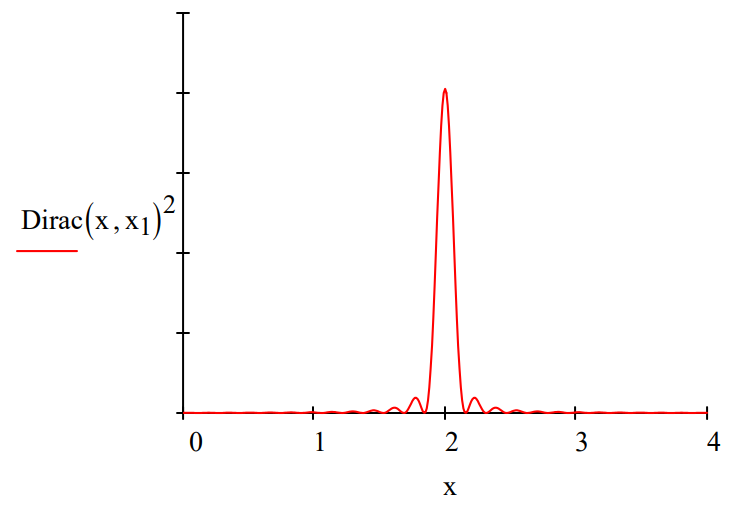
The Fourier transform of the Dirac delta function into the momentum representation yields the following result.
\[
\int_{-\infty}^{\infty}\langle p | x\rangle\langle x | x_{1}\rangle d x=\frac{1}{\sqrt{2 \pi}} \exp \left(-i p x_{1}\right)=\langle p | x_{1}\rangle
\nonumber \]
The normalization constant is omitted for clarity of expression and the previous value of x1 is cleared to allow symbolic calculation.
\[
\mathrm{x}_{1} =\mathrm{x}_{1} \qquad \int_{-\infty}^{\infty} \exp (-\mathrm{i} \cdot \mathrm{p} \cdot \mathrm{x}) \cdot \Delta\left(\mathrm{x}-\mathrm{x}_{1}\right) \mathrm{d} \mathrm{x} \text { simplify } \rightarrow \; \mathrm{e}^{-\mathrm{p} \cdot \mathrm{x}_{1} \cdot \mathrm{i}}
\nonumber \]
Mathematical Appendix
The position and momentum completeness conditions:
\[
\int | x \rangle\langle x|d x=1 \qquad \int| p\rangle\langle p|d p=1
\nonumber \]
The momentum eigenstate in the coordinate representation:
\[
\langle x | p\rangle=\frac{1}{\sqrt{2 \pi}} \exp (i p x)
\nonumber \]
The position eigenstate in the momentum representation:
\[
\langle p | x\rangle=\frac{1}{\sqrt{2 \pi}} \exp (-i p x)
\nonumber \]
This page titled 1.25: The Dirac Delta Function was last modified on Wed, 11 Jan 2023 07:23:01 GMT and is shared under a CC BY 4.0 license and was authored, remixed, and/or curated by Frank Rioux via source content that was edited to the style and standards of the LibreTexts platform.
The book could not be loaded just now.