Opening the book…
After completing this section, you should be able to
- outline, by means of equations, how a racemic mixture of given amino acid can be prepared from a carboxylic acid using reactions you studied earlier in the course.
-
- outline, by means of equations, the preparation of a given amino acid by the amidomalonate synthesis.
- identify the amino acid formed from using a given alkyl halide in an amidomalonate synthesis.
- identify the alkyl halide needed to produce a given amino acid by the amidomalonate synthesis.
- describe, by means of equations, how an α‑keto acid can be transformed to an amino acid by reductive amination.
-
- describe a general method for resolving a racemic mixture of a given amino acid.
- provide a brief example of how a biological method may be employed to resolve a racemic mixture of a given amino acid.
- show the enantioselective preparation of an amino acid from the corresponding Z enamido acid.
Make certain that you can define, and use in context, the key terms below.
- amidomalonate synthesis
- enantioselective synthesis
- racemic mixture
Bio-synthesis of α-Amino Acids
De novo synthesis of amino acids in human beings from intermediates of the citric acid cycle or glycolysis: ribose-5-phosphate, pyruvate, erythrose-4-phosphate, oxaloacetate, and α-ketoglutarate.
 Figure \(\PageIndex{1}\): General Metabolism Diagram.
The nitrogen needed for amino acid biosynthesis ultimately comes from atmospheric nitrogen gas (N2). However, the triple bond that holds a molecule of nitrogen gas together is very stable and resists alteration. Only certain microorganisms, including “nitrogen-fixing” bacteria and blue-green algae, have the capability to reduce atmospheric nitrogen. In an energy-consuming process, these organisms are able to convert N2 into ammonium ions (NH4+).
In higher organisms, including human beings, NH4+ can be used by the enzyme glutamate dehydrogenase to synthesize the amino acid l-glutamate from α-ketoglutarate, a citric acid cycle intermediate. A second ammonium ion can then be incorporated by glutamine synthetase to form l-glutamine (Fig. 2). The amino groups (-NH2) of the other amino acids are then derived from those of l-glutamate or l-glutamine by transamination, as in the synthesis of alanine from pyruvate. As is true for glutamate, glutamine, and alanine, the carbon-rich “backbones” of the other amino acids are also derived from intermediates of major metabolic pathways, such as the citric acid cycle, glycolysis, and the pentose phosphate pathway.

The enzymatic reactions used by human beings to synthesize most of the nonessential amino acids are similar to those used by plants and microorganisms (Fig. 3). However, we use alternative pathways to produce cysteine, tyrosine, and arginine. We make these from other amino acids: cysteine from methionine, tyrosine from phenylalanine, and arginine from proline (via conversion of proline to ornithine). In lower organisms, histidine is synthesized from ribose 5-phosphate, a product of the pentose phosphate pathway. The extent and route of histidine biosynthesis in human beings are unclear.

Phenylalanine, tyrosine, and tryptophan are produced from erythrose 4-phosphate and phosphoenolpyruvate,
Synthesis of α-Amino Acids
1-Amination of alpha-bromocarboxylic acids
Amination of alpha-bromocarboxylic acids, illustrated by the following equation, provides a straightforward method for preparing alpha-aminocarboxylic acids.
The bromoacid is conveniently prepared from carboxylic acids by treatment with Br2 and PBr3 (the Hell–Volhard–Zelinskii reaction; Section 22.4). The SN2 substitution of the α-bromo acid with ammonia then yields an α-amino acid. Although this direct approach gave mediocre results when used to prepare simple amines from alkyl halides, it is more effective for making amino acids, thanks to the reduced nucleophilicity of the nitrogen atom in the product.
Show how you could prepare the following α-amino acids from the appropriate carboxylic acids:
- Phenylalanine
- Valine
- Answer
-
- Start with 3-phenylpropanoic acid: 1. Br2, PBr3; 2. NH3
- Start with 3-methylbutanoic acid: 1. Br2, PBr3; 2. NH3
2-Reductive Amination of α-Keto Acids
Yet another method for the synthesis of α-amino acids is by reductive amination of an α-keto acid with ammonia and a reducing agent. Alanine, for instance, is prepared by treatment of pyruvic acid with ammonia in the presence of NaBH4. As described in Section 10.6, the reaction proceeds through formation of an intermediate imine which is then reduced.
3-Strecker synthesis
An elegant procedure, known as the Strecker synthesis, assembles an alpha-amino acid from ammonia (the amine precursor), cyanide (the carboxyl precursor), and an aldehyde. This reaction (shown below) is essentially an imino analog of cyanohydrin formation. The alpha-amino nitrile formed in this way can then be hydrolyzed to an amino acid by either acid- or base-catalysis.

4-The Amidomalonate Synthesis
A more general method for the preparation of α-amino acids is the amidomalonate synthesis, a straightforward extension of the malonic ester synthesis (Section 8.7). The reaction begins with the conversion of diethyl acetamidomalonate into an enolate ion by treatment with base, followed by SN2 alkylation with a primary alkyl halide. Hydrolysis of both the amide protecting group and the esters occurs when the alkylated product is warmed with aqueous acid, and decarboxylation then takes place to yield an α-amino acid. For example, aspartic acid can be prepared from ethyl bromoacetate, BrCH2CO2Et:
What alkyl halides would you use to prepare the following α-amino acids by the amidomalonate method?
- Leucine
- Histidine
- Tryptophan
- Methionine
- Answer
-
b.
c.
d.
5-Gabriel Synthesis
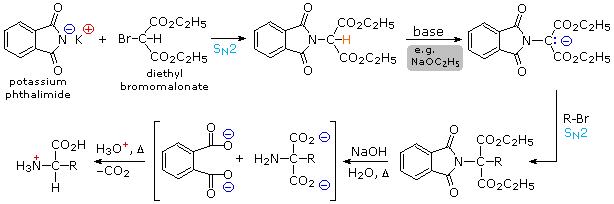
By modifying the nitrogen as a phthalimide salt, the propensity of amines to undergo multiple substitutions is removed, and a single clean substitution reaction of 1º- and many 2º-alkylhalides takes place. This procedure, known as the Gabriel synthesis, can be used to advantage in aminating bromomalonic esters, as shown in the upper equation of the following scheme. Since the phthalimide substituted malonic ester has an acidic hydrogen (colored orange), activated by the two ester groups, this intermediate may be converted to an ambident anion and alkylated. Finally, base catalyzed hydrolysis of the phthalimide moiety and the esters, followed by acidification and thermal decarboxylation, produces an amino acid and phthalic acid (not shown).
Resolution of Racemic Mixtures
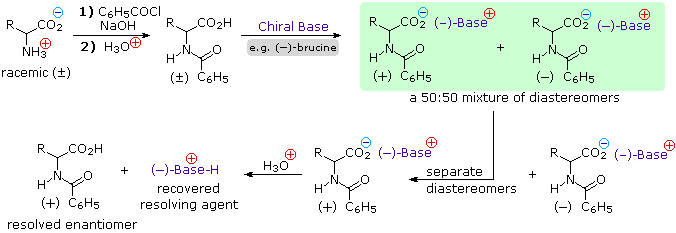
The five synthetic procedures described above, as well as many others that can be conceived, yield racemic amino acid products. If pure L or D enantiomers are desired, it is necessary to resolve racemic mixtures. A common method of resolving racemates is by diastereomeric salt formation with a pure chiral acid or base. This is illustrated for a generic amino acid in the following diagram. Be careful to distinguish charge symbols, shown in colored circles, from optical rotation signs, shown in parenthesis.
In the initial display, the carboxylic acid function contributes to the formation of diastereomeric salts. The racemic amino acid is first converted to a benzamide derivative to remove the basic character of the amino group. Next, an ammonium salt is formed by combining the carboxylic acid with an optically pure amine, such as brucine (a relative of strychnine). The structure of this amine is not shown, because it is not a critical factor in the logical progression of steps. Since the amino acid moiety is racemic and the base is a single enantiomer (levorotatory in this example), an equimolar mixture of diastereomeric salts is formed (drawn in the green shaded box). Diastereomers may be separated by crystallization, chromatography or other physical manipulation, and in this way one of the isomers may be isolated for further treatment, in this illustration it is the (+):(-) diastereomer. Finally the salt is broken by acid treatment, giving the resolved (+)-amino acid derivative together with the recovered resolving agent (the optically active amine). Of course, the same procedure could be used to obtain the (-)-enantiomer of the amino acid.
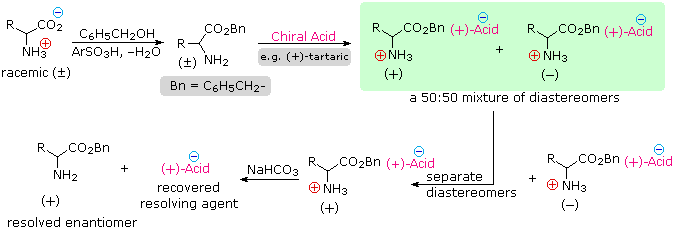
Since amino acids are amphoteric, resolution could also be achieved by using the basic character of the amine function. For this approach we would need an enantiomerically pure chiral acid such as tartaric acid to use as the resolving agent. This alternative resolution strategy will be illustrated. Note that the carboxylic acid function is first esterified, so that it will not compete with the resolving acid.
Resolution of amino acid derivatives may also be achieved by enzymatic discrimination in the hydrolysis of amides. For example, an aminoacylase enzyme from pig kidneys cleaves an amide derivative of a natural L-amino acid much faster than it does the D-enantiomer. If the racemic mixture of amides shown in the green shaded box above is treated with this enzyme, the L-enantiomer (whatever its rotation) will be rapidly converted to its free zwitterionic form, whereas the D-enantiomer will remain largely unchanged. Here, the diastereomeric species are transition states rather than isolable intermediates. This separation of enantiomers, based on very different rates of reaction, is called kinetic resolution.
Enantioselective Synthesis
To date, all the synthetic routes to α-amino acids we have discussed yield racemic mixtures. Once produced, one could resolve the mixture to obtain pure L or D enantiomers. However, enantioselective synthetic methods to produce pure compounds are being developed in the presence of an appropriate chiral ligands. For instance, several catalysts are now available for reduction of C=C to expose enantiopure beta amino acids.
 Source: https://pmc.ncbi.nlm.nih.gov/articles/PMC8038868/
A good example is the industrial synthesis of L-DOPA, a drug used in the treatment of Parkinson’s disease. W.S. Knowles shared the 2001 Nobel Price with R. Noyori and K.B. Sharpless for their contributions in the area of asymmetric catalytic reductions. Knowles developed several chiral phosphine–metal catalysts for asymmetric reductions. The rhodium(I) catalyst shown, which is complexed by large organic ligands, facilitates the production of almost pure L-DOPA.
This page titled 12.3: Synthesis of Amino Acids was last modified on Thu, 23 Apr 2026 04:47:01 GMT and is shared under a CC BY-NC-SA 4.0 license and was authored, remixed, and/or curated by Sol Parajon Puenzo (Cañada College) .
The book could not be loaded just now.