Opening the book…
After completing this section, you should be able to use the terms “ether,” “diethyl ether ” and “ethyl ether ” appropriately in context.
Ethers and Epoxides
Ethers (R–O–R′), like the alcohols, are organic derivatives of water, but they have two organic groups bonded to the same oxygen atom rather than one. The organic groups might be alkyl, aryl, or vinylic, and the oxygen atom might be in an open chain or a ring.
Perhaps the most well-known ether is diethyl ether, which has a long history of medicinal use as an anesthetic and industrial use as a solvent. Other useful ethers include anisole, a pleasant-smelling aromatic ether used in perfumery, and tetrahydrofuran (THF), a cyclic ether often used as a solvent.
Thiols and Sulfides
Thiols (R–S–H, otherwise called thio alcohols or mercaptans) and sulfides (R–S–R′) are sulfur analogs of alcohols and ethers, respectively. Both functional groups are found in various biomolecules, although not as commonly as their oxygen-containing relatives.
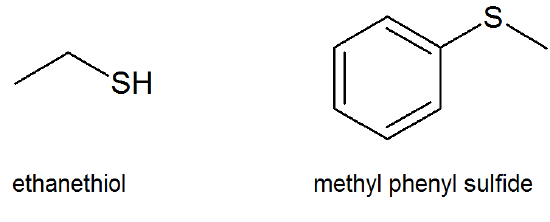
Make certain that you can define, and use in context, the key terms below.
- ether (\(\ce{R-O-R′}\))
- sulfide (\(\ce{R-S-R′}\))
- thiol (\(\ce{R-S-H}\))
As defined in the textbook, an “ether” is a substance with the general formula (\(\ce{R-O-R′}\)) where \(\ce{R}\) and \(\ce{R′}\) are alkyl, aryl, vinyl or allyl groups. However, the word “ether” is also commonly used to refer to the specific compound, \(\ce{CH3-CH2-O-CH2-CH3}\), which is correctly called “diethyl ether.” Further confusion can arise because some chemists refer to “diethyl ether ” as “ethyl ether.” In this course, “ether ” will be used to refer to the class of compounds with the structure (\(\ce{R-O-R′}\)); diethyl ether will refer to the compound, \(\ce{CH3-CH2-O-CH2-CH3}\); and “ethyl ether ” will not be used.
This page titled 4.0: Introduction was last modified on Mon, 03 Feb 2025 22:37:18 GMT and is shared under a CC BY-NC-SA 4.0 license and was authored, remixed, and/or curated by Sol Parajon Puenzo (Cañada College) .
The book could not be loaded just now.