Opening the book…
After completing this section, you should be able to
- draw the resonance contributors for the carbocation intermediate formed during the reaction of a given monosubstituted benzene derivative with any of the electrophiles discussed in this chapter.
- classify substituents as either meta or ortho/para directing.
- classify substituents as ortho/para directing activators, ortho/para directing deactivators, or meta directing deactivators.
- predict the product or products formed from the reaction of a given monosubstituted benzene derivative with each of the electrophiles discussed in this chapter.
- explain, by drawing the resonance contributors for the intermediate carbocation, why the electrophilic substitution of an alkyl benzene results in a mixture of mainly ortho- and para- substituted products.
- explain why the electrophilic substitution of phenols, amines and their derivatives proceeds more rapidly than the electrophilic substitution of benzene itself.
- explain, by drawing the resonance contributors for the intermediate carbocation, why meta substitution predominates in electrophilic aromatic substitution reactions carried out on benzene derivatives containing one of the substituents R3N+, NO2, CO2H, CN, CO2R, COR or CHO.
- explain why electrophilic aromatic substitution of benzene derivatives containing one of the substituents listed in Objective 7, above, proceeds more slowly than the electrophilic substitution of benzene itself.
- explain, by drawing the resonance contributors for the intermediate carbocation, why the electrophilic aromatic substitution of halobenzenes produces a mixture of mainly ortho- and para-substituted products.
- explain why the electrophilic aromatic substitution of halobenzenes proceeds more slowly than does the electrophilic substitution of benzene itself.
Substituents affect the orientation of the reaction.
The three possible disubstituted products—ortho, meta, and para—are usually not formed in equal amounts. Instead, the nature of the substituent initially present on the benzene ring determines the position of the second substitution. An –OH group directs substitution toward the ortho and para positions, for instance, while a carbonyl group such as –CHO directs substitution primarily toward the meta position. Table 1 lists experimental results for the nitration of some substituted benzenes.
| Product (%) | |||
|---|---|---|---|
| Ortho | Meta | Para | |
| Meta-directing deactivators | |||
| \(-\stackrel{+}{\mathrm{N}}\left(\mathrm{CH}_3\right)_3\) | 2 | 87 | 11 |
| –NO2 | 7 | 91 | 2 |
| –CO2H | 22 | 76 | 2 |
| –CN | 17 | 81 | 2 |
| –CO2CH3 | 28 | 66 | 6 |
| –COCH3 | 26 | 72 | 2 |
| –CHO | 19 | 72 | 9 |
| Ortho- and para-directing deactivators | |||
| –F | 13 | 1 | 86 |
| –Cl | 35 | 1 | 64 |
| –Br | 43 | 1 | 56 |
| –I | 45 | 1 | 54 |
| Ortho- and para-directing activators | |||
| –CH3 | 63 | 3 | 34 |
| –OH | 50 | 0 | 50 |
| –NHCOCH3 | 19 | 2 | 79 |
Substituents can be classified into three groups, as shown in Figure \(\PageIndex{1}\): ortho- and para-directing activators, ortho- and para-directing deactivators, and meta-directing deactivators. There are no meta-directing activators. Notice how the directing effect of a group correlates with its reactivity. All meta-directing groups are strongly deactivating, and most ortho- and para-directing groups are activating. The halogens are unique in being ortho- and para-directing but weakly deactivating.
Predict the major product of the sulfonation of toluene.
Strategy
Identify the substituent present on the ring, and decide whether it is ortho- and para-directing or meta-directing. According to Figure \(\PageIndex{1}\), an alkyl substituent is ortho- and para-directing, so sulfonation of toluene will primarily give a mixture of o -toluenesulfonic acid and p -toluenesulfonic acid.
Solution

The direction of the reaction
The activating group directs the reaction to the ortho or para position, meaning the electrophile substitutes for the hydrogen on carbon 2 or carbon 4. The deactivating group directs the reaction to the meta position, which means the electrophile substitutes for the hydrogen that is on carbon 3, with the exception of the halogens, which are deactivating groups but direct the ortho or para substitution.


Substituents determine the reaction direction by resonance or inductive effect
Resonance effect is the conjugation between the ring and the substituent, which means the delocalization of the \(\pi\) electrons between the ring and the substituent. Inductive effect is the withdrawal of the sigma ( the single bond ) electrons away from the ring toward the substituent, due to the higher electronegativity of the substituent compared to the carbon of the ring.
Activating groups (ortho or para directors)
The hydroxyl substituent of phenol is ortho and para directing and makes the aromatic ring strongly activated towards electrophilic aromatic substitution reaction.

When substituents such as -OH have an unshared pair of electrons, the resonance effect is stronger than the inductive effect, which makes these substituents stronger activators, since this resonance effect directs the electron toward the ring. In cases where the substrates are esters or amides, they are less activating because they form a resonance structure that pulls the electron density away from the ring.

By looking at the mechanism above, we can see how electron-donating groups direct electrophilic substitution to the ortho and para positions. Since the extra electron density is localized on the ortho and para carbons, these carbons are more likely to react with the electrophile.
Inductive effects of alkyl groups activate the direction of the ortho or para substitution, which is when s electrons gets pushed toward the ring.
Deactivating group (meta directors)
The deactivating groups deactivate the ring via the inductive effect of electronegative atoms, which withdraw electron density from the ring.

The mechanism above shows that when electron density is withdrawn from the ring, it leaves the carbons at the ortho and para positions with partial positive charges, which is unfavorable for the electrophile; therefore, the electrophile attacks the carbon at the meta position.
Halogens are an exception to the deactivating group that directs to the ortho or para substitution. The halogens deactivate the ring by inductive effect, not by resonance, even though they have an unpaired pair of electrons. The unpaired electron pair is donated to the ring, but the inductive effect pulls the ring's s electrons away due to the electronegativity of the halogens.
Substituents determine the reactivity of rings
The reaction of a substituted ring with an activating group is faster than the same reaction with benzene. On the other hand, a substituted ring with a deactivated group reacts more slowly than benzene.
Activating groups speed up reaction with electrophiles due to increased electron density on the ring. This stabilizes the carbocation intermediate, thereby decreasing the reaction's activation energy. On the other hand, deactivating groups withdraw electron density from the carbocation formed in the intermediate step, thereby increasing the activation energy and slowing the reaction.
The CH3 Group is an ortho, para director
Alkyl groups are inductively donating, therefore are activators. This results in o/p attack to form a tertiary arenium carbocation, which speeds up the reaction.
The O-CH3 Group is an ortho, para director
The methoxy group is an example of groups that are ortho, para directors by having an oxygen or nitrogen adjacent to the aromatic ring. This same activation is present with alcohols, amines, esters and amides (with the oxygen or nitrogen attached to the ring, not the carbonyl).
Groups with oxygen or nitrogen attached to the aromatic ring are ortho- and para-directing, since the O or N can withdraw electrons from the ring, making the ortho and para positions more reactive and stabilizing the arenium ion that forms. This causes ortho and para products to form faster than meta products. Generally, the para product is preferred because of steric effects.
Acyl groups are meta directors
Ketones are an example of groups that deactivate an aromatic ring through resonance. Similar deactivation also occurs with ammonium ions, nitro groups, aldehydes, nitriles, sulfonic acids, and groups with a carbonyl attached to the ring (amides, esters, carboxylic acids, and anhydrides).
Acyl groups are resonance deactivators. Ortho and para attack produce a resonance structure which places the arenium cation next to an additional cation. This destabilizes the arenium cation and slows down the reaction over the ortho and para positions. By default, the meta product forms faster because it lacks this destabilizing resonance structure.
Halogens
Halogens are an interesting hybrid case. They are ortho, para directors, but deactivators. Overall, they remove electron density from the ring, making it less reactive. However, due to their resonance donation to the ring, if it does react, it reacts primarily at ortho and para positions.
References
- Schore, N.E. and P.C. Vollhardt. 2007. Organic Chemistry, structure and function, 5th ed. New York,NY: W.H. Freeman and Company.
- Fryhle, C.B. and G. Solomons. 2008. Organic Chemistry, 9th ed.Danvers,MA: Wiley.
Predict the pattern of the electrophilic substitution on these rings:

- Answer
-
The first substitution will be ortho and/or para substitution, since we have a halogen substituent. The second substitution is going to be ortho and/or para substitution, also, since we have an alkyl substituent.
Which nitration product is going to form faster: nitration of aniline or nitration of nitrobenzene?
- Answer
-
The nitration of aniline is going to be faster than the nitration of nitrobenzene, since the aniline is a ring with NH2 substituent and nitrobenzene is a ring with NO2 substituent. As described above NH2 is an activating group which speeds up the reaction and NO2 is a deactivating group that slows down the reaction.
Predict the product of the following sulfonation reaction:
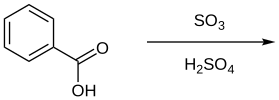
- Answer
-

Consider the intermediates of the following molecule during an electrophilic substitution. Draw resonance structures for ortho, meta, and para attacks.
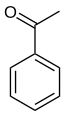
- Answer
-

Make sure you can define and use the key terms below in context.
- steric effect
- steric hindrance
As you saw in Section 16.4, a substituent on a benzene ring can be an activator or a deactivator. At the same time, a substituent can also be a meta-directing or ortho/para-directing substituent. Of the four possible combinations, only three are known—there are no meta directing activators.
If you look at the data for the nitration of toluene, you will see that the yield of o‑nitrotoluene is 63% and that of p‑nitrotoluene is 34%. Statistically, we should expect to obtain twice as much ortho product as para product, because the former is produced by attack at either of two carbon atoms whereas the latter is produced by attack at only one carbon atom (see Figure below).
In this instance, the observed ortho/para ratio is almost 2:1, as we might expect. However, if we study the ortho/para ratio found in the nitration of a number of other arenes, we see that this is not always the case. Note that the data for the nitration of toluene given in the table below differ from those presented elsewhere. The variation may result from a difference in temperature, reaction conditions or reagent, and emphasizes the point that it is the trends which are important, not the numbers themselves.
| Substrate | % ortho | % para | ortho/para ratio |
|---|---|---|---|
| toluene | 58 | 37 | 1.57:1 |
| ethylbenzene | 45 | 49 | 0.92:1 |
| isopropylbenzene | 30 | 62 | 0.48:1 |
| tert-butylbenzene | 16 | 73 | 0.22:1 |
[Source: These data were taken from the audiocassette Some Organic Reaction Pathways, by Peter Sykes. London: Educational Techniques Subject Group, The Chemical Society, 1975.]
Table \(\PageIndex{1}\): Nitration of arenes
The table above shows us that as the size of the alkyl substituent already present in the ring increases, attack at the ortho position becomes more difficult, and the percentage of ortho isomers in the mixture of products decreases. This is an example of a steric effect—an effect caused by the size of the substituent—and we would say that as the size of the alkyl group increases, attack at the ortho position becomes less favorable as a result of steric hindrance. Note that the size of the electrophile can also be a factor in determining the ortho/para ratio: the larger the electrophile, the less able it is to attack at the ortho position, particularly if the substituent already present in the ring is itself quite bulky.
When drawing the resonance contributors to the carbocation formed during an electrophilic aromatic substitution, bear in mind that those of the type
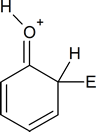
are particularly important because, in such structures, each atom has a complete octet of electrons.
Note that, as do the hydroxyl and amino groups, the halogens have an inductive electron-withdrawing effect and a resonance electron-releasing effect on a benzene ring. The difference in behavior during electrophilic substitutions arises because, with the hydroxyl and amino groups, the resonance effect is much greater than the inductive effect, whereas with the halogens, there is a much finer balance. In the case of the latter, the inductive effect reduces the overall reactivity, but the resonance effect means that this reduction is felt less at the ortho and para positions than at the meta position.
This page titled 3.5: The Direction of the Reaction was last modified on Tue, 17 Feb 2026 01:38:09 GMT and is shared under a CC BY-NC-SA 4.0 license and was authored, remixed, and/or curated by Sol Parajon Puenzo (Cañada College) .
The book could not be loaded just now.