Opening the book…
The Monsanto Acetic Acid Process
Another carbonylation reaction involving an organometallic catalyst is the Monsanto acetic acid process (Figure \(\PageIndex{1}\)). It has been introduced by Monsanto in the 1970s for the industrial production of acetic acid from methanol. The reaction involves dual catalysis with HI and [RhI2(CO)2]- as a co-catalysts. How does this reaction work?
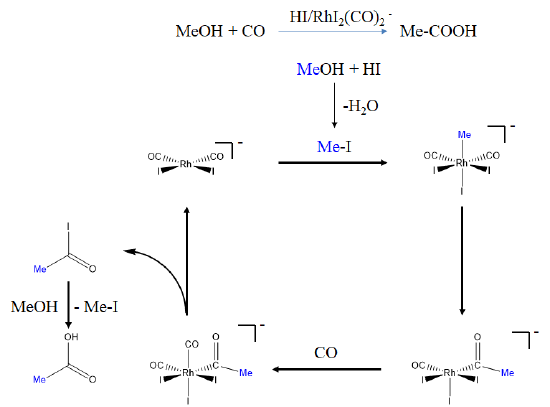
In the first step methanol reacts with HI to form methyl iodide. The methyl iodide then reacts with the Rh-catalyst in an oxidative addition reaction in which a methyl and an iodo group are added in trans-fashion to the square-planar Rh-complex to give an octahedral complex. The octahedral complex then undergoes a migratory insertion reaction with CO producing an acyl group and a vacant site. A CO molecule can then add to the vacant site. The acetyl iodide can then be eliminated in a reductive elimination to reform the Rh-catalyst thereby closing the catalytic cycle. The acetyl iodide can then react with methanol to form new methyl iodide and acetic acid. The methyl iodide can start a new catalytic cycle with the Rh-catalyst.
This page titled 7.3.3: Monsanto Acetic Acid Process was last modified on Tue, 06 Aug 2024 16:53:08 GMT and is shared under a CC BY-NC-SA 4.0 license and was authored, remixed, and/or curated by Kathryn Haas.
The book could not be loaded just now.