Opening the book…
Just as the SN2 reaction is strongly influenced by the structure of the substrate, the leaving group, the nucleophile, and the solvent, the SN1 reaction is similarly influenced. Factors that lower ∆G‡, either by lowering the energy level of the transition state or by raising the energy level of the ground state, favor faster SN1 reactions. Conversely, factors that raise ∆G‡, either by raising the energy level of the transition state or by lowering the energy level of the reactant, slow down the SN1 reaction.
As discussed in the previous section, SN1 reactions follow first-order kinetics due to a multi-step mechanism in which the rate-determining step consists of the ionization of the alkyl halide to form a carbocation.

Rate-Determining Step
The transition state for the rate-determining step shows the transition of an alkyl halide to a carbocation. Because the rate-determining step is endothermic, the Hammond postulate says that the transition state resembles, more closely, the carbocation intermediate. Factors that stabilize this intermediate will lower the energy of activation for the rate-determining step and cause the rate of reaction to increase. In general, a more stable carbocation intermediate allows for a faster SN1 reaction rate.

Transition State 1 ([TS1]‡)
The Substrate
According to the Hammond postulate, any factor that stabilizes a high-energy intermediate also stabilizes the transition state leading to that intermediate. Because the rate-limiting step in an SN1 reaction is the spontaneous, unimolecular dissociation of the substrate to yield a carbocation, the reaction is favored whenever a stabilized carbocation intermediate is formed.
We saw in Section 10.4 that the stability order of alkyl carbocations is 3° > 2° > 1° > methyl. To this list we should also add the resonance-stabilized allyl and benzyl cations. Just as allylic radicals are unusually stable because the unpaired electron can be delocalized over an extended \(\pi\) orbital system (Section 10.4), so allylic and benzylic carbocations are unusually stable. (The word benzylic means “next to an aromatic ring.”)
As Figure \(\PageIndex{2}\) indicates, an allylic cation has two resonance forms. In one form, the double bond is on the “left”; in the other form, it’s on the “right.” A benzylic cation has five resonance forms, all of which contribute to the overall resonance hybrid.
Because of resonance stabilization, a primary allylic or benzylic carbocation is about as stable as a secondary alkyl carbocation, and a secondary allylic or benzylic carbocation is about as stable as a tertiary alkyl carbocation. This stability order of carbocations is the same as the order of SN1 reactivity for alkyl halides and tosylates.
We should also note parenthetically that primary allylic and benzylic substrates are particularly reactive in SN2 reactions as well as in SN1 reactions. Allylic and benzylic C–X bonds are about 50 kJ/mol (12 kcal/mol) weaker than the corresponding saturated bonds and are therefore more easily broken.
.
Rank the following substances in order of their expected SN1 reactivity:

- Answer
-
H2C ═ CHCH(Br)CH3 > CH3CH(Br)CH3 > CH3CH2Br > H2C ═ CHBr
The Leaving Group
We said during the discussion of SN2 reactivity that the best leaving groups are those that are most stable; that is, those that are the conjugate bases of strong acids. An identical reactivity order is found for the SN1 reaction because the leaving group is directly involved in the rate-limiting step. Thus, the SN1 reactivity order is
The two reactions below only vary by the different leaving groups in each reaction. The reaction with a more stable leaving group is significantly faster than the other. This is because the better leaving group leaves faster and thus the reaction can proceed faster.

Preparing a Better Leaving Group
Note that in the SN1 reaction, which is often carried out under acidic conditions, neutral water is sometimes the leaving group. This occurs, for example, when an alkyl halide is prepared from a tertiary alcohol by reaction with HBr or HCl (Section 10.6). As shown in Figure \(\PageIndex{2}\),
- Because the -OH group itself is a poor nucleophile, the mechanism starts with protonation to form a hydronium ion.
- Neutral water is then lost as a leaving group to create the carbocation intermediate,
- which then reacts with the halide ion nucleophile to provide the alkyl halide product.
Knowing that an SN1 reaction is involved in the conversion of alcohols to alkyl halides explains why the reaction works well only for tertiary alcohols. Tertiary alcohols react fastest because they give the most stable carbocation intermediates.

The Nucleophile
The nature of the nucleophile plays a major role in the SN2 reaction but does not affect an SN1 reaction. Because the SN1 reaction occurs through a rate-limiting step in which the added nucleophile has no part, the nucleophile can’t affect the reaction rate. The reaction of 2-methyl-2-propanol with HX, for instance, occurs at the same rate regardless of whether X is Cl, Br, or I. Furthermore, neutral nucleophiles are just as effective as negatively charged ones, so SN1 reactions frequently occur under neutral or acidic conditions.
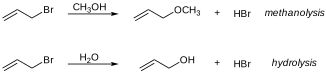
Note that SN1 reactions in which the nucleophile is also the solvent are commonly called solvolysis reactions. The SN1 reaction of allyl bromide in methanol is called methanolysis, while if water is the solvent, the reaction would be called hydrolysis:
The Strength of the Nucleophile
The strength of the nucleophile does not affect the reaction rate of SN1 because, as described previously, the nucleophile is not involved in the rate-determining step. However, if you have more than one nucleophile competing to bond to the carbocation, the strengths and concentrations of those nucleophiles affects the distribution of products that you will get. For example, if you have (CH3)3CCl reacting in water and formic acid where the water and formic acid are competing nucleophiles, you will get two different products: (CH3)3COH and (CH3)3COCOH. The relative yields of these products depend on the concentrations and relative reactivities of the nucleophiles.

The Solvent
What about the solvent? Do solvents have the same effect in SN1 reactions that they have in SN2 reactions? The answer is both yes and no. Yes, solvents have a large effect on SN1 reactions, but no, the reasons for the effects on SN1 and SN2 reactions are not the same. Solvent effects in the SN2 reaction are due largely to stabilization or destabilization of the nucleophile reactant, while solvent effects in the SN1 reaction are due largely to stabilization or destabilization of the transition state.
The Hammond postulate says that any factor stabilizing the intermediate carbocation should increase the rate of an SN1 reaction. Solvation of the carbocation—the interaction of the ion with solvent molecules—has such an effect. Solvent molecules orient around the carbocation so that the electron-rich ends of the solvent dipoles face the positive charge (Figure \(\PageIndex{3}\)), thereby lowering the energy of the ion and favoring its formation.

The properties of a solvent that contribute to its ability to stabilize ions by solvation are related to the solvent’s polarity. SN1 reactions take place much more rapidly in strongly polar solvents, such as water and methanol, than in less polar solvents, such as ether and chloroform.
The polarity and the ability of the solvent to stabilize the intermediate carbocation are very important, as shown by the relative rate data for a solvolysis (see table below). The dielectric constant of a solvent roughly provides a measure of the solvent's polarity. A dielectric constant below 15 is usually considered non-polar. Basically, the dielectric constant can be thought of as the solvent's ability to reduce the internal charge of the solvent. So for our purposes, the higher the dielectric constant, the more polar the substance, and in the case of SN1 reactions, the faster the rate.
| Solvent | Dielectric Constant | Relative Rate |
|---|---|---|
| CH3CO2H | 6 | 1 |
| CH3OH | 33 | 4 |
| H2O | 78 | 150,000 |
(Note that even though acetic acid is a highly polar molecule, it tends to make a dimer with itself, greatly reducing its dielectric constant)
In the reaction of 2-chloro-2-methylpropane, for example, a rate increase of 100,000 is observed upon going from ethanol (less polar) to water (more polar). The rate increases when going from a hydrocarbon solvent to water are so large that they can’t be measured accurately.
It should be emphasized again that both the SN1 and the SN2 reaction show solvent effects, but that they do so for different reasons. SN2 reactions are disfavored in protic solvents because the ground-state energy of the nucleophile is lowered by solvation. SN1 reactions are favored in protic solvents because the transition-state energy leading to carbocation intermediate is lowered by solvation.
A Summary of SN1 Reaction Characteristics
The effects on SN1 reactions of the four variables—substrate, leaving group, nucleophile, and solvent—are summarized in the following statements:
- Substrate: The best substrates yield the most stable carbocations. As a result, SN1 reactions are best for tertiary, allylic, and benzylic halides.
- Leaving group: Good leaving groups increase the reaction rate by lowering the energy level of the transition state for carbocation formation.
- Nucleophile: The nucleophile must be nonbasic to prevent a competitive elimination of HX (Section 11.7), but otherwise does not affect the reaction rate. Neutral nucleophiles work well.
- Solvent: Polar solvents with a high dielectric constant stabilize the carbocation intermediate by solvation, thereby increasing the reaction rate.
3-bromo-1-pentene and 1-bromo-2-pentene, one is a secondary halide while the other is a primary halide, but both undergo SN1 reaction at almost the same rate. Explain why this is.
- Answer
-
They have the same intermediates when you look at the resonance forms.

Put the following leaving groups highlighted in blue in order of decreasing leaving group ability

- Answer
-

Which solvent would an SN1 reaction occur faster in? H2O or CH3CN
- Answer
-
An SN1 reaction would occur faster in H2O because it's polar protic, and would stabilize the carbocation, and CH3CN is polar aprotic.
Rank the following by increasing reactivity in an SN1 reaction.
_1-bromopropane%252C_b)_(E)-1-bromobut-2-ene%252C_c)_3-bromopent-1-ene%252C_d)_3-bromopentane.svg?revision=2&size=bestfit&width=339&height=137)
- Answer
-
Consider the stability of the intermediate, the carbocation. (least reactive) A < D < B < C (most reactive)
Draw the solvolysis product expected when the compound is heated in ethanol vs water. Draw the expanded form of the solvent.
_3-iodo-3-methylhexane%252C_b)_(2-bromo-2-methylpropyl)cyclopentane%252C_c)_(4-bromobutyl)benzene%252C_d)_5-chloro-2%252C2-dimethylhexane.svg?revision=1&size=bestfit&width=224&height=346)
Give the products of the following SN1 reaction. Show stereochemistry.

- Answer
-

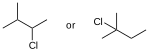
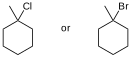
Predict with compound in each pair will undergo an SN1 reaction more quickly.
a)
b)

c)
d)

- Answer
-
a)

b)

c)

d)

This page titled 11.5: Characteristics of the SN1 Reaction was last modified on Mon, 20 Oct 2025 18:27:07 GMT and is shared under a CC BY-NC-SA 4.0 license and was authored, remixed, and/or curated by Ashiv Sharma (Cañada College) via source content that was edited to the style and standards of the LibreTexts platform.
The book could not be loaded just now.