Opening the book…
Design a multistep synthesis to prepare a given product from a given starting material, using any of the reactions introduced up to this point.
The study of organic chemistry introduces students to a wide range of interrelated reactions. Alkenes, for example, may be converted to structurally similar alkanes, alcohols, alkyl halides, epoxides, glycols and boranes; cleaved to smaller aldehydes, ketones and carboxylic acids; and enlarged by carbocation and radical additions as well as cycloadditions. Most of these reactions are shown in the Alkene Reaction Map below. All of these products may be subsequently transformed into a host of new compounds incorporating a wide variety of functional groups. Consequently, the logical conception of a multi-step synthesis for the construction of a designated compound from a specified starting material becomes one of the most challenging problems that may be posed. Functional group reaction maps like the one below for alkenes can be helpful in designing multi-step syntheses. It can be helpful to build and design your own reaction maps for each functional group studied.
Alkene Reaction Map
Please note: The reagents for each chemical transformation have been intentionally omitted so that this map can be used as a study tool. The answers are provided at the end of this section as part of the exercises.

You may have noticed that some of the assigned problems require you to string together a number of organic reactions to convert one organic compound to another when there is no single reaction to achieve this goal. Such a string of reactions is called an “organic synthesis.” One of the major objectives of this course is to assist you in designing such syntheses. To achieve this objective, you will need to have all of the reactions described in the course available in your memory. You will need to recall some reactions much more frequently than others, and the only way to master this objective is to practise. The examples given in this section will be relatively simple, but soon you will design some sophisticated syntheses using a limited number of basic reactions.
Simple Multi-Step Syntheses
A one or two-step sequence of simple reactions is not that difficult to deduce. For example, the synthesis of meso-3,4-hexanediol from 3-hexyne can occur by more than one multi-step pathway.

One approach would be to reduce the alkyne to cis or trans-3-hexene before undertaking glycol formation. Permanaganate or osmium tetroxide hydroxylation of cis-3-hexene would form the desired meso isomer.

From trans-3-hexene, it would be necessary to first epoxidize the alkene with a peracid, followed by ring opening with acidic or basic hydrolysis.

Longer multi-step syntheses require careful analysis and thought, since many options need to be considered. Like an expert chess player evaluating the long range pros and cons of potential moves, the chemist must appraise the potential success of various possible reaction paths, focusing on the scope and limitations constraining each of the individual reactions being employed. The skill is acquired by practice, experience, and often trial and error.
Thinking it Through with 3 Examples
The following three examples illustrate strategies for developing multi-step syntheses from the reactions studied in the first ten chapters of this text. It is helpful to systematically look for structural changes beginning with the carbon chain and brainstorm relevant functional group conversion reactions. Retro-synthesis is the approach of working backwards from the product to the starting material.
In the first example, we are asked to synthesize 1-butanol from acetylene.

The carbon chain doubles in size indicating an acetylide SN2 reaction with an alkyl halide. Primary alcohol formation from an anti-Markovnikov alkene hydration reaction (hydroboration-oxidation) is more likely than a substitution reaction. Applying retro-synthesis, we work backwards from the alcohol to the alkene to the alkyne from an acetylide reaction that initially builds the carbon chain.
Retro-Synthesis

Working forwards, we specify the reagents needed for each transformation identified from the retro-synthesis. The ethylbromide must also be derived from acetylene so multiple reaction pathways are combined as shown below.

In the second example, we are asked to synthesize 1,2-dibromobutane from acetylene.

Once again, there is an increase in the carbon chain length, indicating an acetylide SN2 reaction with an alkyl halide similar to the first example. The hydrohalogenation can be subtle to discern because the hydrogen atoms are not shown in bond-line structures. Comparing the chemical formulas of 1-butyne with 1,2-dibromobutane, there is a difference of two H atoms and two Br atoms, indicating hydrohalogenation and not halogenation. The addition of both bromine atoms to the same carbon atom also supports the idea that hydrohalogenation occurs on an alkyne and not an alkene. The formation of the geminal dihalide also indicates hydrohalogenation instead of halogenation because halogenation produces vicinal dihalides. With this insight, the retro-synthesis indicates the following series of chemical transformations.
Retro-Synthesis

Working forwards, we specify the reagents needed for each transformation.

In the third example, we are asked to produce 6-oxoheptanal from methylcyclohexane.

Counting the carbons, the starting material and product both contain seven carbon atoms and there is a cleavage reaction of an alkene under reductive conditions. One important missing aspect of this reaction is a good leaving group (LG). Alkanes are chemically quite boring. We can burn them as fuel or perform free-radical halogenation to create alkyl halides with excellent leaving groups. With these observations, the following retro-synthesis is reasonable.
Retro-Synthesis

Working forwards, we specify the reagents needed for each reaction. For the initial free-radical halogenation of the alkane, we have the option of chlorine (Cl2) or bromine (Br2). Because methylcyclohexane has several different classifications of carbons, the selectivity of Br2 is more important than the faster reactivity of Cl2. A strong base with heat can be used for the second step to follow an E2 mechanism and form 1-methylcyclohexene. The aldehyde group on the final product indicates gentle oxidative cleavage by any of several reaction pathways. These reactions can be combined in to the following multi-step synthesis.

Synthesis Design and Retrosynthesis
There’s no secret to planning an organic synthesis: all it takes is a knowledge of the different reactions and some practice. The only real trick is to work backward in what is often called a retrosynthetic direction. Don’t look at a potential starting material and ask yourself what reactions it might undergo. Instead, look at the final product and ask, “What was the immediate precursor of that product?” For example, if the final product is an alkyl halide, the immediate precursor might be an alkene, to which you could add HX. If the final product is a cis alkene, the immediate precursor might be an alkyne, which you could hydrogenate using the Lindlar catalyst. Having found an immediate precursor, work backward again, one step at a time, until you get back to the starting material. You have to keep the starting material in mind, of course, so that you can work back to it, but you don’t want that starting material to be your main focus.
Let’s work through several examples of increasing complexity.
How would you synthesize cis-2-hexene from 1-pentyne and an alkyl halide? More than one step is needed.

Strategy
When undertaking any synthesis problem, you should look at the product, identify the functional groups it contains, and then ask yourself how those functional groups can be prepared. Always work retrosynthetically, one step at a time.
The product in this case is a cis-disubstituted alkene, so the first question is, “What is an immediate precursor of a cis-disubstituted alkene?” We know that an alkene can be prepared from an alkyne by reduction and that the right choice of experimental conditions will allow us to prepare either a trans-disubstituted alkene (using lithium in liquid ammonia) or a cis-disubstituted alkene (using catalytic hydrogenation over the Lindlar catalyst). Thus, reduction of 2-hexyne by catalytic hydrogenation using the Lindlar catalyst should yield cis-2-hexene.

Next ask, “What is an immediate precursor of 2-hexyne?” We’ve seen that an internal alkyne can be prepared by alkylation of a terminal alkyne anion. In the present instance, we’re told to start with 1-pentyne and an alkyl halide. Thus, alkylation of the anion of 1-pentyne with iodomethane should yield 2-hexyne.

Solution
cis-2-Hexene can be synthesized from the given starting materials in three steps.

How would you synthesize 2-bromopentane from acetylene and an alkyl halide? More than one step is needed.

Strategy
Identify the functional group in the product (an alkyl bromide) and work the problem retrosynthetically. What is an immediate precursor of an alkyl bromide? Perhaps an alkene plus HBr. Of the two possibilities, Markovnikov addition of HBr to 1-pentene looks like a better choice than addition to 2-pentene because the latter reaction would give a mixture of isomers.

What is an immediate precursor of an alkene? Perhaps an alkyne, which could be reduced.

What is an immediate precursor of a terminal alkyne? Perhaps sodium acetylide and an alkyl halide.

Solution
The desired product can be synthesized in four steps from acetylene and 1-bromopropane.

How would you synthesize 5-methyl-1-hexanol (5-methyl-1-hydroxyhexane) from acetylene and an alkyl halide?

Strategy
What is an immediate precursor of a primary alcohol? Perhaps a terminal alkene, which could be hydrated with non-Markovnikov regiochemistry by reaction with borane followed by oxidation with H2O2.

What is an immediate precursor of a terminal alkene? Perhaps a terminal alkyne, which could be reduced.

What is an immediate precursor of 5-methyl-1-hexyne? Perhaps acetylene and 1-bromo-3-methylbutane.

Solution
The synthesis can be completed in four steps from acetylene and 1-bromo-3-methylbutane:

Reaction Maps to Build Functional Group Conversion Mastery
After working through the examples above, we can see how important it is to memorize all of the functional group reactions studied in the first ten chapters. We can apply the knowledge of these reactions to the wisdom of multi-step syntheses.
Please note: The reagents for each chemical transformation have been intentionally omitted so that these maps can be used as a study tools. The answers are provided at the end of this section as part of the exercises.
Alkyne Reaction Map

Alkane and Alkyl Halide Reaction Map

Exercises
Starting at 3-hexyne predict synthetic routes to achieve:
- trans-3-hexene
- 3,4-dibromohexane
- 3-hexanol
- Answer

Show how you would accomplish the following synthetic transformations.


- Answer
-
a)

b)

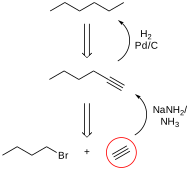
Starting with acetylene and any alkyl halides, propose a synthesis to make:
- pentanal
- hexane
- Answer
-
a-
 b-
Beginning with 4-octyne as your only source of carbon, and using any inorganic reagents necessary, how would you synthesize the following compounds?
- cis-4-Octene
- Butanal
- 4-Bromooctane
- 4-Octanol
- 4,5-Dichlorooctane
- Butanoic acid
- Answer
-
- \(\ce{H2}\), Lindlar catalyst
- 1. \(\ce{H2}\), Lindlar catalyst; 2. \(\ce{O3}\); 3. \(\ce{Zn}\) \(\ce{CH3CO2H}\)
- 1. \(\ce{H2}\)/Lindlar; 2. \(\ce{HBr}\)
- 1. \(\ce{H2}\)/Lindlar; 2. \(\ce{BH3}\); 3. \(\ce{NaOH}\), \(\ce{H2O2}\)
- 1. \(\ce{H2}\)/Lindlar; 2. \(\ce{Cl2}\)
- \(\ce{KMnO4}\), \(\ce{H3O^{+}}\)
Beginning with acetylene and any alkyl halide needed, how would you synthesize the following compounds?
- Decane
- 2,2-Dimethylhexane
- Hexanal
- 2-Heptanone
- Answer
-
- 1. \(\ce{HC≡CH + NaNH2}\) ; 2. \(\ce{CH3(CH2)6CH2Br}\); 3. \(\ce{H2/Pd}\)
- 1. \(\ce{HC≡CH + NaNH2}\); 2. \(\ce{(CH3)3CCH2CH2I}\); 3. \(\ce{H2/Pd}\)
- 1. \(\ce{HC≡CH + NaNH2}\); 2. \(\ce{CH3CH2CH2CH2I}\); 3. \(\ce{BH3}\); 4. \(\ce{H2O2}\)
- 1. \(\ce{HC≡CH + NaNH2}\); 2. \(\ce{CH3CH2CH2CH2CH2I}\); 3. \(\ce{HgSO4}\), \(\ce{H3O^{+}}\)
This page titled 9.7: An Introduction to Organic Synthesis was last modified on Thu, 18 Sep 2025 03:44:58 GMT and is shared under a CC BY-SA 4.0 license and was authored, remixed, and/or curated by Sol Parajon Puenzo (Cañada College) .
The book could not be loaded just now.