Opening the book…
- Describe osmosis and how it relates to osmotic pressure.
Osmotic Pressure
The last colligative property of solutions we will consider is a very important one for biological systems. It involves osmosis, the process by which solvent molecules can pass through certain membranes but solute particles cannot. When two solutions of different concentration are present on either side of these membranes (called semipermeable membranes), there is a tendency for solvent molecules to move from the more dilute solution to the more concentrated solution until the concentrations of the two solutions are equal. This tendency is called osmotic pressure. External pressure can be exerted on a solution to counter the flow of solvent; the pressure required to halt the osmosis of a solvent is equal to the osmotic pressure of the solution.
Consider the apparatus illustrated in Figure \(\PageIndex{1}\), in which samples of pure solvent and a solution are separated by a membrane that only solvent molecules may permeate. Solvent molecules will diffuse across the membrane in both directions. Since the concentration of solvent is greater in the pure solvent than the solution, these molecules will diffuse from the solvent side of the membrane to the solution side at a faster rate than they will in the reverse direction. The result is a net transfer of solvent molecules from the pure solvent to the solution. Diffusion-driven transfer of solvent molecules through a semipermeable membrane is a process known as osmosis.
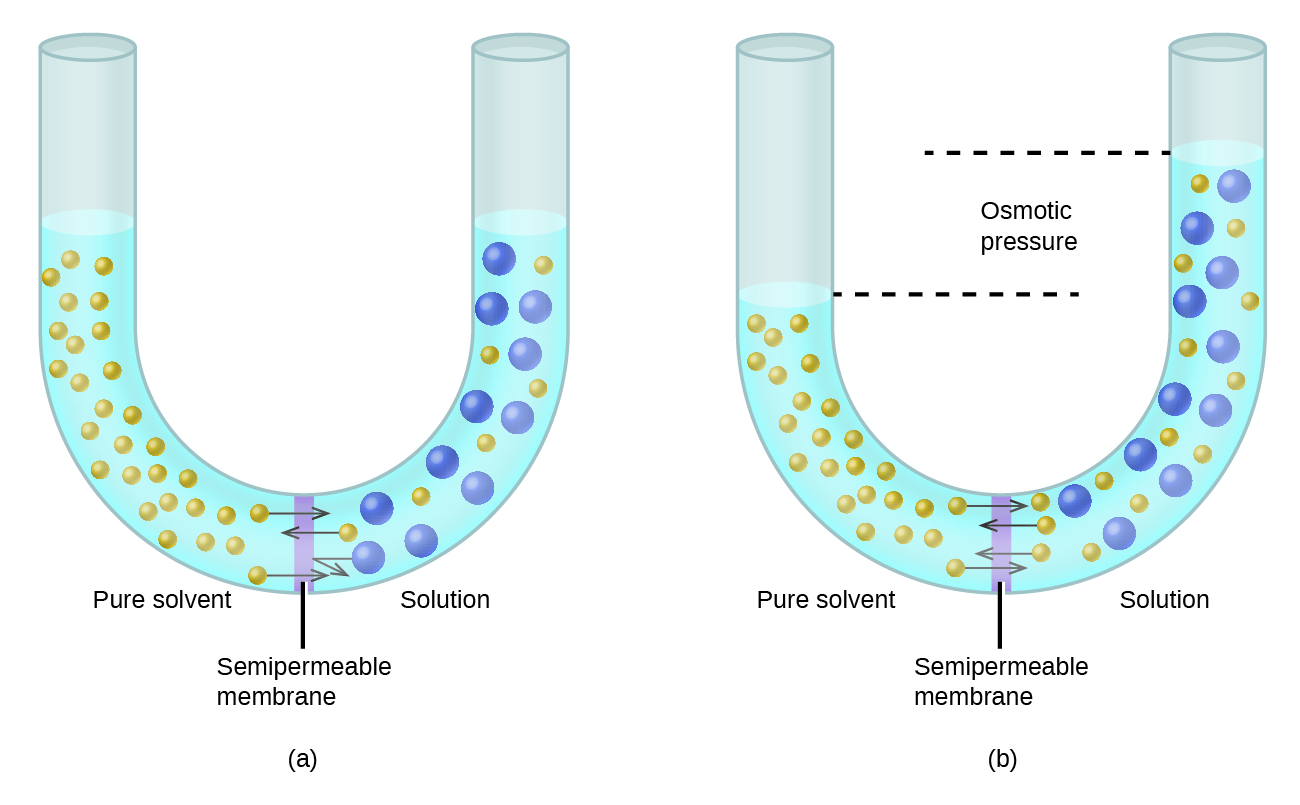
When osmosis is carried out in an apparatus like that shown in Figure \(\PageIndex{1}\), the volume of the solution increases as it becomes diluted by accumulation of solvent. This causes the level of the solution to rise, increasing its hydrostatic pressure (due to the weight of the column of solution in the tube) and resulting in a faster transfer of solvent molecules back to the pure solvent side. When the pressure reaches a value that yields a reverse solvent transfer rate equal to the osmosis rate, bulk transfer of solvent ceases. This pressure is called the osmotic pressure (\(\pi\)) of the solution.
Examples of osmosis are evident in many biological systems because cells are surrounded by semipermeable membranes. Carrots and celery that have become limp because they have lost water can be made crisp again by placing them in water. Water moves into the carrot or celery cells by osmosis. A cucumber placed in a concentrated salt solution loses water by osmosis and absorbs some salt to become a pickle. Osmosis can also affect animal cells. Solute concentrations are particularly important when solutions are injected into the body. Solutes in body cell fluids and blood serum give these solutions an osmotic pressure of approximately 7.7 atm. Solutions injected into the body must have the same osmotic pressure as blood serum; that is, they should be isotonic with blood serum. If a less concentrated solution, a hypotonic solution, is injected in sufficient quantity to dilute the blood serum, water from the diluted serum passes into the blood cells by osmosis, causing the cells to expand and rupture (Figure \(\PageIndex{2a}\)). This process is called hemolysis. When a more concentrated solution, a hypertonic solution, is injected, the cells lose water to the more concentrated solution, shrivel, and possibly die in a process called crenation (Figure \(\PageIndex{2c}\)). Only if red blood cells are placed in isotonic solutions that have the same ion concentration as exists inside the cells are they unaffected by negative effects of osmotic pressure (Figure \(\PageIndex{2b}\)). Glucose solutions of about 0.31 M, or sodium chloride (NaCl) solutions of about 0.16 M, are isotonic with blood plasma.

The concentration of an red blood cell isotonic solution made with sodium chloride (NaCl) is half that of an isotonic solution made with glucose (0.16 M and 0.31 M respectively). This is because NaCl produces two ions when a formula unit dissolves, while molecular glucose produces only one particle when a formula unit dissolves. The osmolarities are therefore the same even though the concentrations of the two solutions are different.
isotonic NaCl solution: \(osmol = 0.16\ M \times 2 = 0.32\ osmol/L \nonumber\)
isotonic glucose solution: \(osmol = 0.31\ M \times 1 = 0.31\ osmol/L \nonumber\)
Osmotic pressure explains why you should not drink seawater if you are abandoned in a life raft in the middle of the ocean. Its concentration of ions is about three times higher than most bodily fluids. You would actually become thirstier as water from your cells was drawn out to dilute the salty ocean water you ingested. Our bodies do a better job coping with hypotonic solutions than with hypertonic ones. The excess water is collected by our kidneys and excreted.
Osmotic pressure effects are used in the food industry to make pickles from cucumbers and other vegetables and in brining meat to make corned beef. It is also a factor in the mechanism of getting water from the roots to the tops of trees!
This page titled 8.10: Osmosis and Osmotic Pressure was last modified on Wed, 20 Dec 2023 20:03:45 GMT and is shared under a CC BY-NC-SA 3.0 license and was authored, remixed, and/or curated by Staff.
The book could not be loaded just now.