Opening the book…
- To identify a chemical reaction as an oxidation-reduction reaction.
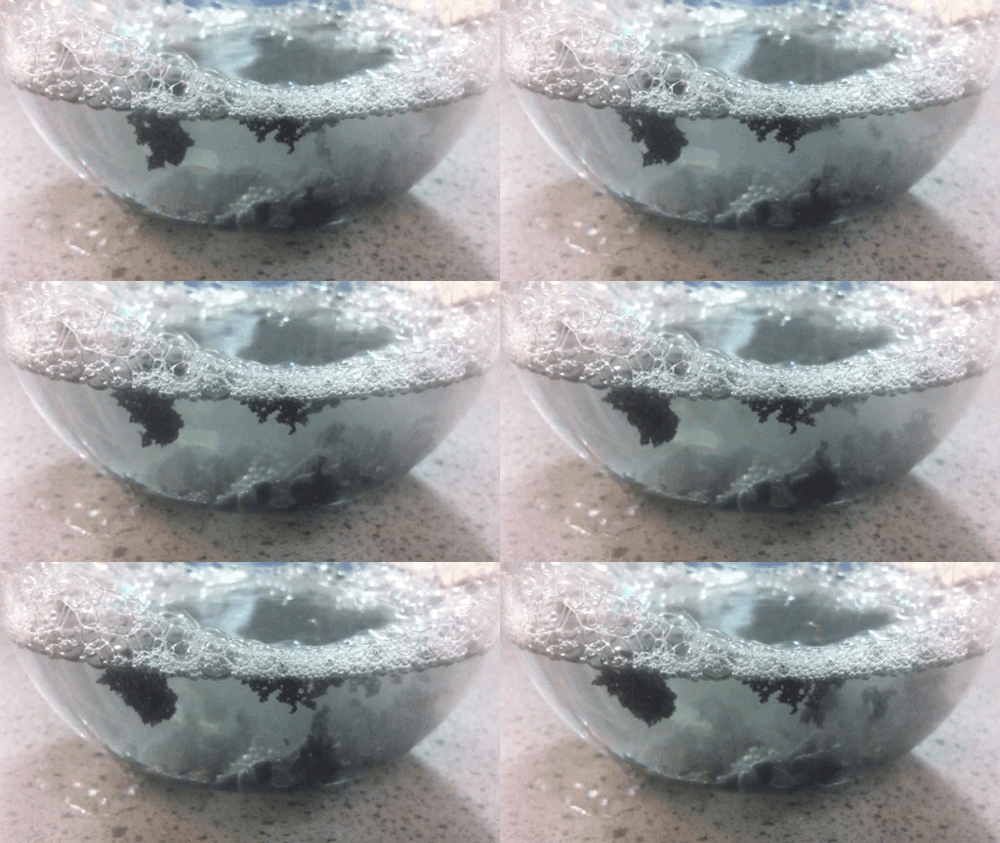
When zinc metal is submerged into a quantity of aqueous \(\ce{HCl}\), the following reaction occurs (Figure \(\PageIndex{1}\)):
\[\ce{Zn (s) + 2HCl (aq) → H2 (g) + ZnCl2(aq)} \label{eq:1} \]
This is one example of what is sometimes called a single replacement reaction because \(\ce{Zn}\) replaces \(\ce{H}\) in combination with \(\ce{Cl}\).
Because some of the substances in this reaction are aqueous, we can separate them into ions:
\[\ce{Zn (s) + 2H^{+} (aq) + 2Cl^{−} (aq) → H2(g) + Zn^{2+} (aq) + 2Cl^{−} (aq)} \nonumber \]
Viewed this way, the net reaction seems to be a charge transfer between zinc and hydrogen atoms. (There is no net change experienced by the chloride ion.) In fact, electrons are being transferred from the zinc atoms to the hydrogen atoms (which ultimately make a molecule of diatomic hydrogen), changing the charges on both elements.
To understand electron-transfer reactions like the one between zinc metal and hydrogen ions, chemists separate them into two parts: one part focuses on the loss of electrons, and one part focuses on the gain of electrons. The loss of electrons is called oxidation. The gain of electrons is called reduction. Because any loss of electrons by one substance must be accompanied by a gain in electrons by something else, oxidation and reduction always occur together. As such, electron-transfer reactions are also called oxidation-reduction reactions, or simply redox reactions. The atom that loses electrons is oxidized, and the atom that gains electrons is reduced. Also, because we can think of the species being oxidized as causing the reduction, the species being oxidized is called the reducing agent, and the species being reduced is called the oxidizing agent.
Because batteries are used as sources of electricity (that is, of electrons), all batteries are based on redox reactions.
Although the two reactions occur together, it can be helpful to write the oxidation and reduction reactions separately as half reactions. In half reactions, we include only the reactant being oxidized or reduced, the corresponding product species, any other species needed to balance the half reaction, and the electrons being transferred. Electrons that are lost are written as products; electrons that are gained are written as reactants. For example, in our earlier equation, now written without the chloride ions,
\[\ce{Zn (s) + 2H^{+} (aq) → Zn^{2+}(aq) + H2(g)} \nonumber \]
zinc atoms are oxidized to Zn2+. The half reaction for the oxidation reaction, omitting phase labels, is as follows:
\[\ce{Zn → Zn^{2+} + 2e^{−}} \nonumber \]
This half reaction is balanced in terms of the number of zinc atoms, and it also shows the two electrons that are needed as products to account for the zinc atom losing two negative charges to become a 2+ ion. With half reactions, there is one more item to balance: the overall charge on each side of the reaction. If you check each side of this reaction, you will note that both sides have a zero net charge.
Hydrogen is reduced in the reaction. The balanced reduction half reaction is as follows:
\[\ce{2H^{+} + 2e^{−} → H2} \nonumber \]
There are two hydrogen atoms on each side, and the two electrons written as reactants serve to neutralize the 2+ charge on the reactant hydrogen ions. Again, the overall charge on both sides is zero.
The overall reaction is simply the combination of the two half reactions and is shown by adding them together.
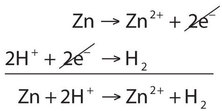
Because we have two electrons on each side of the equation, they can be canceled. This is the key criterion for a balanced redox reaction: the electrons have to cancel exactly. If we check the charge on both sides of the equation, we see they are the same—2+. (In reality, this positive charge is balanced by the negative charges of the chloride ions, which are not included in this reaction because chlorine does not participate in the charge transfer.)
You will not be required in this course to balance half-reactions. However, you will need to learn to classify reactions, including redox reactions.
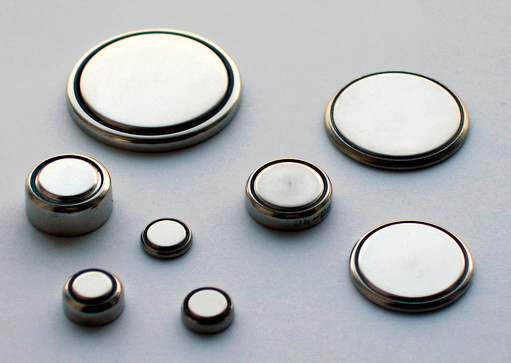
All batteries use redox reactions to supply electricity because electricity is basically a stream of electrons being transferred from one substance to another. Pacemakers—surgically implanted devices for regulating a person’s heartbeat—are powered by tiny batteries, so the proper operation of a pacemaker depends on a redox reaction.
Pacemakers used to be powered by NiCad batteries, in which nickel and cadmium (hence the name of the battery) react with water according to this redox reaction:
\[\ce{Cd(s) + 2NiOOH(s) + 2H2O(ℓ) → Cd(OH)2(s) + 2Ni(OH) 2(s)} \nonumber \]
The cadmium is oxidized, while the nickel atoms in NiOOH are reduced. Except for the water, all the substances in this reaction are solids, allowing NiCad batteries to be recharged hundreds of times before they stop operating. Unfortunately, NiCad batteries are fairly heavy batteries to be carrying around in a pacemaker. Today, the lighter lithium/iodine battery is used instead. The iodine is dissolved in a solid polymer support, and the overall redox reaction is as follows:
\[\ce{2Li(s) + I2(s) → 2LiI (s)} \nonumber \]
Lithium is oxidized, and iodine is reduced. Although the lithium/iodine battery cannot be recharged, one of its advantages is that it lasts up to 10 years. Thus, a person with a pacemaker does not have to worry about periodic recharging; about once per decade a person requires minor surgery to replace the pacemaker/battery unit. Lithium/iodine batteries are also used to power calculators and watches.

Oxidation and reduction can also be defined in terms of changes in composition. The original meaning of oxidation was “adding oxygen,” so when oxygen is added to a molecule, the molecule is being oxidized. The reverse is true for reduction: if a molecule loses oxygen atoms, the molecule is being reduced. For example, the acetaldehyde (\(\ce{CH3CHO}\)) molecule takes on an oxygen atom to become acetic acid (\(\ce{CH3COOH}\)).
\[\ce{2CH3CHO + O2 → 2CH_3COOH} \nonumber \]
Thus, acetaldehyde is being oxidized.
Similarly, reduction and oxidation can be defined in terms of the gain or loss of hydrogen atoms. If a molecule adds hydrogen atoms, it is being reduced. If a molecule loses hydrogen atoms, the molecule is being oxidized. For example, in the conversion of acetaldehyde into ethanol (\(\ce{CH3CH2OH}\)), hydrogen atoms are added to acetaldehyde, so the acetaldehyde is being reduced:
\[\ce{CH3CHO + H2 → CH3CH2OH} \nonumber \]
| Process | Change in oxygen (some reactions) | Change in hydrogen (some reactions) |
|---|---|---|
| Oxidation | gain | lose |
| Reduction | lose | gain |
Identifying Oxidation-Reduction Reactions
The primary key to identifying oxidation-reduction reactions is that electrons have changed hands. That is, some element or molecule lost at least one electron and another element or molecule gained at least one electron. You can use what you have learned about charges ion ionic compounds to help you identify redox reactions. For example, the reaction of copper (II) nitrate and zinc goes by the chemical equation:
\[\ce{Cu(NO3)2(aq) + Zn(s) → Zn(NO3)2(aq) + Cu(s)} \nonumber \]
In order to determine if this is a redox reaction, we must determine if any electrons changed hands. Most commonly in reactions involving metals, it is the metal that changes charge. So we start by looking at the charges on the metals. In \( \ce{Cu(NO3)2} \) the nitrate group has a -1 charge (we have previously memorized this fact). Since there are two nitrate groups, the copper ion must have a charge of +2 to balance out the nitrate groups. Thus, at the start of the reaction, copper has a +2 charge.
The charge on the Zn(s) at the start of the reaction is not immediately obvious. However, elements in their standard states have no charge (unless indicated). Since zinc is written here without a charge and with no other chemicals bonded (i.e. it is in its standard state), the charge on zinc is zero. On the products side of the equation, the roles are reversed. Zinc has two nitrate groups and so has a charge of +2, and copper has nothing bonded, so has a charge of zero. To summarize, copper went from a +2 charge to a 0 charge, and zinc went from a zero charge to a +2 charge.
Since electrons changed hands, we can classify this reaction as a redox reaction. Furthermore, since copper gained electrons (going from a +2 to 0 charge requires gaining two electrons), we say that copper was reduced. Since zinc lost electrons (going from a 0 charge to a +2 charge requires losing two electrons), we say that zinc was oxidized.
Key Takeaway
Chemical reactions in which electrons are transferred are called oxidation-reduction, or redox, reactions. Oxidation is the loss of electrons. Reduction is the gain of electrons. Oxidation and reduction always occur together, even though they can be written as separate chemical equations.
This page titled 6.6: Redox Reactions was last modified on Wed, 20 Dec 2023 19:22:14 GMT and is shared under a CC BY-NC-SA 3.0 license and was authored, remixed, and/or curated by Staff.
The book could not be loaded just now.