Opening the book…
Problem 17-1
(a) 5-Methyl-2,4-hexanediol
(b) 2-Methyl-4-phenyl-2-butanol
(c) 4,4-Dimethylcyclohexanol
(d) trans-2-Bromocyclopentanol
(e) 4-Bromo-3-methylphenol
(f) 2-Cyclopenten-1-ol
Problem 17-2
(a) 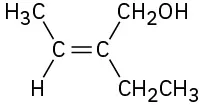
(b) 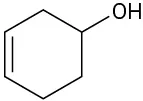
(c) 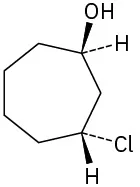
(d) 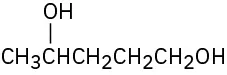
(e) 
(f) 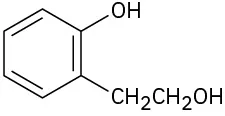
Problem 17-3 Hydrogen-bonding is more difficult in hindered alcohols.
Problem 17-4
(a) HCCH < (CH3)2CHOH < CH3OH < (CF3)2CHOH
(b) p-Methylphenol < Phenol < p-(Trifluoromethyl)phenol
(c) Benzyl alcohol < Phenol < p-Hydroxybenzoic acid
Problem 17-5 The electron-withdrawing nitro group stabilizes an alkoxide ion, but the electron-donating methoxyl group destabilizes the anion.
Problem 17-6
(a) 2-Methyl-3-pentanol
(b) 2-Methyl-4-phenyl-2-butanol
(c) meso-5,6-Decanediol
Problem 17-7
(a) NaBH4
(b) LiAlH4
(c) LiAlH4
Problem 17-8
(a) Benzaldehyde or benzoic acid (or ester)
(b) Acetophenone
(c) Cyclohexanone
(d) 2-Methylpropanal or 2-methylpropanoic acid (or ester)
Problem 17-9
(a) 1-Methylcyclopentanol
(b) 1,1-Diphenylethanol
(c) 3-Methyl-3-hexanol
Problem 17-10
(a) 
(b) 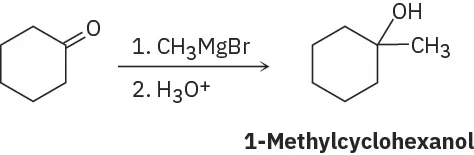
(c) 
(d) 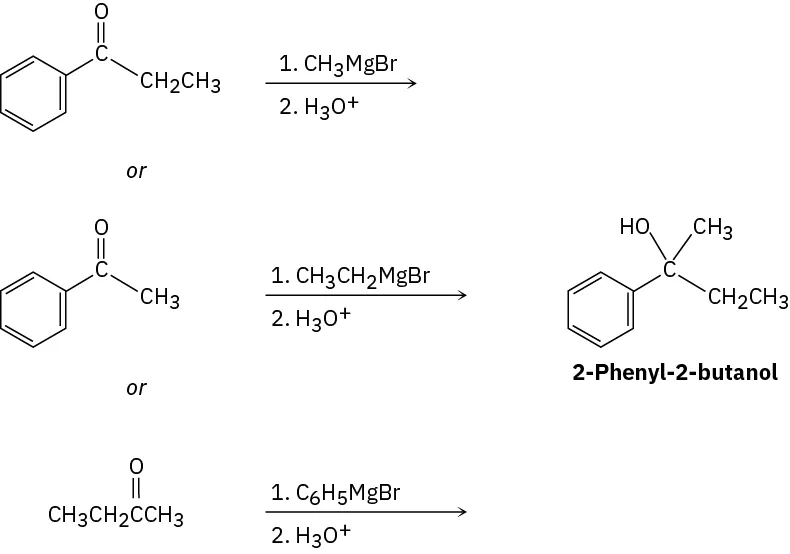
(e) 
(f) 
Problem 17-11 Cyclohexanone + CH3CH2MgBr
Problem 17-12 1. p-TosCl, pyridine; 2. NaCN
Problem 17-13
(a) 2-Methyl-2-pentene
(b) 3-Methylcyclohexene
(c) 1-Methylcyclohexene
(d) 2,3-Dimethyl-2-pentene
(e) 2-Methyl-2-pentene
Problem 17-14
(a) 1-Phenylethanol
(b) 2-Methyl-1-propanol
(c) Cyclopentanol
Problem 17-15
(a) Hexanoic acid, hexanal
(b) 2-Hexanone
(c) Hexanoic acid, no reaction
Problem 17-16 SN2 reaction of F− on silicon with displacement of alkoxide ion.
Problem 17-17 Protonation of 2-methylpropene gives the tert-butyl cation, which carries out an electrophilic aromatic substitution reaction.
Problem 17-18 Disappearance of –OH absorption; appearance of CO
Problem 17-19
(a) Singlet
(b) Doublet
(c) Triplet
(d) Doublet
(e) Doublet
(f) Singlet
This page titled 32.4.16: Chapter 17 was last modified on Thu, 28 Sep 2023 23:08:45 GMT and is shared under a CC BY-NC-SA 4.0 license and was authored, remixed, and/or curated by OpenStax via source content that was edited to the style and standards of the LibreTexts platform.
The book could not be loaded just now.