Opening the book…
- Learn examples of reactions that involve five- or six-member transition state, including cyclonic hemiacetal formation of monosaccharides, Diels-Alter reactions producing six-membered cyclic products, and decarboxylation of \(\beta\)-keto acids.
Intramolecular reactions happen if the two reacting groups are on the same molecule and can come to a bonding distance through a five- or six-member cyclic transition state. Some examples of it are described in the next sections.
Cyclic hemiacetal formation of monosaccharides
Monosaccharides, like glucose, fructose, galactose, etc., have a \(\ce{C=O}\)-group on one \(\ce{C}\) and \(\ce{-OH}\)-group on every other \(\ce{C}\). \(\ce{-OH}\)-group can add to \(\ce{C=O}\)-group forming a hemiacetal. Monosaccharides exist primarily in a five- or six-membered hemiacetal form because one of their \(\ce{-OH}\)-group can form a five- or six-membered transition state for the reaction, as shown in Figure \(\PageIndex{1}\) for the case of D-glucose and D-fructose.


Diels–Alder reaction
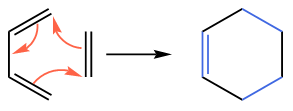
A conjugated diene, e.g., butadiene, and an alkene, e.g., ethene, make a cyclic six-member transition state. They react by the Diels-Alder reaction mechanism and produce a six-member cyclic product. This reaction can be intermolecular, e.g., between butadiene and then, or intramolecular, e.g., in the biosynthesis of antibiotic lovastatin, illustrated in Figure \(\PageIndex{2}\).

Decarboxylation
Decarboxylation is the removal of carbon dioxide (\(\ce{CO2}\)) from a carboxylic acid (\(\ce{R-COOH}\)), as in this example: \(\ce{R-COOH ->[\Delta] R-H + CO2}\).
This reaction requires high temperatures, such as in the thermal decomposition process. However, if there is a second carbonyl (\(\ce{C=O}\))) group \(\beta\}\) to the \(\ce{-COOH}\) group, it can easily acquire a six-member transition state and decarboxylate at moderate temperatures, as illustrated in Figure \(\PageIndex{3}\).

Acetoacetic acid and its reduced product \(\beta\)-hydroxybutyric acid, shown below, are produced in the liver as a result of the metabolism of fatty acids and some amino acids.

Acetoacetic acid and \(\beta\)-hydroxybutyric acid are called ketone bodies. Their concentration in the blood of healthy persons is about 0.01 mmol/L but in persons suffering from starvation or diabetes mellitus may be up to 500 times higher.
Carboxylic acids exist as carboxylate anions under physiological conditions. Decarboxylation of the \(\beta\)-keto carboxylates happens spontaneously under physiological conditions. For example, acetoacetate decarboxylates and produces carbon dioxide and acetone, as illustrated in Figure \(\PageIndex{4}\).

Carbon dioxide leaves under moderate conditions in this case because the anion left behind is in resonance with the \(\beta\)-\(\ce{C=O}\) group. The body does not metabolize acetone but exhales through the lungs. Acetone is responsible for its characteristic sweet smell in the breath of people with swear diabetes.
This page titled 4.10: Reactions with cyclic transition state was last modified on Thu, 21 Sep 2023 16:54:14 GMT and is shared under a Public Domain license and was authored, remixed, and/or curated by Muhammad Arif Malik.
The book could not be loaded just now.