Opening the book…
What is Stoichiometry
Stoichiometry (stoi·chi·om·e·try /ˌstɔɪkiˈɒmɪtri/) is the study of the quantities of substances and energy consumed and produced in chemical reactions.
The basis of the stoichiometric calculations is the law of conservation of mass which states that the mass is neither created nor destroyed in a chemical reaction. Another form of the law states that atoms are neither created nor destroyed in a chemical reaction. It is the basis of stoichiometric calculations that are described in this chapter.
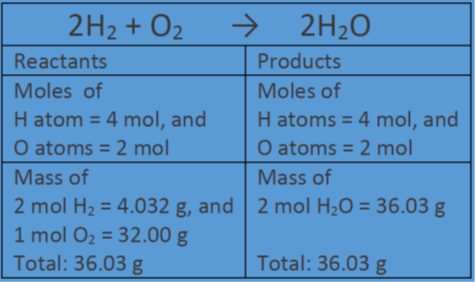
It can be concluded from the law of mass action that atoms of each element and their masses are the same in reactants and products. A balanced chemical equation shows atoms of each element and the total mass of reactants equal to that in the product, as illustrated in Fig. 4.1.1. The number of atoms and molecules is related to their quantity in moles through Avogadro's number. The mole, in turn, is related to the mass of the substance through molar mass in grams. These relationships are described in the next sections.
Atomic mass
Atomic mass is the weighted average of the masses of the isotopes present in a natural sample of the element, as explained with an example calculation in section 2.3. The mass of a single atom or molecule is expressed in the atomic mass unit (amu), which is equal to \(\frac{1}{2}\)th of the mass of \(\ce{^12_6C}\) isotope of carbon that is unbound.
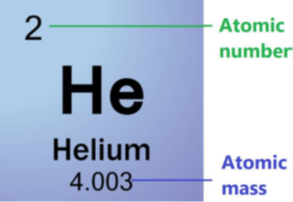
Atomic mass is listed in a periodic table as a number below the symbol and name of the element, as illustrated in Fig. 4.1.2. Atomic mass is listed as a number without a unit because it is the mass of an atom in amu and it is also the mass of one mole (molar mass) of the atom in grams. Molar mass is often used in stoichiometry calculation as explained in the next sections.
This page titled 4.1: Stoichiometry was last modified on Mon, 03 Apr 2023 00:14:25 GMT and is shared under a Public Domain license and was authored, remixed, and/or curated by Muhammad Arif Malik.
The book could not be loaded just now.