Opening the book…
- Write condensed structural formulas for alkanes given complete structural formulas.
- Draw line-angle formulas given structural formulas.
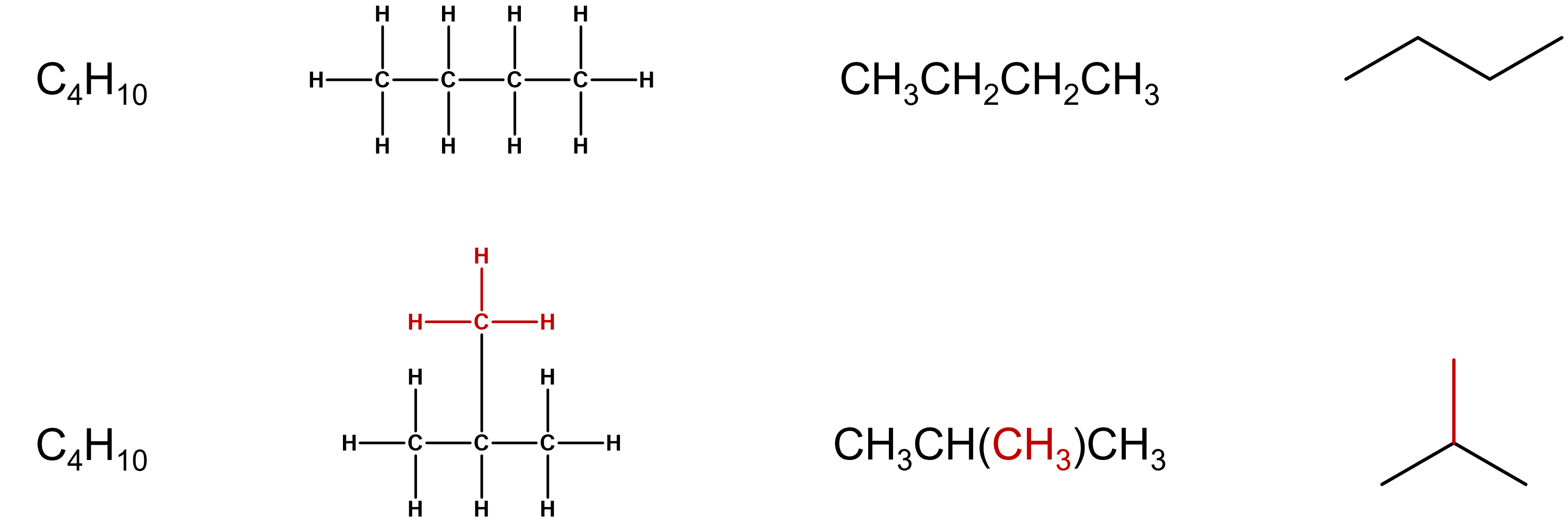
We use several kinds of formulas to describe organic compounds. A molecular formula shows only the kinds and numbers of atoms in a molecule. For example, the molecular formula C4H10 tells us there are 4 carbon atoms and 10 hydrogen atoms in a molecule, but it does not distinguish between butane and isobutane. While a molecular formula indicates the number and types of atoms present, it does not indicate how the atoms are bonded to one another. In contrast to molecular formulas, structural formulas do illustrate how the atoms are joined together. There are different types of structural formulas and they each show different levels of detail and types of information.
A structural formula (or Lewis Structure) shows all the carbon and hydrogen atoms and the bonds attaching them. Thus, structural formulas identify the specific isomers by showing the order of attachment of the various atoms. This is the most time consuming of the structural formulas, but it gives the most information as to the bonding arrangement of the atoms.
Condensed structural formulas are often used to alleviate the difficulty that comes with typing/writing the structural form. A condensed structure does not illustrate all of the bonds in a molecule, but it does give information regarding the bonding in the molecule. This structural representation shows hydrogen atoms right next to the carbon atoms to which they are attached, as illustrated for propane (Figure \(\PageIndex{1}\)).
Skeletal Structures (or line-angle structures) provide a simpler way to represent large organic molecules. These represent the ultimate condensed formula where carbon atoms are implied at the corners and ends of lines. Skeletal structures involve bonds between carbon atoms always being shown, but hydrogen atoms attached to carbons are implied and not shown. Each carbon atom is understood to be attached to enough hydrogen atoms to give the carbon four bonds.


As you will see in the next section, some molecules will have an atom or groups of atoms branching from a chain of carbon atoms. These molecules can also be represented using the structural formulas described above. These condensed structural formulas would use parentheses to indicate the group that is attached to the adjacent carbon atom (Figure \(\PageIndex{2}\)).
Key Takeaways
- Condensed chemical formulas show the hydrogen atoms (or other atoms or groups) right next to the carbon atoms to which they are attached.
- Line-angle formulas imply a carbon atom at the corners and ends of lines. Each carbon atom is understood to be attached to enough hydrogen atoms to give each carbon atom four bonds.
This page titled 1.2: Structures of Organic Compounds was last modified on Wed, 19 Mar 2025 06:05:41 GMT and is shared under a CC BY-NC-SA 4.0 license and was authored, remixed, and/or curated by Tanesha Osborne.
The book could not be loaded just now.