Opening the book…
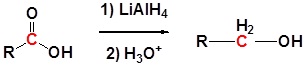
Carboxylic acids can be converted to 1o alcohols using Lithium aluminum hydride (LiAlH4). Note that NaBH4 is not strong enough to convert carboxylic acids or esters to alcohols. An aldehyde is produced as an intermediate during this reaction, but it cannot be isolated because it is more reactive than the original carboxylic acid.
General reaction

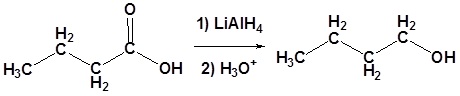
Example
Possible Mechanism
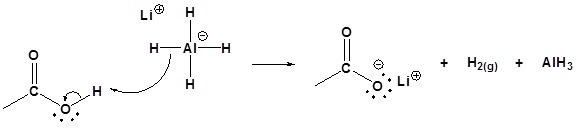
1) Deprotonation
2) Nucleophilic attack by the hydride anion

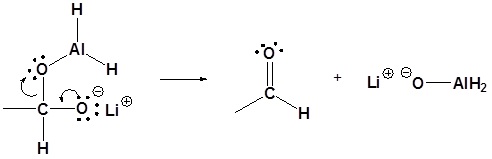
3) Leaving group removal
4) Nucleophilic attack by the hydride anion
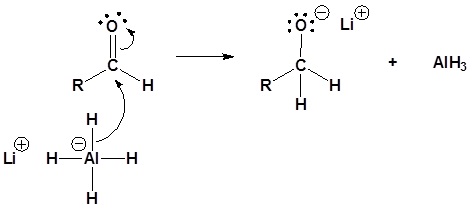
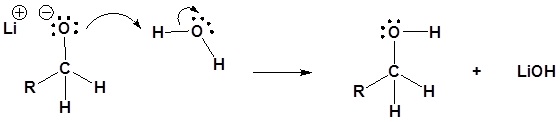
5) The alkoxide is protonated
Contributors
Prof. Steven Farmer (Sonoma State University)
19.11: Reduction of Carboxylic Acids by Lithium Aluminum Hydride is shared under a CC BY-NC-SA 4.0 license and was authored, remixed, and/or curated by LibreTexts.
The book could not be loaded just now.