Opening the book…
1. Biosynthetic Strategies
(a) Draw a circle around each of the “common atoms” (as defined by Corey) in the carbon skeleton in the following structure of cercosporin (160).
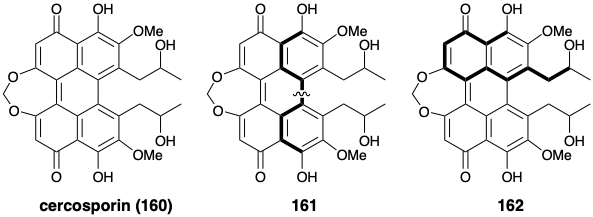
(b) What is the polar reactivity relationship between the two functional groups at the ends of the circuits that are highlighted in 161 with respect to the bond indicated with a wavy line?
(c) What are the polar reactivity relationships between all of the functional groups with respect to all bonds along the circuit that is highlighted in 162?
(d) Presuming that this symmetrical molecule is generated in Nature by dimerization of a precursor, write a structure for that precursor of cercosporin (160).
(e) Name one type of reaction that could generate the bonds which unite two molecules of the biosynthetic precursor of cercosporin (160) that you proposed in d above.
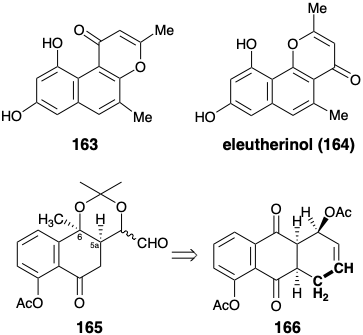
(f) On the basis of a biogenetic hypothesis, the correct structure of eleutherinol was postulated to be 164 and not 163. In the space provided, write the structure of an acyclic precursor of 164 that is suggested by the biogenetic hypothesis.
2. Tactics in Polyketide Synthesis
(a) In his total synthesis of terramycin, Muxfeldt utilized 166 as a precursor for 165. Two of the carbons in 166, the ones that are highlighted, are not needed in the skeleton of 166. Explain all of the benefits of incorporating these two carbons in 166.
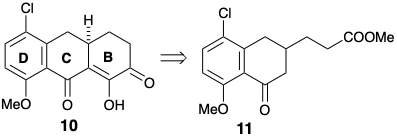
(b) In his total synthesis of 6-desmethyl-6-desoxytetracycline, Woodward exploits chloroester 168 as a precursor for 167. Neither the cholro nor the carbomethoxyl groups in 168 are incorporated into the final product, 6-desmethyl-6-desoxytetracycline. Explain the strategic roles of these two groups in the synthesis.
This page titled 5.6: Study Questions was last modified on Wed, 17 Mar 2021 05:30:43 GMT and is shared under a CC BY-NC 4.0 license and was authored, remixed, and/or curated by Robert G. Salomon.
The book could not be loaded just now.